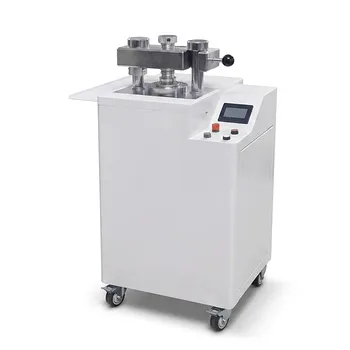
The main function of a Rubber Vulcanizing Press is to generate the specific environmental conditions necessary to cure rubber. This laboratory equipment simultaneously applies controlled hydraulic pressure and precise thermal energy to raw materials, driving the chemical process known as vulcanization.
By acting as a dual-force mechanism, this press does more than just shape material; it facilitates the chemical cross-linking of polymers. This ensures the final product achieves the necessary density, elasticity, and durability required for industrial use.
The Mechanics of the Vulcanization Process
The Role of Hydraulic Pressure
The foundation of the machine’s operation lies in its ability to generate force. The press utilizes a hydraulic system to create the necessary tonnage.
This pressure is transmitted through a hydraulic cylinder. The primary goal is to compress the rubber material, forcing it to flow into every cavity of a mold and removing trapped air that could compromise structural integrity.
Thermal Regulation via Heating Media
Pressure alone cannot vulcanize rubber; heat is the catalyst. The press supplies the required temperature through a dedicated heating medium.
This component raises the temperature of the platens (the pressing surfaces) to a precise degree. Accurate thermal control is essential to trigger the curing reaction without burning or degrading the polymer chains.
Achieving Uniformity and Bonding
The synchronization of heat and pressure serves a critical purpose beyond simple molding. As noted in broader applications of hot presses, this simultaneous application ensures uniformity throughout the material.
This process facilitates strong molecular bonding. The result is a finished product that is consistent in texture and possesses high tensile strength, free from weak spots or irregularities.
Operational Considerations and Trade-offs
Precision vs. Cycle Time
While the press is designed for efficiency, there is an inherent trade-off between the speed of the heating cycle and the quality of the cure. Rushing the thermal transfer by setting temperatures too high can lead to surface scorching before the core is vulcanized.
Maintenance of Hydraulic Systems
The reliance on a hydraulic cylinder for force generation introduces mechanical complexity. To maintain consistent pressure, the hydraulic system requires regular monitoring to prevent leaks or fluid degradation, which would otherwise result in uneven curing.
Optimizing Your Use of the Press
To get the most out of a Rubber Vulcanizing Press, you must align the machine's settings with your specific output goals.
- If your primary focus is material research: Prioritize the precision of the heating medium control to ensure you can replicate exact temperature conditions for experimental data.
- If your primary focus is product durability: Focus on the capacity of the hydraulic system, ensuring the press can deliver sufficient, sustained tonnage to maximize material density.
The Rubber Vulcanizing Press is not just a molding tool, but a precision instrument that dictates the final physical properties of your rubber components.
Summary Table:
| Feature | Function in Vulcanization | Key Benefit |
|---|---|---|
| Hydraulic System | Applies high-tonnage compression | Eliminates air pockets and ensures mold density |
| Heating Medium | Delivers precise thermal energy | Triggers chemical cross-linking of polymers |
| Platen Control | Maintains uniform heat distribution | Prevents surface scorching and ensures material consistency |
| Curing Cycle | Synchronizes time, heat, and force | Optimizes tensile strength and elastic properties |
Elevate Your Research with KINTEK’s Pressing Solutions
At KINTEK, we understand that precision is the heartbeat of material science. Whether you are conducting advanced battery research or developing high-durability polymers, our comprehensive range of laboratory pressing solutions is designed to meet your exacting standards.
From manual and automatic models to heated, multifunctional, and glovebox-compatible presses, we provide the tools necessary for perfect vulcanization and material bonding. We also offer specialized cold and warm isostatic presses for complex industrial applications.
Ready to achieve superior material density and consistency? Contact KINTEK today to find the ideal press for your laboratory.
Related Products
- Laboratory Hydraulic Press Lab Pellet Press Machine for Glove Box
- Automatic Laboratory Hydraulic Press for XRF and KBR Pellet Pressing
- Laboratory Hydraulic Pellet Press for XRF KBR FTIR Lab Press
- Lab Round Bidirectional Press Mold
- Automatic Laboratory Hydraulic Press Lab Pellet Press Machine
People Also Ask
- How does a laboratory hydraulic press contribute to the preparation of Li3-3xScxSb samples? Optimize Ionic Conductivity
- What is the function of a laboratory hydraulic press in FT-IR of curcumin-coated MWCNTs? Achieve Optical Clarity.
- Why is a laboratory hydraulic press required for compression molding boron-siloxane? Solve High-Loading Density Challenges
- What role does a laboratory hydraulic press play in reaction pellets? Optimizing Lunar Soil and Metal Fuel Density
- What role does a laboratory hydraulic press play in the preparation of piezoelectric ceramic discs for DC-PG? | KINTEK