
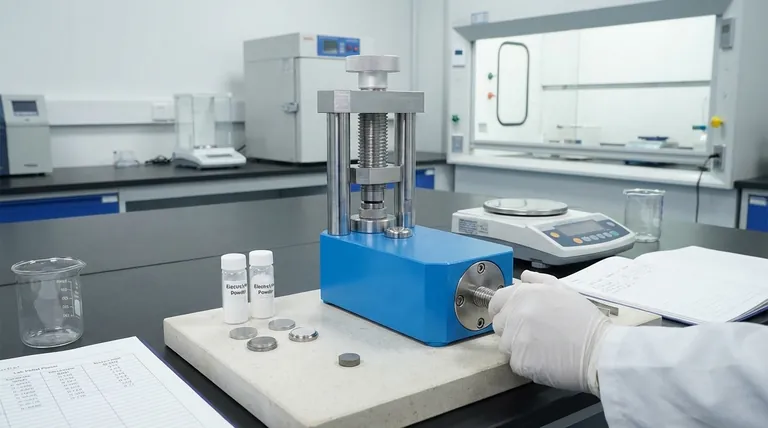
The primary function of a laboratory hydraulic press in solid-state battery research is to apply precise, high-magnitude mechanical pressure to consolidate powdered materials into dense pellets and to enforce intimate contact between rigid cell layers. By exerting forces ranging from moderate stack pressure to high-compaction pressures (often 40–370 MPa), the press transforms loose components into a unified electrochemical system capable of efficient ion transport.
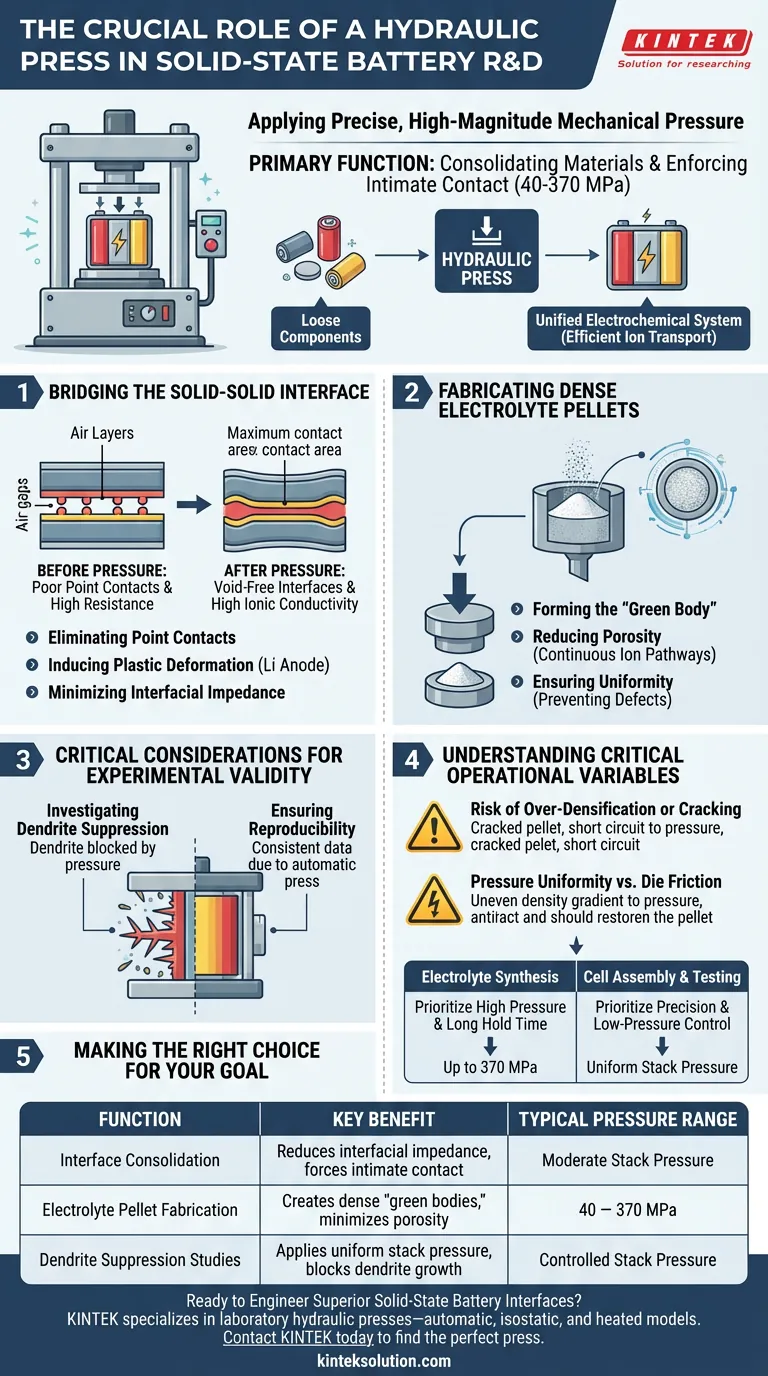
Solid-state batteries face a fundamental challenge: rigid solids naturally form poor "point contacts" with high resistance. A hydraulic press is the critical tool used to overcome this by mechanically forcing materials to densify and plastically deform, creating the void-free interfaces necessary for ionic conductivity and reliable testing.
Bridging the Solid-Solid Interface
The most significant hurdle in assembling all-solid-state batteries is achieving a connection between the electrode and the electrolyte. Unlike liquid batteries that wet surfaces, solid components remain distinct and separated unless acted upon by force.
Eliminating Point Contacts
Without sufficient pressure, rigid components like garnet electrolytes and metal electrodes only touch at microscopic peaks. This phenomenon, known as "point contact," results in extreme interfacial resistance because ions cannot jump across the air gaps between the materials.
Inducing Plastic Deformation
The hydraulic press applies enough force to cause softer materials, specifically Lithium metal anodes, to undergo plastic deformation. This forces the metal to flow into the microscopic depressions and voids of the harder solid electrolyte surface, effectively sealing the interface and maximizing the contact area.
Minimizing Interfacial Impedance
By maximizing the physical contact area, the press directly reduces the impedance (resistance) at the interface. This reduction is a prerequisite for the battery to function efficiently; without it, the internal resistance would be too high to allow for meaningful electrochemical measurements.
Fabricating Dense Electrolyte Pellets
Before a full cell is even assembled, the hydraulic press is often used to fabricate the solid-state electrolyte itself from synthesized powders.
Forming the "Green Body"
The press utilizes "cold-pressing" to compact loose ceramic or polymer powders inside a die. This creates a cohesive "green body" with the necessary mechanical strength and shape to withstand handling or subsequent high-temperature sintering processes.
Reducing Porosity
Applying high pressures (typically 40 to 250+ MPa) drastically reduces the internal porosity of the material. By packing particles closer together, the press ensures there are continuous, dense pathways for ions to travel through, which is essential for high ionic conductivity.
Ensuring Uniformity
The magnitude of pressure and the duration of the "hold time" determine the uniformity of the resulting pellet. A uniform density profile is critical to preventing defects that could lead to cracking or uneven current distribution during battery operation.
Critical Considerations for Experimental Validity
Beyond assembly, the press serves as a controlled variable in testing the performance limits of the battery chemistry.
Investigating Dendrite Suppression
Researchers use the press to apply continuous external stack pressure during cycling to study Lithium dendrite growth. The press allows scientists to determine exactly how much mechanical pressure is required to physically block dendrites from penetrating the electrolyte and short-circuiting the cell.
Ensuring Reproducibility
Automatic laboratory presses provide precise, repeatable force application. This consistency eliminates human error in cell assembly, ensuring that performance data reflects the chemistry of the materials rather than variations in how tightly the cell was squeezed.
Understanding Critical Operational Variables
While the hydraulic press is indispensable, it introduces variables that must be carefully managed to avoid damaging the sample or skewing data.
The Risk of Over-Densification or Cracking
While high pressure increases density, excessive force can fracture brittle ceramic electrolytes (like garnets) or cause short circuits by extruding soft electrode materials too aggressively. Operators must find the specific pressure window that maximizes contact without structurally compromising the pellet.
Pressure Uniformity vs. Die Friction
In powder compaction, friction between the powder and the die walls can lead to density gradients (uneven density within the pellet). If the pressure is not applied uniformly, the resulting electrolyte may have weak spots where current density concentrates, leading to premature failure.
Making the Right Choice for Your Goal
The specific way you utilize a hydraulic press depends on which stage of the battery development lifecycle you are currently addressing.
- If your primary focus is Electrolyte Synthesis: Prioritize high-pressure capability (up to 370 MPa) and long hold times to minimize porosity and create dense, defect-free green bodies for sintering.
- If your primary focus is Cell Assembly and Testing: Prioritize precision and low-pressure control to apply uniform stack pressure that ensures interfacial contact without cracking brittle components or extruding the anode.
Ultimately, the laboratory hydraulic press is not just a manufacturing tool, but a fundamental instrument for engineering the microstructure of the battery to enable ionic flow.
Summary Table:
| Function | Key Benefit | Typical Pressure Range |
|---|---|---|
| Interface Consolidation | Reduces interfacial impedance by forcing intimate contact between electrode and electrolyte layers. | Moderate Stack Pressure |
| Electrolyte Pellet Fabrication | Creates dense "green bodies" from powder, minimizing porosity for high ionic conductivity. | 40 – 370 MPa |
| Dendrite Suppression Studies | Applies uniform stack pressure during cycling to physically block lithium dendrite growth. | Controlled Stack Pressure |
Ready to Engineer Superior Solid-State Battery Interfaces?
Achieving the precise, uniform pressure required for dense electrolyte pellets and low-impedance interfaces is critical for valid experimental data. KINTEK specializes in laboratory hydraulic presses—including automatic, isostatic, and heated models—designed specifically for the demands of battery research.
Our presses provide the repeatable force application and precise control necessary to eliminate assembly variables and focus on your chemistry's true performance. Let us help you accelerate your R&D.
Contact KINTEK today to find the perfect press for your solid-state battery development goals.
Visual Guide
Related Products
- Laboratory Hydraulic Press Lab Pellet Press Machine for Glove Box
- Laboratory Hydraulic Press 2T Lab Pellet Press for KBR FTIR
- 24T 30T 60T Heated Hydraulic Lab Press Machine with Hot Plates for Laboratory
- Laboratory Hydraulic Press Lab Pellet Press Button Battery Press
- Laboratory Hydraulic Pellet Press for XRF KBR FTIR Lab Press
People Also Ask
- How does a laboratory hydraulic press contribute to the preparation of Li3-3xScxSb samples? Optimize Ionic Conductivity
- What is the function of a laboratory hydraulic press in FT-IR of curcumin-coated MWCNTs? Achieve Optical Clarity.
- Why is a laboratory hydraulic press required for compression molding boron-siloxane? Solve High-Loading Density Challenges
- What role does a laboratory hydraulic press play in reaction pellets? Optimizing Lunar Soil and Metal Fuel Density
- What role does a laboratory hydraulic press play in the preparation of piezoelectric ceramic discs for DC-PG? | KINTEK



















