
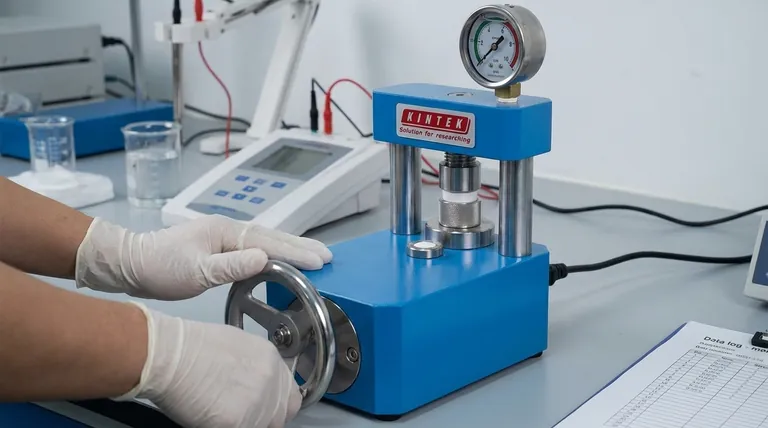
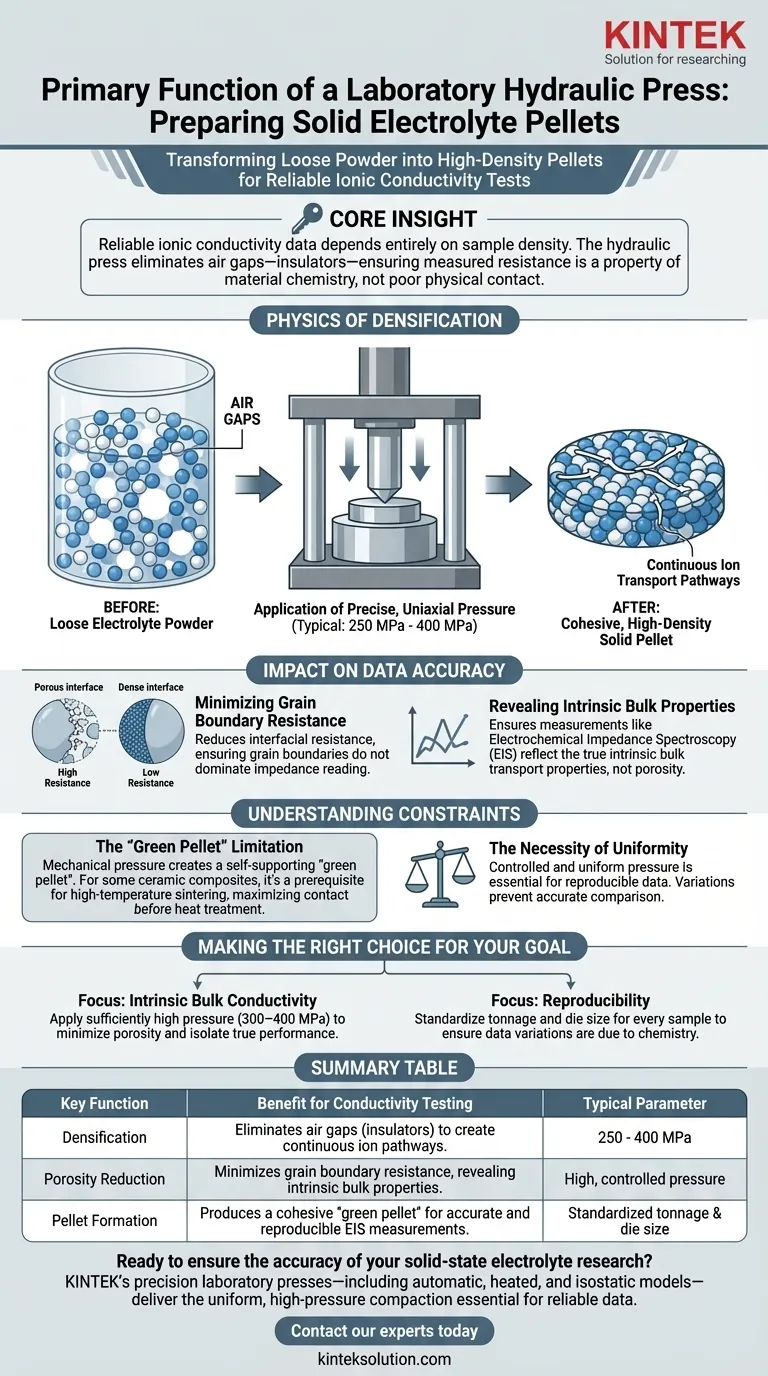
The primary function of a laboratory hydraulic press in this context is to transform loose electrolyte powder into a cohesive, high-density solid pellet through the application of precise, uniaxial pressure. This mechanical consolidation is a critical preparatory step that minimizes porosity and maximizes particle-to-particle contact, allowing for the accurate measurement of the material's ability to conduct ions.
Core Insight: Reliable ionic conductivity data depends entirely on sample density. The hydraulic press eliminates air gaps—which act as insulators—to ensure that the resistance you measure is a property of the material’s chemistry, not a side effect of poor physical contact between grains.
The Physics of Densification
Eliminating Voids and Porosity
Loose electrolyte powders naturally contain significant amounts of empty space, or voids, between particles. Since air is an electrical insulator, these voids severely obstruct the ion transport pathways necessary for a current to flow. The hydraulic press applies massive force (often between 250 MPa and 400 MPa) to collapse these voids and mechanically interlock the powder particles.
Creating Continuous Ion Pathways
For ions to move through a solid electrolyte, they require a physical bridge from one grain to the next. High-pressure compaction forces the particles into intimate physical contact. This effectively turns a collection of isolated dust motes into a unified, macroscopic object capable of sustaining a current.
Impact on Data Accuracy
Minimizing Grain Boundary Resistance
In polycrystalline materials, the interfaces between particles are known as grain boundaries. If these boundaries are loose or porous, they introduce high resistance that interferes with measurement data. By creating a dense pellet, the press significantly reduces this interfacial resistance, ensuring that the grain boundaries do not dominate the impedance reading.
Revealing Intrinsic Bulk Properties
The ultimate goal of conductivity testing is to understand the inherent performance of the material itself. If a sample is porous, the resulting data will show inaccurately low conductivity values. Proper densification ensures that measurements, such as those taken via Electrochemical Impedance Spectroscopy (EIS), reflect the true intrinsic bulk transport properties of the electrolyte.
Understanding the Constraints
The "Green Pellet" Limitation
While a hydraulic press creates a dense, self-supporting disc known as a "green pellet," mechanical pressure alone may not always be sufficient for all materials. Reference data indicates that for some ceramic composites, this pressing step is a prerequisite for high-temperature sintering. The press maximizes contact before heat treatment, but it cannot always replace the fusion that occurs during sintering.
The Necessity of Uniformity
Applying pressure is not just about force; it is about consistency. As noted in the references, the pressure must be controlled and uniform to generate reproducible data. If pressure varies across the die or between different samples, the resulting variations in density will make it impossible to compare conductivity results accurately.
Making the Right Choice for Your Goal
To achieve valid experimental results, you must align your pressing parameters with your specific testing objectives.
- If your primary focus is measuring Intrinsic Bulk Conductivity: Apply sufficiently high pressure (e.g., 300–400 MPa) to minimize porosity and isolate the material's true performance from grain boundary effects.
- If your primary focus is Reproducibility: Standardize the tonnage and die size for every sample to ensure that variations in data are due to material chemistry, not inconsistent sample density.
By effectively eliminating the variable of porosity, the laboratory hydraulic press serves as the foundational tool for validating the performance of solid-state electrolytes.
Summary Table:
| Key Function | Benefit for Conductivity Testing | Typical Parameter |
|---|---|---|
| Densification | Eliminates air gaps (insulators) to create continuous ion pathways. | 250 - 400 MPa |
| Porosity Reduction | Minimizes grain boundary resistance, revealing intrinsic bulk properties. | High, controlled pressure |
| Pellet Formation | Produces a cohesive "green pellet" for accurate and reproducible EIS measurements. | Standardized tonnage & die size |
Ready to ensure the accuracy of your solid-state electrolyte research?
KINTEK's precision laboratory presses—including automatic, heated, and isostatic models—are engineered to deliver the uniform, high-pressure compaction essential for reliable ionic conductivity data. By eliminating the variable of porosity, our equipment helps you validate material performance with confidence.
Contact our experts today to find the perfect lab press for your specific electrolyte testing needs.
Visual Guide
Related Products
- Laboratory Hydraulic Press Lab Pellet Press Button Battery Press
- Laboratory Hydraulic Press 2T Lab Pellet Press for KBR FTIR
- Laboratory Hydraulic Press Lab Pellet Press Machine for Glove Box
- 24T 30T 60T Heated Hydraulic Lab Press Machine with Hot Plates for Laboratory
- Automatic Laboratory Hydraulic Press Lab Pellet Press Machine
People Also Ask
- How is a laboratory hydraulic press used for HAP composite gels? Master Mineral Substrate Standardization
- What role does a laboratory hydraulic press play in reaction pellets? Optimizing Lunar Soil and Metal Fuel Density
- What role does a laboratory hydraulic press play in the preparation of piezoelectric ceramic discs for DC-PG? | KINTEK
- Why is a laboratory hydraulic press required for PBAT and PLA sample preparation? Achieve Flawless Characterization
- What role does a laboratory hydraulic press play in the assembly of all-solid-state battery test cells? Expert Guide



















