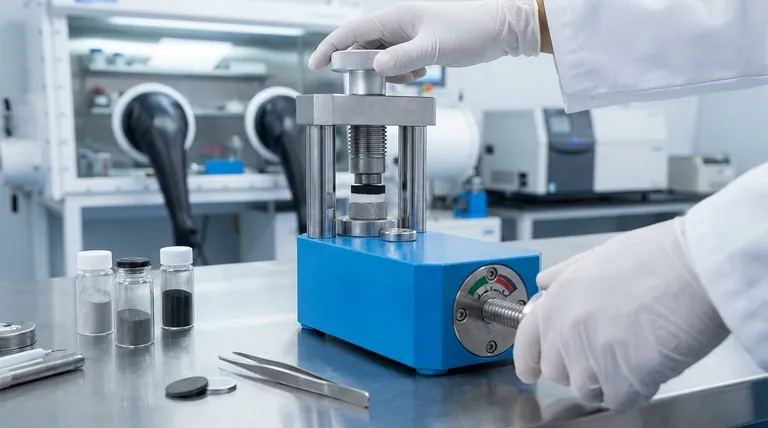
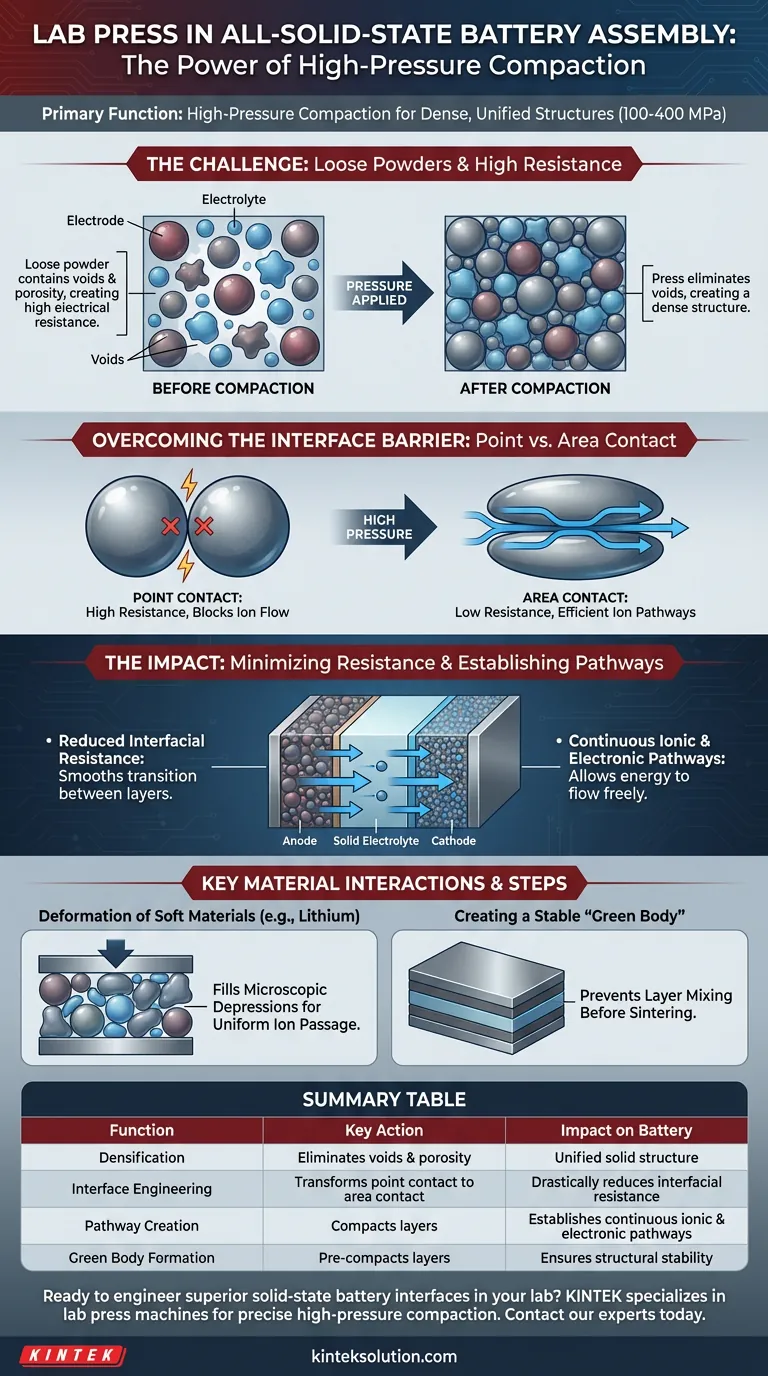
The primary function of a laboratory press in this context is high-pressure compaction. It transforms loose electrolyte and electrode powders into a dense, unified solid structure by applying significant mechanical force (often ranging from 100 MPa to over 400 MPa) to systematically eliminate voids and porosity.
The core objective is not just physical consolidation, but the minimization of electrical resistance. By forcing solid particles into intimate contact, the press establishes the continuous ionic and electronic pathways strictly required for an all-solid-state battery to function.
Overcoming the Solid-Solid Interface Challenge
Eliminating Voids and Porosity
Loose powders naturally contain significant air gaps and spacing between particles.
The laboratory press acts to physically remove these voids, compressing the cathode, anode, and electrolyte layers. This densification process is the foundational step in converting separate raw materials into a functional electrochemical cell.
Transitioning from Point Contact to Area Contact
Without high pressure, rigid particles—such as garnet electrolytes—only touch at specific points.
This "point contact" creates extremely high resistance, blocking ion flow. The press forces these materials together to create area contact, significantly increasing the surface area where particles touch and interact.
The Impact on Electrical Performance
Reducing Interfacial Resistance
High performance in solid-state batteries is dictated by how easily ions move between layers.
Compaction significantly lowers the interfacial resistance between the electrolyte and electrodes. It also reduces grain boundary resistance within the electrolyte itself, removing the bottlenecks that otherwise restrict charge transport.
Establishing Transport Pathways
For a battery to operate, ions and electrons need a continuous road to travel.
By densifying the electrode layer, the press brings active materials, conductive additives, and electrolyte powders together. This creates the necessary continuous pathways for effective ionic and electronic transport.
Specific Material Interactions and Process Steps
Deformation of Soft Materials
The press plays a unique role when combining materials of different hardness, such as rigid electrolytes and soft lithium metal.
The application of mechanical force causes the soft lithium to undergo plastic deformation. This forces the metal to fill microscopic depressions on the surface of the rigid electrolyte, ensuring uniform ion passage.
Creating a Stable "Green Body"
Before final sintering, the press is used to create a structurally stable intermediate form known as a "green body."
This pre-compaction step increases packing density and establishes initial contact. It is critical for preventing the layers from mixing or shifting during handling and transfer to a furnace.
Understanding the Process Constraints
The Necessity of High Pressure
Unlike liquid electrolyte batteries that fill gaps naturally, solid-state batteries rely entirely on mechanical force to bridge gaps.
References indicate that achieving a functional interface often requires pressures between 100 and 200 MPa, and potentially as high as 436.7 MPa for specific densification goals. Failing to reach these thresholds results in a porous structure that lacks the connectivity to hold a charge.
The Material Compatibility Struggle
The process addresses a fundamental physical conflict: rigid materials naturally struggle to form intimate contact.
The press resolves this by overcoming the mechanical resistance of the materials. However, this requires precise control to ensure the soft materials deform correctly without compromising the structural integrity of the rigid components.
Optimizing the Assembly Process
To effectively utilize a laboratory press for solid-state battery assembly, consider your specific developmental stage:
- If your primary focus is Pre-Sintering Preparation: Prioritize creating a stable "green body" to prevent interlayer mixing and ensure structural integrity during transfer.
- If your primary focus is Maximizing Battery Performance: Apply higher pressures (potentially 200+ MPa) to maximize plastic deformation and minimize interfacial resistance for optimal ionic conductivity.
Success in solid-state battery assembly relies on using pressure not just to shape the cell, but to engineer the microscopic interfaces that allow energy to flow.
Summary Table:
| Function | Key Action | Impact on Battery |
|---|---|---|
| Densification | Eliminates voids & porosity in powders | Creates a unified solid structure |
| Interface Engineering | Transforms point contact to area contact | Drastically reduces interfacial resistance |
| Pathway Creation | Compacts electrode/electrolyte layers | Establishes continuous ionic & electronic pathways |
| Green Body Formation | Pre-compacts layers before sintering | Ensures structural stability and prevents mixing |
Ready to engineer superior solid-state battery interfaces in your lab?
KINTEK specializes in lab press machines, including automatic and heated presses, designed to deliver the precise high-pressure compaction (from 100 MPa to over 400 MPa) essential for R&D and production of all-solid-state batteries. Our equipment helps you minimize interfacial resistance and achieve the dense, high-performance cells your research demands.
Contact our experts today to discuss how our lab presses can accelerate your battery development.
Visual Guide
Related Products
- Warm Isostatic Press for Solid State Battery Research Warm Isostatic Press
- Laboratory Hydraulic Press Lab Pellet Press Button Battery Press
- Lab Button Battery Tablet Press Sealing Mold
- Lab Infrared Press Mold for Laboratory Applications
- Carbide Lab Press Mold for Laboratory Sample Preparation
People Also Ask
- Why must composite cathodes be sealed in vacuum lamination bags for WIP? Ensure Battery Stability and Density
- What is the function of elastic molds in warm isostatic pressing? Achieve Uniform Density in Composite Particles
- How do sacrificial volume materials (SVM) maintain microchannels in isostatic pressing? Ensure Structural Integrity
- What is the role of the flexible material in warm isostatic pressing? Key to Uniform Density & Precision
- What is the process involved in warm isostatic pressing? Mastering Uniform Density with WIP Technology