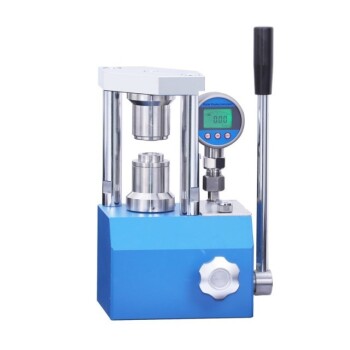
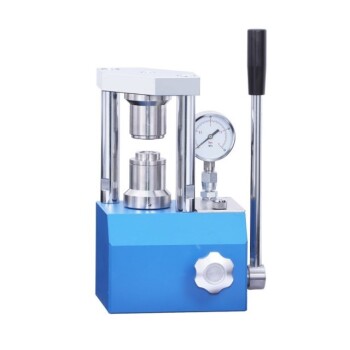
The primary function of the calendering process is to apply vertical mechanical pressure to a dried electrode, forcing the physical displacement and rearrangement of its internal components. This process compacts the Active Material (AM), Solid Electrolyte (SE), and Carbon-Binder Domain (CBD) to reduce electrode thickness and minimize porosity.
The core purpose of calendering is mechanical densification. By eliminating internal voids and forcing particles into intimate contact, the process establishes the continuous ionic and electronic conduction networks necessary for a functioning All-Solid-State Battery (ASSB).
The Mechanics of Densification
Particle Displacement and Rearrangement
The calendering process works by applying vertical pressure to the coated electrode. This force causes the constituent particles—specifically the Active Material, Solid Electrolyte, and Carbon-Binder Domain—to physically shift positions. This rearrangement transforms a loosely packed dried coating into a cohesive structure.
Reduction of Porosity
As the particles are rearranged, the empty spaces (voids) between them are compressed and eliminated. This leads to a measurable reduction in the overall thickness of the electrode. Minimizing this porosity is critical, as air pockets within a solid-state battery act as insulators that block ion flow.
Increasing Contact Area
The pressure creates immediate physical interfaces between the disparate materials. By forcing the solid electrolyte particles against the active material, the process maximizes the physical contact area. This mechanical proximity is the prerequisite for electrochemical reaction in solid-state systems.
Enhancing Electrochemical Performance
Optimizing Ionic Conduction Paths
Unlike liquid electrolytes that flow into pores, solid electrolytes rely on physical touch to transport ions. Calendering creates continuous, uninterrupted pathways for ions to travel through the composite cathode. This optimization of conduction paths directly influences the battery's capacity and efficiency.
Stabilizing the Percolation Network
For the battery to function, electrons and ions must be able to move through the entire thickness of the electrode. Calendering ensures the stability of this "percolation network." A stable network prevents islands of isolated active material that would otherwise be chemically inactive.
Lowering Interface Impedance
Poor contact between particles results in high resistance (impedance) at the interfaces. By densifying the structure and improving particle-to-particle contact, calendering significantly lowers this interface impedance. This reduction is essential for enhancing the electrochemical kinetic performance of the battery.
Critical Considerations and Trade-offs
The Importance of "Appropriate" Pressure
While densification is the goal, the application of pressure must be precise. The supplementary data indicates that the fabrication pressure determines the final electrode microstructure. The objective is to apply enough pressure to eliminate voids without destroying the structural integrity of the particles.
Balancing Ion and Electron Transport
The process must establish a dual network. It needs to facilitate ionic conduction (via the solid electrolyte) and electronic conduction (via conductive agents). Calendering aligns these networks to ensure they coexist effectively within the thick electrode structure.
Making the Right Choice for Your Goal
When optimizing your calendering parameters for composite cathodes, consider your specific performance targets:
- If your primary focus is High Areal Capacity: Prioritize density to maximize the amount of Active Material per unit volume while ensuring deep percolation networks.
- If your primary focus is Rate Performance (Speed): Focus on minimizing interface impedance to ensure rapid ionic and electronic transport kinetics.
Ultimately, successful calendering converts a collection of separate powders into a unified, conductive composite capable of high-performance energy storage.
Summary Table:
| Feature | Impact of Calendering in ASSB Preparation |
|---|---|
| Primary Goal | Mechanical densification and particle rearrangement |
| Structure | Reduces electrode thickness and eliminates internal voids (porosity) |
| Conductivity | Establishes continuous ionic and electronic percolation networks |
| Interface | Increases particle contact area and lowers interface impedance |
| Key Outcome | Enhanced electrochemical kinetics and battery capacity |
Elevate Your Battery Research with KINTEK’s Precision Pressing Solutions
Unlock the full potential of your All-Solid-State Battery (ASSB) research by achieving perfect electrode densification. KINTEK specializes in comprehensive laboratory pressing solutions tailored for high-performance battery development. Whether you require manual, automatic, heated, or multifunctional models, or specialized cold and warm isostatic presses, our equipment ensures the precise pressure control needed to minimize interface impedance and maximize ionic conduction.
Why choose KINTEK?
- Glovebox-compatible designs for sensitive solid-state materials.
- Uniform pressure application for stable percolation networks.
- Expertise in battery material compaction from R&D to scale-up.
Contact KINTEK today to find the ideal pressing solution for your lab!
References
- Siwar Ben Hadj Ali, Alejandro A. Franco. A New Three‐Dimensional Microstructure‐Resolved Model to Assess Mechanical Stress in Solid‐State Battery Electrodes. DOI: 10.1002/batt.202500540
This article is also based on technical information from Kintek Solution Knowledge Base .
Related Products
- Warm Isostatic Press for Solid State Battery Research Warm Isostatic Press
- Button Battery Sealing Machine for Button Batteries
- Manual Button Battery Sealing Machine for Battery Sealing
- Button Battery Sealing Press Machine for Lab
People Also Ask
- Why must composite cathodes be sealed in vacuum lamination bags for WIP? Ensure Battery Stability and Density
- What is the function of elastic molds in warm isostatic pressing? Achieve Uniform Density in Composite Particles
- How do sacrificial volume materials (SVM) maintain microchannels in isostatic pressing? Ensure Structural Integrity
- How does Warm Isostatic Pressing differ from traditional pressing methods? Unlock Uniform Density for Complex Parts
- What is the significance of temperature control in Warm Isostatic Pressing? Unlock Uniform Densification and Process Stability