
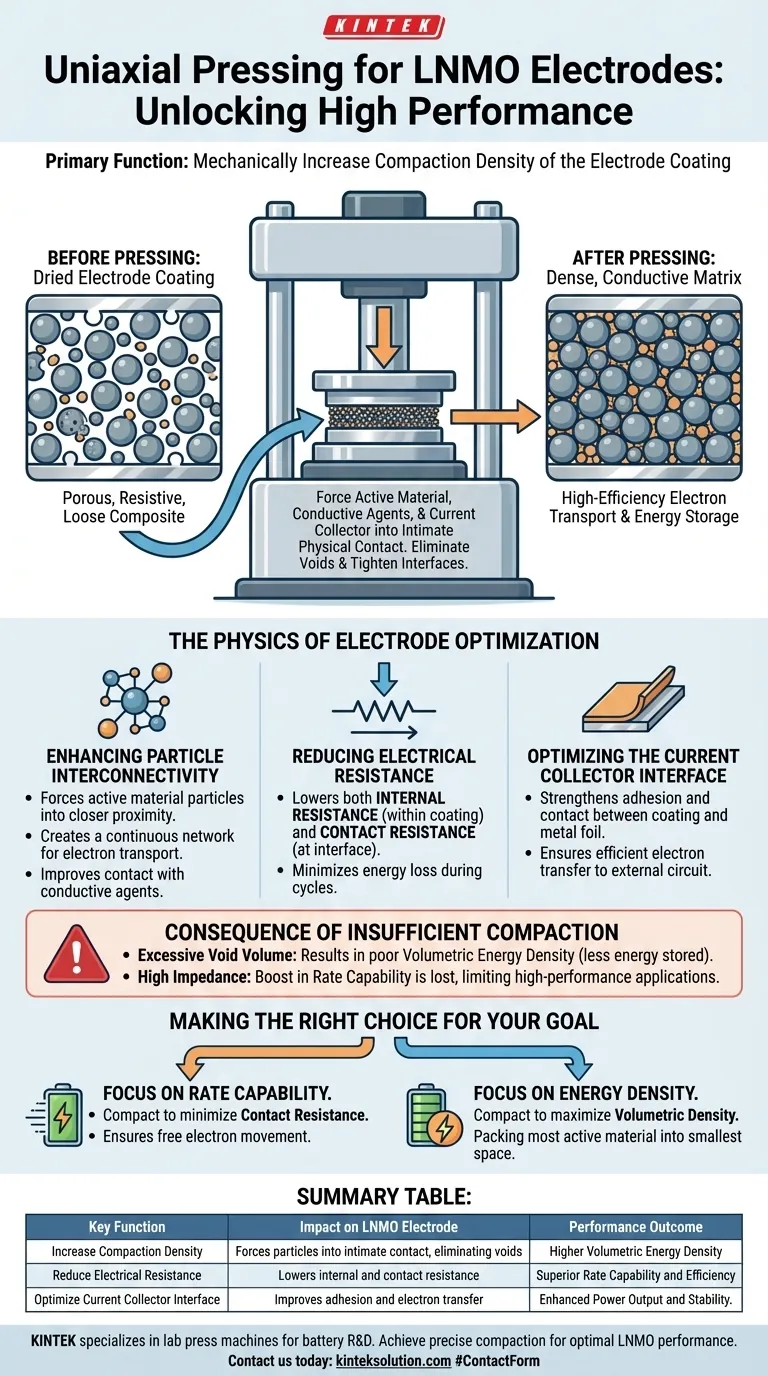
The primary function of using a uniaxial press machine for dried LiNi0.5Mn1.5O4 (LNMO) electrodes is to mechanically increase the compaction density of the electrode coating.
This mechanical compression is not merely about reducing thickness; it is a critical processing step designed to force active material particles, conductive agents, and the current collector into intimate physical contact. By eliminating voids and tightening these interfaces, the press significantly reduces both internal and contact resistance, directly enabling the battery to achieve higher volumetric energy density and superior rate capability.
The Core Objective
A dried electrode coating is inherently porous and resistive. The uniaxial press acts as a bridge between fabrication and performance, transforming a loose composite into a dense, conductive matrix essential for high-efficiency electron transport and energy storage.

The Physics of Electrode Optimization
The application of uniaxial pressure drives structural changes within the LNMO electrode that are fundamental to its electrochemical operation.
Enhancing Particle Interconnectivity
Before pressing, the dried electrode coating consists of loosely packed particles. The uniaxial press forces the active material particles (LNMO) into closer proximity with one another.
This creates a continuous network for electron transport. Simultaneously, it improves the contact between the active material and the conductive agent, ensuring that the electrochemical reactions are adequately supported by electron flow.
Reducing Electrical Resistance
The immediate outcome of improved particle contact is a drastic reduction in resistance.
Specifically, the process lowers both internal resistance (within the coating itself) and contact resistance (at the interface). Lower resistance is a prerequisite for efficient battery operation, minimizing energy loss during charge and discharge cycles.
Optimizing the Current Collector Interface
A critical, often overlooked aspect of this process is the interface between the coating and the metal foil.
The press strengthens the adhesion and contact between the electrode particles and the current collector. This ensures that electrons generated or consumed at the active sites can be efficiently transferred to the external circuit.
The Consequence of Insufficient Compaction
While the benefits of pressing are clear, it is vital to understand the operational pitfalls of neglecting this step. The references highlight specific performance metrics that rely directly on the physical density of the electrode.
The Density-Performance Link
If an electrode is not sufficiently compacted, it retains excessive void volume. This results in poor volumetric energy density, meaning the battery stores less energy per unit of volume.
Furthermore, a lack of compaction leaves the electrode with high impedance. The references indicate that the boost in rate capability—the ability of the battery to charge and discharge quickly—is a direct result of the density achieved during this step. Without proper pressing, the electrode cannot support high-performance applications.
Making the Right Choice for Your Goal
The use of a uniaxial press is a standardizing step that determines the final capability of your LNMO electrode. Depending on your specific performance targets, the importance of this step varies slightly in focus.
- If your primary focus is Rate Capability: You are compacting to minimize contact resistance, ensuring electrons move freely during rapid charge/discharge cycles.
- If your primary focus is Energy Density: You are compacting to maximize volumetric density, packing the most active material into the smallest possible space.
Ultimately, uniaxial pressing is the defining step that converts a dried chemical coating into a functional, high-performance battery component.
Summary Table:
| Key Function | Impact on LNMO Electrode | Performance Outcome |
|---|---|---|
| Increase Compaction Density | Forces particles into intimate contact, eliminating voids. | Higher volumetric energy density. |
| Reduce Electrical Resistance | Lowers internal and contact resistance within the electrode. | Superior rate capability and efficiency. |
| Optimize Current Collector Interface | Improves adhesion and electron transfer to the external circuit. | Enhanced power output and stability. |
Ready to transform your electrode development with precise compaction?
KINTEK specializes in lab press machines, including automatic and heated lab presses, designed to meet the exacting demands of battery research and development. Our equipment ensures the consistent, high-pressure compaction required to achieve optimal density and performance for your LNMO and other advanced electrode materials.
Contact us today using the form below to discuss how our solutions can enhance your lab's capabilities and accelerate your path to high-performance energy storage.
Visual Guide
Related Products
- Lab Isostatic Pressing Molds for Isostatic Molding
- Lab Infrared Press Mold for No Demolding
- Cylindrical Lab Electric Heating Press Mold for Laboratory Use
- Lab Infrared Press Mold for Laboratory Applications
- Special Shape Lab Press Mold for Laboratory Applications
People Also Ask
- What is the purpose of incorporating cartridge heaters into a lab press mold for MLCC block compression? Optimize Results
- What is the function of an isostatic lab press in energy storage research? Achieve Superior Material Standardization
- How do laboratory press machines resolve increased impedance in solid-state batteries? Achieve Low-Resistance Interfaces
- How does controlling the parameters of a laboratory isostatic press contribute to reducing deformation in LTCC channels?
- What is the key value provided by a laboratory isostatic press for TRIP steel? Enhance Densification & Precision















