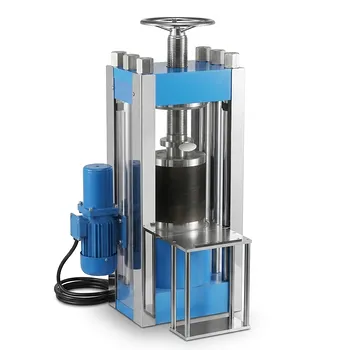
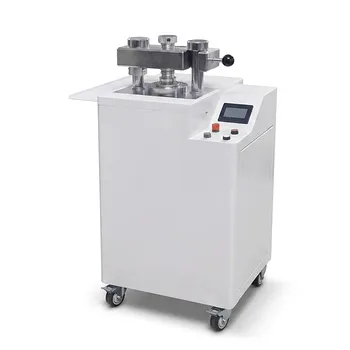
The primary purpose of a KBr press is to compress potassium bromide (KBr) powder into transparent pellets specifically for infrared (IR) spectroscopy. These pellets serve as a solid, optically clear medium that allows researchers to analyze the molecular structure of solid samples without interference. Because KBr is transparent to infrared light, the press creates a "window" that enables accurate spectral analysis of the sample material suspended within it.
By applying immense hydraulic pressure to potassium bromide powder, a KBr press transforms loose material into a solid, glass-like disc. This transparency is critical for infrared spectroscopy, enabling the light to pass through the medium and interact solely with the sample material for precise chemical analysis.
The Role of KBr in Analytical Chemistry
The KBr press is not just a compaction tool; it is an essential instrument for ensuring data integrity in spectroscopy.
Transparency to Infrared Light
The fundamental reason for using a KBr press is the optical nature of potassium bromide. KBr is transparent to IR radiation, meaning it does not absorb the light used in the analysis. This ensures that the resulting spectrum represents the sample alone, not the matrix holding it.
Versatility in Application
These presses are versatile tools used across various sectors. In Research and Development, they help scientists study the properties of new materials and compounds. In Quality Control, they are critical for verifying the consistency and purity of manufactured materials.
High Reproducibility
Using a press standardizes the sample preparation process. The mechanical compression ensures that pellets are consistent in density and thickness. This reproducibility allows for reliable comparison of results across multiple analyses.
Key Components and Operation
A KBr press functions through the interaction of three specific mechanical components designed to handle high stress.
The Die Set
This acts as the mold for the pellet. It typically consists of a cylindrical die and two plungers. The die set shapes the loose KBr powder into a specific form before pressure is applied.
The Hydraulic Press mechanism
The core function of the device is to generate force. The press applies hydraulic pressure, generally in the range of 8 to 10 tons. This extreme force is required to fuse the crystalline powder into a solid, cohesive pellet.
The Base Plate
This component provides a stable foundation for the die set. It ensures that the immense pressure from the hydraulic mechanism is distributed evenly. Even distribution is vital to prevent the pellet from cracking or forming unevenly.
Understanding the Trade-offs
While KBr presses are standard in spectroscopy, there are operational limitations and requirements that users must acknowledge.
Storage Limitations
Pellets created via this method, particularly those made with hand presses, are often not suitable for long-term storage. They can degrade or absorb moisture from the air, which compromises future analysis.
Maintenance and Corrosion Risks
The longevity of the press depends on strict maintenance. The die set and plungers must be cleaned regularly to prevent sample cross-contamination. Furthermore, because KBr is a salt, the equipment must be stored in a dry environment to prevent corrosion on the metal components.
Evacuation Efficiency
Some presses, specifically hand-operated models, may lack efficient air evacuation features compared to larger hydraulic units. Trapped air can lead to cloudy pellets, which reduces the quality of the spectral data.
Making the Right Choice for Your Goal
When integrating a KBr press into your workflow, consider your specific analytical requirements.
- If your primary focus is High-Precision Research: Prioritize a press with a high-quality die set and evacuation capabilities to ensure maximum transparency and minimal artifacts in your spectral data.
- If your primary focus is Routine Quality Control: Leverage the reproducibility of the hydraulic press to ensure every batch of material is tested against identical preparation standards.
Mastering the KBr press allows you to eliminate variables in sample preparation, ensuring your data reflects the true chemistry of your sample.
Summary Table:
| Feature | Description |
|---|---|
| Primary Function | Compressing KBr powder into transparent, glass-like pellets |
| Core Application | Infrared (IR) Spectroscopy for solid sample analysis |
| Pressure Range | Typically 8 to 10 tons of hydraulic force |
| Key Components | Die set (mold), hydraulic mechanism, and stable base plate |
| Optical Benefit | KBr transparency ensures light interacts only with the sample |
| Common Users | R&D laboratories and industrial Quality Control (QC) |
Optimize Your Spectroscopy with KBr Pressing Excellence
Precision in IR spectroscopy starts with a flawless pellet. KINTEK specializes in comprehensive laboratory pressing solutions, offering manual, automatic, heated, multifunctional, and glovebox-compatible models, as well as cold and warm isostatic presses. Whether you are conducting advanced battery research or routine quality control, our equipment ensures high reproducibility and maximum optical transparency.
Ready to enhance your lab's analytical integrity? Contact KINTEK today to find the perfect press for your research!
Related Products
- Laboratory Hydraulic Press 2T Lab Pellet Press for KBR FTIR
- Laboratory Hydraulic Pellet Press for XRF KBR FTIR Lab Press
- Automatic Laboratory Hydraulic Press for XRF and KBR Pellet Pressing
- Lab Infrared Press Mold for No Demolding
- Button Battery Sealing Press Machine for Lab
People Also Ask
- What is the role of a laboratory pressure machine and KBr in FTIR? Master Sample Preparation for Flame Retardants
- What is the role of a laboratory hydraulic press in high-loading NCM811 cathode prep for solid-state batteries?
- Why is a laboratory hydraulic press necessary for sample preparation? Precise Pelleting for Spiro Heterocyclic Analysis
- What role does a laboratory hydraulic press play in reaction pellets? Optimizing Lunar Soil and Metal Fuel Density
- Why is precise load control from laboratory pressure equipment necessary for soil bulk density? Ensure Data Integrity