
The application of a second pressure of 120 MPa serves as the definitive integration step that bonds the negative electrode (often a Lithium-Indium alloy) to the pre-existing positive electrode and electrolyte layers. This specific hydraulic pressing stage is not merely about compaction; it effectively fuses the separate components into a single, unified three-layer cell structure, ensuring the mechanical and electrochemical connectivity required for the battery to function.
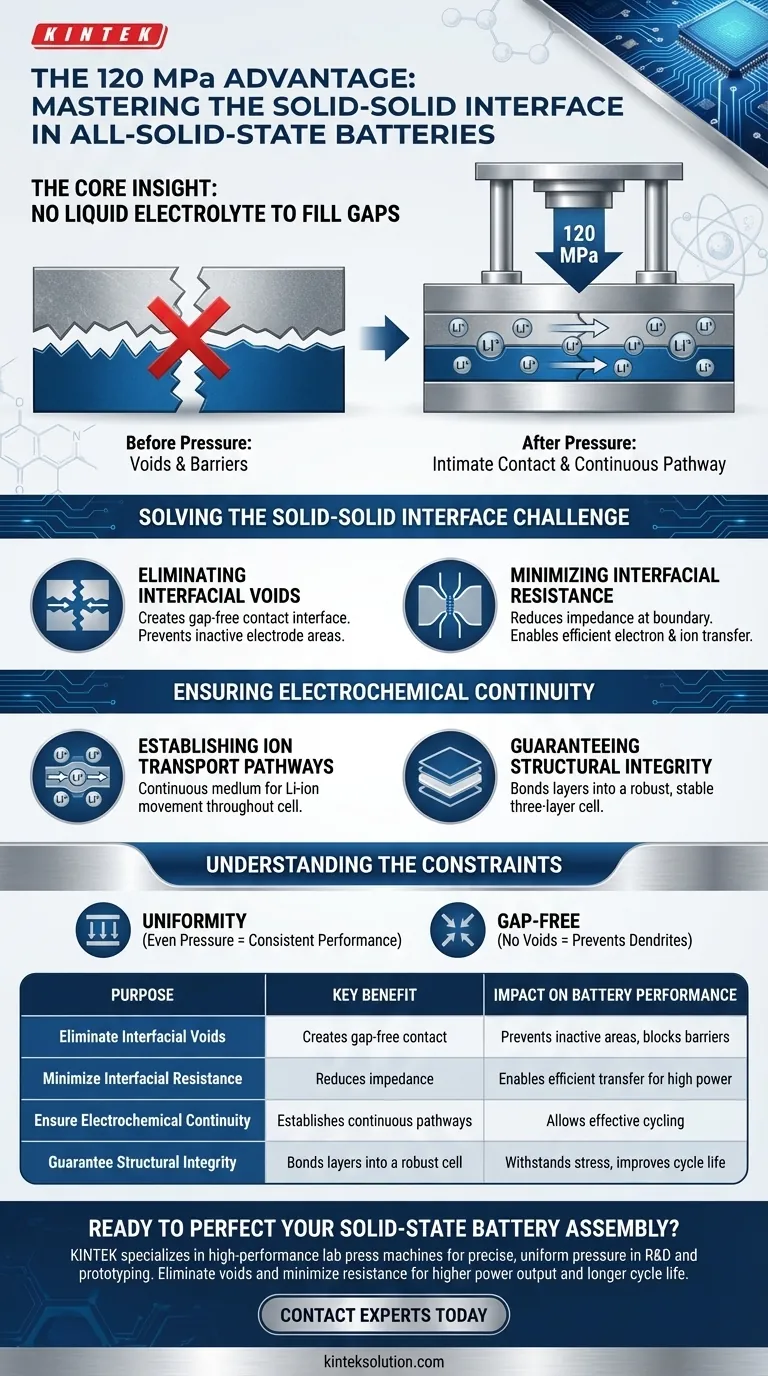
The Core Insight: In all-solid-state batteries, liquid electrolytes are not present to wet surfaces and fill microscopic gaps. Therefore, high external pressure acts as the physical bridge, forcing solid materials into intimate contact to eliminate voids and create a low-resistance highway for lithium-ion transport.
Solving the Solid-Solid Interface Challenge
The primary obstacle in solid-state battery assembly is the inherent roughness and rigidity of solid materials. Unlike liquids, solids do not naturally flow to create perfect contact. The 120 MPa pressure step addresses this fundamental physics problem.
Eliminating Interfacial Voids
When the negative electrode sheet is placed onto the electrolyte pellet, microscopic gaps exist between the two surfaces.
Applying 120 MPa forces the materials to deform slightly and interlock. This creates a gap-free contact interface between the negative electrode and the solid electrolyte layer.
Without this "intimate" contact, the battery would suffer from voids that block the movement of ions, rendering parts of the electrode inactive.
Minimizing Interfacial Resistance
The physical gaps mentioned above act as barriers to electricity and ion flow, resulting in high impedance (resistance).
By creating a uniform, tight connection, the press significantly reduces interfacial resistance.
This ensures that the boundary between the anode and electrolyte does not become a bottleneck for performance, allowing for efficient electron and ion transfer.
Ensuring Electrochemical Continuity
Beyond simple physical contact, this pressure step is critical for the actual electrochemical operation of the battery.
Establishing Ion Transport Pathways
Lithium ions require a continuous material medium to move from the anode to the cathode.
The pressure establishes a continuous and efficient pathway for lithium-ion transport throughout the entire cell.
If this pathway is interrupted by poor contact, the battery cannot cycle effectively.
Guaranteeing Structural Integrity
The 120 MPa pressure provides the mechanical force necessary to construct a robust three-layer cell.
It ensures the stability and integrity of the battery's internal reaction interfaces.
This mechanical bonding is essential for the cell to withstand the physical stresses of handling and testing without delaminating.
Understanding the Constraints
While pressure is vital, it introduces specific engineering challenges that must be managed to ensure success.
The Requirement for Uniformity
The pressure applied must be precise and uniform across the entire surface area of the stack.
Uneven pressure leads to variations in current density, which can cause localized degradation or inefficient active material utilization.
The Necessity of "Gap-Free" Contact
The references highlight that "poor contact" is an inherent challenge in solid-state systems.
If the press fails to achieve a truly void-free interface, the wettability of lithium on the electrolyte surface remains poor.
This can lead to issues such as lithium dendrite growth, which compromises long-term cycling stability and safety.
Making the Right Choice for Your Goal
The application of 120 MPa is a calculated parameter designed to balance mechanical adhesion with electrochemical needs. Here is how to prioritize this step based on your specific objectives:
- If your primary focus is High Power Output: Ensure the pressure is applied uniformly to minimize interfacial impedance, creating the lowest possible resistance for rapid ion transport.
- If your primary focus is Long-Term Cycle Life: Prioritize the elimination of all voids to suppress dendrite growth and maintain the mechanical integrity of the stack over repeated cycles.
Ultimately, the 120 MPa pressing step is the bridge that transforms isolated material layers into a cohesive, high-performance electrochemical system.
Summary Table:
| Purpose | Key Benefit | Impact on Battery Performance |
|---|---|---|
| Eliminate Interfacial Voids | Creates gap-free contact between solid layers | Prevents inactive electrode areas, blocks ion flow barriers |
| Minimize Interfacial Resistance | Reduces impedance at the anode-electrolyte boundary | Enables efficient electron and ion transfer for higher power output |
| Ensure Electrochemical Continuity | Establishes continuous pathways for lithium-ion transport | Allows the battery to cycle effectively |
| Guarantee Structural Integrity | Bonds layers into a robust, three-layer cell | Withstands physical stresses of handling and testing, improves cycle life |
Ready to perfect your solid-state battery assembly?
At KINTEK, we specialize in high-performance lab press machines, including automatic and isostatic presses, designed to deliver the precise, uniform pressure required for reliable R&D and prototyping. Our equipment helps researchers like you eliminate interfacial voids and minimize resistance, paving the way for higher power output and longer cycle life.
Let's build the future of energy storage together. Contact our experts today to find the perfect press for your laboratory needs!
Visual Guide
Related Products
- Warm Isostatic Press for Solid State Battery Research Warm Isostatic Press
- Laboratory Hydraulic Press Lab Pellet Press Button Battery Press
- Automatic Laboratory Hydraulic Press for XRF and KBR Pellet Pressing
- Laboratory Hydraulic Press 2T Lab Pellet Press for KBR FTIR
- Lab Button Battery Tablet Press Sealing Mold
People Also Ask
- Why must composite cathodes be sealed in vacuum lamination bags for WIP? Ensure Battery Stability and Density
- What is the function of elastic molds in warm isostatic pressing? Achieve Uniform Density in Composite Particles
- How do sacrificial volume materials (SVM) maintain microchannels in isostatic pressing? Ensure Structural Integrity
- How does Warm Isostatic Pressing differ from traditional pressing methods? Unlock Uniform Density for Complex Parts
- What are the advantages of using a Warm Isostatic Press (WIP) for batteries? Achieve Superior Interface Contact



















