
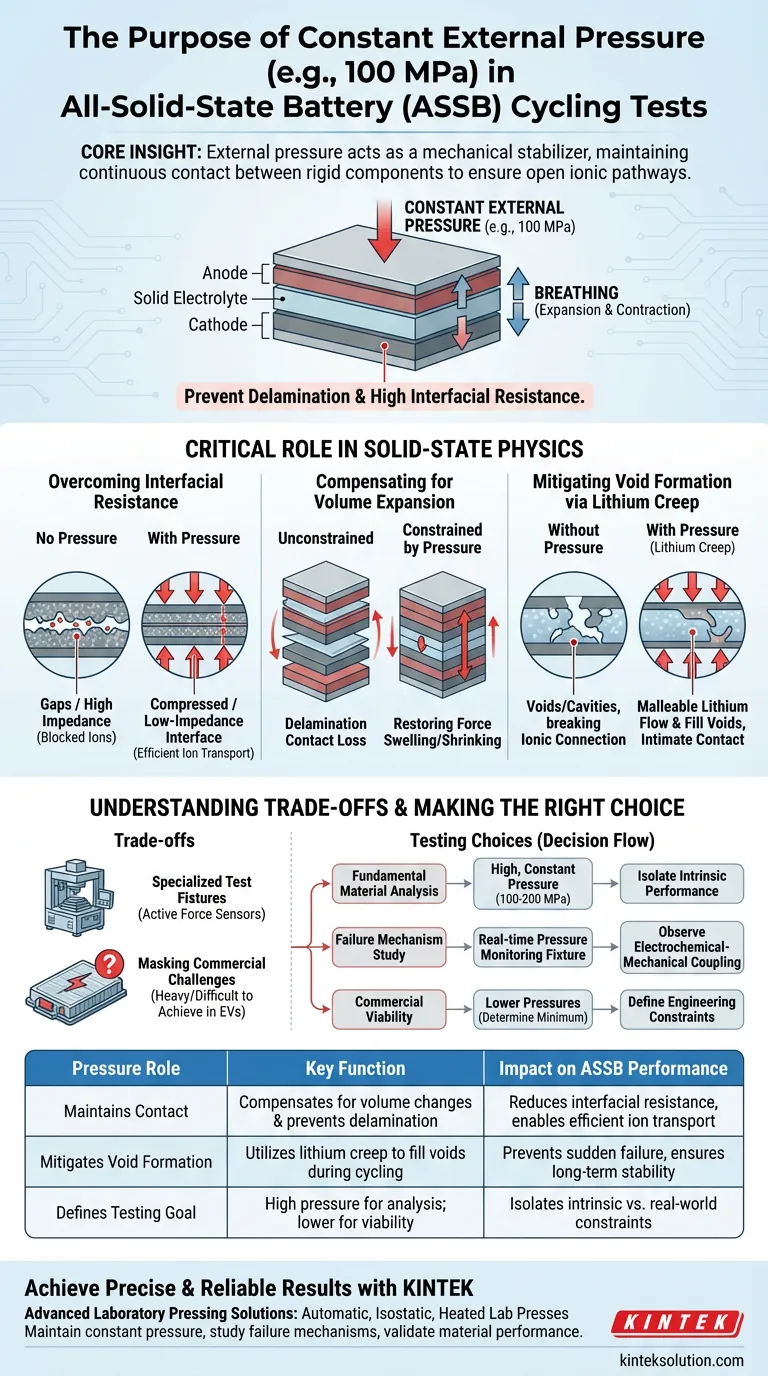
The primary purpose of applying constant external pressure, such as 100 MPa, during all-solid-state battery (ASSB) cycling is to maintain continuous physical contact between rigid components that naturally separate during operation.
Because solid-state batteries lack liquid electrolytes to fill gaps, this pressure is mechanically essential to force the electrode and electrolyte particles together. Without it, the "breathing" of the battery (expansion and contraction) during charge cycles leads to delamination, high interfacial resistance, and rapid performance failure.
The Core Insight All-solid-state batteries rely on rigid interfaces that cannot "wet" surfaces like liquid electrolytes. External pressure acts as a mechanical stabilizer, ensuring that ionic pathways remain open by compensating for the volume changes and void formation that inevitably occur as the battery charges and discharges.
The Critical Role of Pressure in Solid-State Physics
Overcoming Interfacial Resistance
In a liquid battery, the electrolyte flows into every pore of the electrode. In a solid-state system, the interface is defined by rigid solid-solid contact.
Without sufficient pressure, microscopic gaps exist between the cathode, anode, and solid electrolyte. These gaps create high impedance (resistance), blocking the flow of lithium ions.
Applying high pressure (e.g., 100–200 MPa) compresses these layers, maximizing the active surface area and establishing the low-impedance interface required for efficient ion transport.
Compensating for Volume Expansion
Active materials, particularly silicon anodes, undergo significant volumetric changes (expansion and contraction) during lithium insertion and extraction.
If the battery is unconstrained, this "breathing" causes the material layers to pull apart, leading to delamination or separation at the interface.
A constant external stack pressure counteracts this expansion. It acts as a restoring force that keeps the layers pressed together, preventing contact loss even when the materials swell or shrink.
Mitigating Void Formation via Lithium Creep
During the discharge cycle, lithium is stripped away from the anode. In a solid system, this removal of material can leave behind physical voids or cavities.
These voids sever the ionic connection, causing a spike in resistance.
Applying pressure utilizes the creep properties of lithium metal. The force physically pushes the malleable lithium to "flow" and fill these voids, maintaining the intimate contact necessary for long-cycle-life stability.
Understanding the Trade-offs
The Complexity of Test Fixtures
To maintain a precise pressure like 100 MPa or 62.4 MPa, you cannot simply clamp the cell once. You must use a specialized test fixture or laboratory press equipped with active force sensors.
This is because the cell's internal pressure changes as it expands. The fixture must actively monitor and adjust to maintain constant pressure, adding significant complexity to the testing setup compared to liquid cells.
Masking Practical Challenges
While high pressure (100+ MPa) is excellent for obtaining stable electrochemical data in a lab, it can sometimes mask commercial viability issues.
Achieving 100 MPa of uniform pressure in a commercial electric vehicle battery pack is extremely difficult and mechanically heavy. Therefore, while high pressure validates the chemistry, it may not always perfectly simulate the constraints of a mass-market product.
Making the Right Choice for Your Goal
When designing your testing protocol, the pressure you apply defines the data you get.
- If your primary focus is Fundamental Material Analysis: Apply high, constant pressure (e.g., 100–200 MPa) to eliminate contact issues and isolate the intrinsic electrochemical performance of your materials.
- If your primary focus is Failure Mechanism Study: Use a fixture with real-time pressure monitoring to observe how internal stress evolves, providing data on electrochemical-mechanical coupling.
- If your primary focus is Commercial Viability: Consider testing at lower pressures later in development to determine the minimum pressure required for stability, as this dictates the engineering constraints of the final battery pack.
Ultimately, external pressure is not just a testing parameter; it is a functional component of the all-solid-state battery system that ensures the mechanical integrity required for ionic flow.
Summary Table:
| Pressure Role | Key Function | Impact on ASSB Performance |
|---|---|---|
| Maintains Contact | Compensates for volume changes & prevents delamination | Reduces interfacial resistance, enables efficient ion transport |
| Mitigates Void Formation | Utilizes lithium creep to fill voids created during cycling | Prevents sudden failure and ensures long-term cycle stability |
| Defines Testing Goal | High pressure for material analysis; lower pressure for commercial viability studies | Isolates intrinsic material performance vs. real-world application constraints |
Ready to achieve precise and reliable results in your all-solid-state battery research?
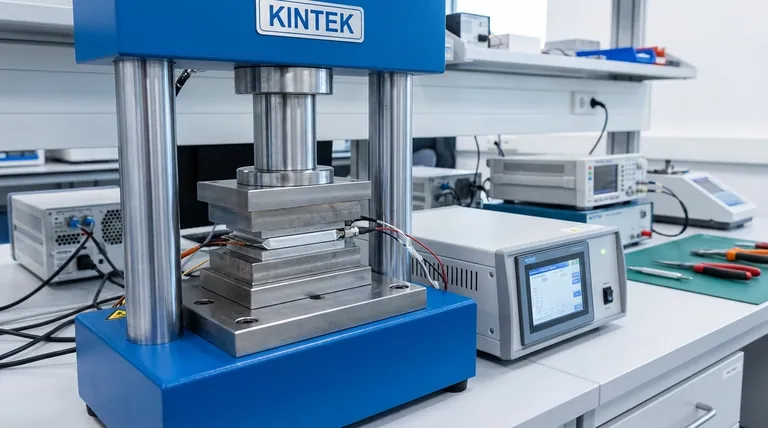
KINTEK specializes in advanced laboratory pressing solutions, including automatic lab presses, isostatic presses, and heated lab presses, designed to deliver the consistent, high-pressure environments essential for accurate ASSB cycling tests.
Our equipment helps you:
- Maintain constant pressure (e.g., 100 MPa) throughout charge-discharge cycles.
- Study failure mechanisms with real-time pressure monitoring.
- Validate material performance under conditions that mirror both R&D and commercial requirements.
Enhance your lab's capabilities—contact our experts today to find the ideal press for your solid-state battery development!
Visual Guide
Related Products
People Also Ask
- Why must composite cathodes be sealed in vacuum lamination bags for WIP? Ensure Battery Stability and Density
- What is the function of elastic molds in warm isostatic pressing? Achieve Uniform Density in Composite Particles
- How do sacrificial volume materials (SVM) maintain microchannels in isostatic pressing? Ensure Structural Integrity
- How does Warm Isostatic Pressing differ from traditional pressing methods? Unlock Uniform Density for Complex Parts
- What is the function of hydraulic pressure in warm isostatic pressing? Achieve Uniform Material Density
