Applying and maintaining constant stack pressure is the fundamental engineering solution required to overcome the physical limitations of solid-solid interfaces in all-solid-state batteries (ASSBs). By applying significant external force—often ranging from 50 MPa to 100 MPa—you force the rigid cathode, solid electrolyte, and anode layers into intimate physical contact. This process eliminates microscopic voids caused by surface roughness, drastically reducing interfacial impedance and allowing lithium ions to transport efficiently between layers.
Core Takeaway Solid-state materials do not "wet" surfaces like liquid electrolytes; without external pressure, the contact between layers is poor and resistant to ion flow. Constant stack pressure is therefore mandatory to minimize internal resistance and mechanically secure the layers against the expansion and contraction that occurs during charging cycles.
Overcoming the Solid-Solid Interface Challenge
Eliminating Microscopic Voids
Unlike liquid electrolytes that flow into porous electrodes, solid electrolytes are rigid. Without pressure, the natural surface roughness of the material layers creates microscopic gaps and voids at the interface. Applying high pressure (e.g., 74 MPa) forces these layers together, creating a "void-free" connection essential for battery activation.
Minimizing Interfacial Impedance
The primary obstacle in ASSB performance is high resistance at the boundaries between materials. By maintaining intimate contact, you significantly lower the interfacial impedance. This reduction is critical for enabling high-rate performance, as it clears the path for rapid lithium-ion transport.
Managing Mechanical Stability and Cycle Life
Compensating for Volumetric Changes
Battery electrodes effectively "breathe" during operation, expanding and contracting as lithium ions enter and exit the structure. Constant stack pressure accommodates these volumetric changes dynamically. This is essential for preventing the mechanical stress that leads to material degradation over time.
Preventing Delamination
If pressure is not maintained, the volume changes described above will cause the layers to physically separate. This separation, or delamination, breaks the ionic pathway, leading to a rapid spike in resistance and battery failure. Sustained pressure acts as a preventative measure, ensuring the interface remains intact throughout long-term cycling.
Ensuring Research Reliability
Standardization of Test Conditions
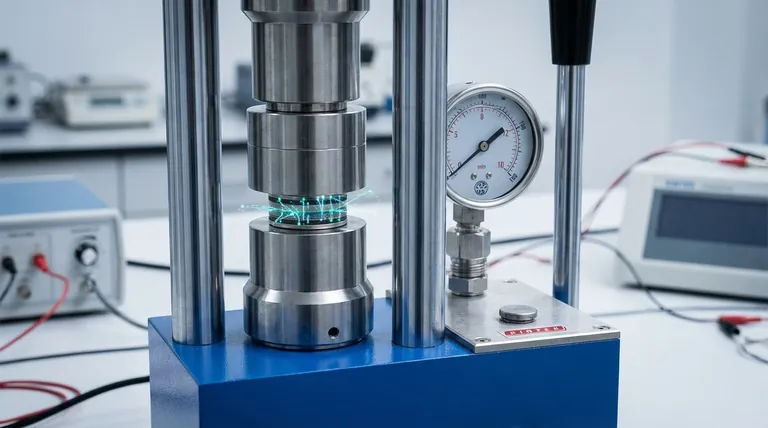
In a laboratory setting, using a hydraulic press to maintain consistent forming pressure is vital for data integrity. It ensures that the contact quality is identical from one cell to the next. This consistency minimizes variations in impedance data, allowing researchers to accurately evaluate the actual properties of the materials rather than artifacts of assembly.
Understanding the Trade-offs
Complexity of Assembly and Testing
While pressure is beneficial for performance, implementing it requires specialized equipment. References highlight the need for in-situ compression setups and hydraulic presses capable of delivering 70–100 MPa. This adds significant complexity to the battery packaging and testing hardware compared to liquid-electrolyte systems.
The Necessity of Simulation
Testing without this pressure yields data that does not reflect real-world potential. Applying 100 MPa during testing is often necessary to simulate the conditions inside a commercial battery package. Failing to apply this pressure during testing will result in premature failure that falsely suggests the material chemistry is poor, when the issue is actually mechanical.
Making the Right Choice for Your Goal
To maximize the efficacy of your all-solid-state battery project, align your pressure strategy with your specific technical objectives:
- If your primary focus is Long Cycle Life: Ensure your setup applies continuous pressure (dynamic compensation) to counteract the volumetric expansion and contraction of the electrodes during cycling.
- If your primary focus is High-Rate Performance: Prioritize high initial stacking pressure (e.g., >70 MPa) to minimize interfacial impedance and eliminate all microscopic voids before cycling begins.
- If your primary focus is Material Evaluation: Maintain strict consistency in pressure application across all samples to ensure that variations in performance are due to material chemistry, not assembly variables.
The success of an all-solid-state battery relies as much on its mechanical assembly as its chemical composition.
Summary Table:
| Purpose of Constant Stack Pressure | Key Benefit | Typical Pressure Range |
|---|---|---|
| Eliminate Microscopic Voids | Reduces interfacial impedance, enables battery activation | 50 - 100 MPa |
| Manage Volumetric Changes | Prevents delamination, extends cycle life | Sustained, dynamic pressure |
| Ensure Research Reliability | Standardizes test conditions for accurate material evaluation | Consistent pressure (e.g., 74 MPa) |
Achieve reliable, high-performance results in your all-solid-state battery research.
The success of your ASSB project hinges on precise mechanical control. KINTEK specializes in laboratory press machines, including automatic lab presses, isostatic presses, and heated lab presses, designed to deliver and maintain the constant, high stack pressure (70-100 MPa) essential for accurate testing and material evaluation.
Let us help you eliminate assembly variables and focus on your material chemistry.
Contact our experts today to find the perfect press for your lab's needs!
Visual Guide

Related Products
- Warm Isostatic Press for Solid State Battery Research Warm Isostatic Press
- Laboratory Hydraulic Press Lab Pellet Press Button Battery Press
- Button Battery Sealing Press Machine for Lab
- Lab Button Battery Tablet Press Sealing Mold
- Lab Infrared Press Mold for Laboratory Applications
People Also Ask
- Why must composite cathodes be sealed in vacuum lamination bags for WIP? Ensure Battery Stability and Density
- How do sacrificial volume materials (SVM) maintain microchannels in isostatic pressing? Ensure Structural Integrity
- What is the function of elastic molds in warm isostatic pressing? Achieve Uniform Density in Composite Particles
- What are the advantages of using a Warm Isostatic Press (WIP) for batteries? Achieve Superior Interface Contact
- What is the significance of temperature control in Warm Isostatic Pressing? Unlock Uniform Densification and Process Stability