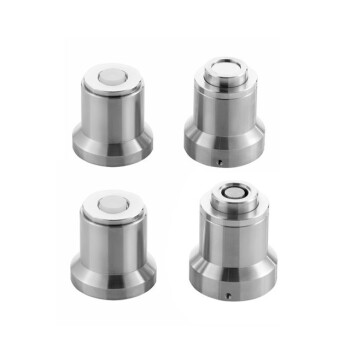
The primary purpose of applying solid lubrication to molds and punches is to drastically reduce lateral friction between the composite powder and the steel tooling walls. This facilitates uniform pressure transmission during pressing and protects the structural integrity of the part during ejection.
By creating a protective thin film, solid lubrication ensures consistent density within the "green" compact and prevents material adhesion, effectively preserving both the sample quality and the lifespan of the precision tooling.
The Mechanics of Friction Reduction
Minimizing Lateral Resistance
When composite powders are compressed, friction generates naturally where the particles contact the steel walls of the mold.
Applying solid lubrication creates a saturated, protective layer at this interface. This significantly lowers the coefficient of friction during the high-pressure compaction phase.
Enhancing Pressure Transmission
High wall friction creates a "drag" effect that prevents pressure from reaching the center or bottom of the powder column.
By reducing this drag, lubrication allows compaction pressure to transmit more uniformly throughout the powder mass. This directly reduces density gradients, ensuring the final part has a consistent structure rather than being dense at the edges and porous in the center.
Protecting Sample and Tool Integrity
Ensuring Safe Ejection
The risk of damage is highest when the compacted part (the green compact) is pushed out of the mold.
The lubrication layer acts as a slip agent during this critical ejection stage. It prevents the edges of the sample from fraying, cracking, or crumbling as they slide against the mold walls.
Preventing Adhesion and Sticking
Under high pressure, metal powders (such as aluminum) have a tendency to cold-weld or stick to steel tooling.
The lubricant film acts as a physical barrier that prevents this adhesion. This ensures the surface integrity of the green compact remains flawless immediately after demolding.
Extending Mold Service Life
Precision molds and punches are expensive assets susceptible to wear and scoring.
By consistently reducing frictional resistance and preventing powder buildup on the tool faces, solid lubrication significantly extends the service life of these components.
Common Pitfalls to Avoid
The Risk of Over-Application
While lubrication is essential, the application must result in a thin film.
Excessive lubrication can occupy volume within the mold that should be filled by powder. This can lead to dimensional inaccuracies or surface defects on the final part.
Inconsistent Coverage
Partial lubrication is nearly as dangerous as no lubrication.
If the film is not applied to the entire cavity surface, localized sticking can occur. This creates stress risers that may cause the compact to crack internally during ejection.
Making the Right Choice for Your Goal
To maximize the quality of your composite pressing, consider your primary objective:
- If your primary focus is part consistency: Prioritize lubrication to ensure uniform pressure transmission, which eliminates weak spots caused by density gradients.
- If your primary focus is tooling longevity: Ensure a consistent lubricant film to prevent metal-on-metal adhesion and reduce abrasive wear on precision surfaces.
Correct application of solid lubrication is the single most effective variable for bridging the gap between powder potential and structural reality.
Summary Table:
| Key Benefit | Description | Impact on Result |
|---|---|---|
| Friction Reduction | Minimizes resistance between powder and steel walls | Uniform pressure transmission |
| Density Control | Eliminates "drag" effects during compaction | Consistent, high-quality green compacts |
| Safe Ejection | Acts as a slip agent during part removal | Prevents cracking and surface fraying |
| Tool Protection | Creates a barrier against cold-welding and wear | Extended mold and punch service life |
| Surface Quality | Prevents powder adhesion to tooling faces | Flawless, smooth part finish |
Optimize Your Lab Pressing Results with KINTEK
Don't let friction compromise your material research. KINTEK specializes in comprehensive laboratory pressing solutions, offering a versatile range of manual, automatic, heated, and multifunctional presses, as well as cold and warm isostatic presses designed for the most demanding battery and composite research.
Our precision-engineered equipment, paired with expert advice on lubrication and mold maintenance, ensures your samples achieve perfect density and structural integrity every time. Contact KINTEK today to discover how our specialized lab solutions can streamline your powder compaction workflow!
References
- H.M. Mallikarjuna, R. Keshavamurthy. Microstructure and Microhardness of Carbon Nanotube-Silicon Carbide/Copper Hybrid Nanocomposite Developed by Powder Metallurgy. DOI: 10.17485/ijst/2016/v9i14/84063
This article is also based on technical information from Kintek Solution Knowledge Base .
Related Products
- Lab Ball Press Mold
- Lab Anti-Cracking Press Mold
- Assemble Square Lab Press Mold for Laboratory Use
- Lab Ring Press Mold for Sample Preparation
- Special Shape Lab Press Mold for Laboratory Applications
People Also Ask
- What is the purpose of incorporating cartridge heaters into a lab press mold for MLCC block compression? Optimize Results
- What are the requirements for pressing molds when using SSCG? Key Materials for Complex Single Crystal Production
- How do the design and geometric precision of pressing molds and mandrels affect the quality of PTFE composite samples?
- How does the geometry of laboratory molds influence mycelium-based composites? Optimize Density and Strength
- What role do precision positioning and pressure molds play in single-lap joints? Ensure 100% Data Integrity