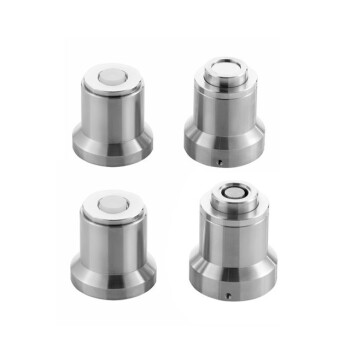
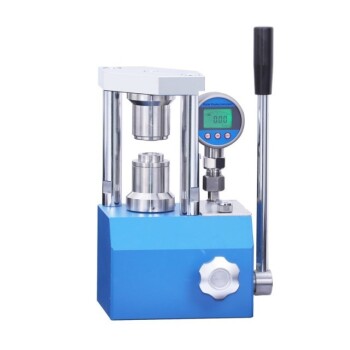
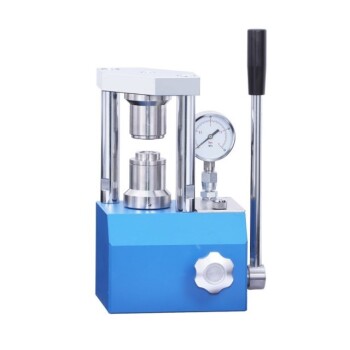
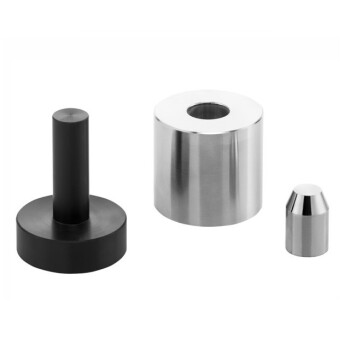
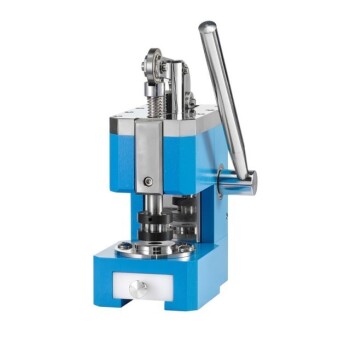
The primary purpose of a coin cell crimper is to apply precise, uniform mechanical pressure to hermetically seal the battery casing while simultaneously compacting the internal stack. This mechanical action ensures the anode, cathode, and solid electrolyte maintain continuous physical contact to minimize electrical resistance. Furthermore, it isolates chemically sensitive internal materials from the external environment, preventing contamination that would invalidate test results.
Core Insight: While a crimper physically closes the battery case, its true technical value lies in minimizing interfacial resistance through consistent compression. In solid-state batteries, where liquid electrolytes cannot "wet" the surface, this mechanical pressure is the only variable ensuring the intimate contact required for ion transport and reproducible data.
The Mechanics of Interface Management
Overcoming the Solid-Solid Interface Challenge
Unlike liquid electrolytes that naturally fill voids, solid-state batteries rely entirely on mechanical contact between layers. A coin cell crimper applies uniform radial pressure to force the solid electrolyte against the electrodes. This compaction is essential to close microscopic gaps that would otherwise block ion flow.
Reducing Internal Resistance
By ensuring tight physical contact, the crimper significantly reduces interface impedance. High-precision crimping eliminates contact fluctuations, allowing for the accurate measurement of critical metrics like current density and lithium stripping/plating efficiency.
Ensuring Data Reproducibility
Consistent assembly pressure is vital for obtaining credible electrochemical data. If pressure varies between cells due to poor crimping, results from Electrochemical Impedance Spectroscopy (EIS) or long-cycle charge-discharge tests will fluctuate, making it impossible to distinguish material performance from assembly errors.
Environmental Isolation and Safety
Creating a Hermetic Seal
Solid-state components, particularly lithium metal anodes, are highly reactive to moisture and oxygen. The crimper deforms the battery case gasket to create a reliable airtight seal. This prevents the ingress of external air that would degrade the cell immediately.
Preventing Leakage and Ensuring Stability
A proper crimp secures the structural integrity of the cell for long-term testing. It prevents the leakage of any semi-solid components and ensures the battery remains stable and safe during the stress of repeated charging and cycling.
Understanding the Trade-offs
The Risk of Inconsistent Pressure
Not all crimpers deliver equal force distribution. If the pressure is too low, the interface resistance will remain high, leading to poor performance that falsely reflects on the active materials.
The Danger of Over-Compression
Conversely, excessive or uneven force can damage fragile components. In solid-state setups, uncontrolled pressure can lead to crack propagation within the solid electrolyte layer or short circuits between the current collectors, ruining the cell before testing begins.
Making the Right Choice for Your Goal
To maximize the reliability of your solid-state battery testing, align your assembly process with your specific objectives:
- If your primary focus is Fundamental Material Analysis (EIS/CV): Prioritize a crimper with high-precision pressure control to minimize interface impedance and ensure the data reflects the chemistry, not the contact resistance.
- If your primary focus is Long-Term Cycling Stability: Ensure your crimping process delivers a robust, hermetic seal to prevent moisture ingress and mechanical relaxation over weeks of testing.
Ultimately, the crimper is not just a packaging tool; it is a critical instrument for standardizing the physical conditions under which your electrochemical chemistry operates.
Summary Table:
| Feature | Function in Solid-State Assembly | Impact on Research Data |
|---|---|---|
| Mechanical Compaction | Minimizes gaps between solid electrolyte and electrodes | Lowers interfacial resistance and impedance |
| Hermetic Sealing | Isolates reactive materials (e.g., Lithium) from air/moisture | Prevents contamination and ensures cell safety |
| Uniform Pressure | Provides consistent radial force across the internal stack | Ensures data reproducibility across multiple test batches |
| Gasket Deformation | Creates a structural airtight barrier | Enables long-term cycling and stability testing |
Optimize Your Battery Research with KINTEK Precision
Consistency in assembly is the bridge between a breakthrough material and a successful test result. KINTEK specializes in comprehensive laboratory pressing solutions, offering a range of manual, automatic, heated, and glovebox-compatible coin cell crimpers designed to eliminate assembly variables.
Whether you are performing sensitive EIS analysis or long-cycle stability tests, our high-precision equipment—including cold and warm isostatic presses—ensures your solid-state interfaces are perfectly compacted and hermetically sealed.
Ready to elevate your battery assembly standards? Contact KINTEK today to find the ideal pressing solution for your laboratory.
Related Products
- Lab Button Battery Disassembly and Sealing Mold
- Button Battery Sealing Machine for Button Batteries
- Manual Button Battery Sealing Machine for Battery Sealing
- Lab Button Battery Tablet Press Sealing Mold
- Button Battery Sealing Press Machine for Lab
People Also Ask
- How does a sealed battery mold facilitate the assembly and testing of asymmetric supercapacitors using VO2?
- What is the function of specialized battery molds and sealing consumables? Optimize Your In-situ XRD Testing Today
- How does the geometry of laboratory molds influence mycelium-based composites? Optimize Density and Strength
- Why are specialized battery test molds used? Ensure Peak Performance for All-Solid-State Sodium Batteries (ASSIBs)
- What role do battery testing molds play in electrolyte performance? Exploring Pressure vs. Viscoelasticity