
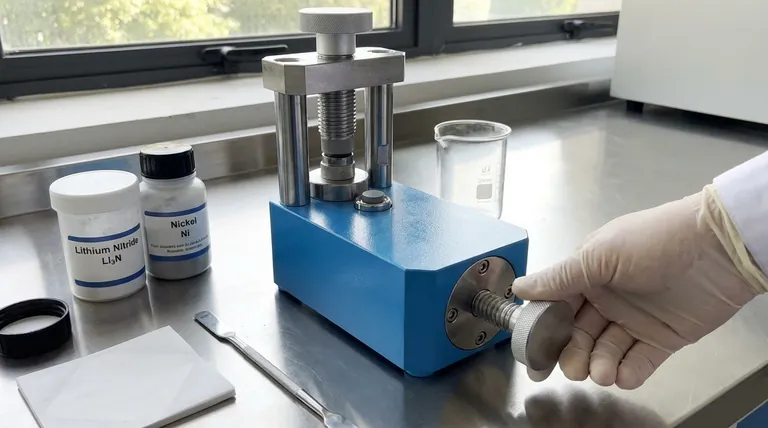
The primary purpose of using a hydraulic press in this context is to drive an efficient solid-state reaction between Lithium Nitride (Li3N) and Nickel (Ni) powders. By compacting these precursors into a dense pellet, you significantly increase the contact area between reactant particles and shorten the distance ions must diffuse. This mechanical preparation allows the subsequent high-temperature sintering to proceed rapidly and completely, ensuring the formation of the high-purity target phase, Li2.07Ni0.62N.
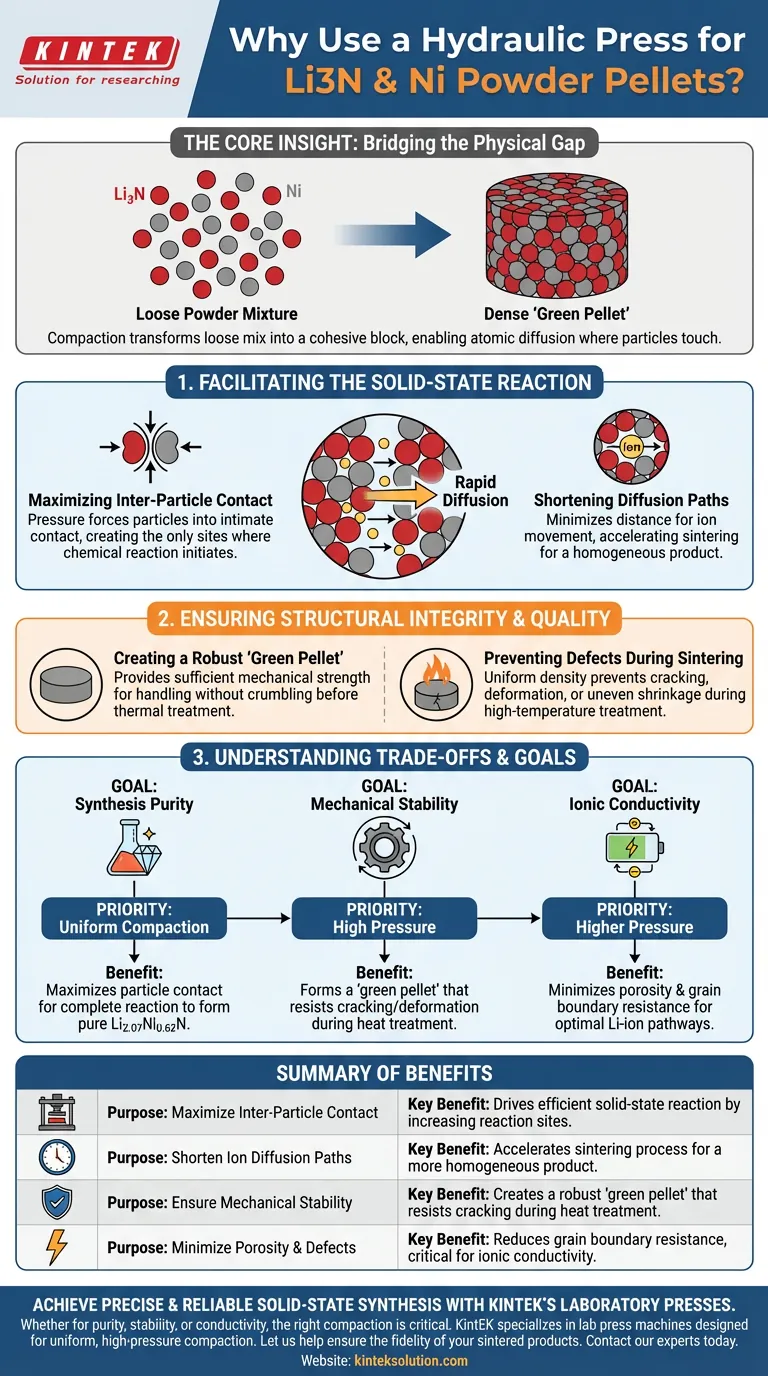
Core Insight: In solid-state synthesis, chemistry acts only where particles touch. The hydraulic press transforms a loose mixture into a dense, cohesive block, bridging the physical gap between reactants to enable atomic diffusion.
Facilitating the Solid-State Reaction
To achieve a high-purity material, you must overcome the physical limitations of mixing dry powders.
Maximizing Inter-Particle Contact
Loose powders naturally have large gaps and voids between individual grains. Applying pressure—often in the range of hundreds of megapascals—forces these particles into intimate physical contact.
This contact area is the only site where the chemical reaction can initiate. Without sufficient pressure, the reaction remains localized and incomplete.
Shortening Diffusion Paths
Solid-state reactions rely on ions moving (diffusing) from one particle to another.
Compaction minimizes the distance these ions must travel. By shortening the ion diffusion paths, the sintering process becomes faster and results in a more homogeneous product.
Ensuring Structural Integrity and Quality
Beyond the chemical reaction, the physical structure of the pellet—often called the "green pellet" or "green body"—dictates the quality of the final ceramic.
Creating a Robust "Green Pellet"
The pressing process creates a pellet with sufficient mechanical strength to be handled without crumbling.
A uniform, dense green pellet is essential for stability. It prevents the material from falling apart before the thermal treatment begins.
Preventing Defects During Sintering
High-temperature treatment causes materials to shrink. If the initial density is low or inconsistent, this shrinkage will be uneven.
A tightly packed pellet helps prevent critical defects such as cracking, deformation, or uneven shrinkage. This uniformity ensures that heat conduction is consistent throughout the entire sample during the sintering process.
Understanding the Trade-offs
While pressing is beneficial, understanding the implications of density and pressure is vital for material performance.
Minimizing Porosity
The goal of pressing is to reduce internal porosity and inter-particle pores.
If the pellet is not pressed densely enough, voids remain in the final structure. These voids act as barriers to ion movement, reducing the material's overall conductivity.
Reducing Grain Boundary Resistance
High density is directly linked to electrical performance.
By ensuring intimate contact between grains, you reduce grain boundary resistance. This is critical if the final goal is to construct high-performance all-solid-state batteries or accurately measure intrinsic ionic conductivity.
Making the Right Choice for Your Goal
The specific pressure and density you target should depend on your ultimate objective for the material.
- If your primary focus is Synthesis Purity: Prioritize uniform compaction to maximize particle contact, ensuring the reaction goes to completion to form pure Li2.07Ni0.62N.
- If your primary focus is Mechanical Stability: Ensure the pressure is high enough to form a "green pellet" that resists cracking and deformation during the shrinkage of heat treatment.
- If your primary focus is Ionic Conductivity: Apply higher pressure to minimize porosity and grain boundary resistance, providing an optimal pathway for lithium-ion conduction.
Mastering the pressing stage is the single most effective way to guarantee the structural and chemical fidelity of your final sintered product.
Summary Table:
| Purpose of Hydraulic Pressing | Key Benefit |
|---|---|
| Maximize Inter-Particle Contact | Drives efficient solid-state reaction by increasing reaction sites. |
| Shorten Ion Diffusion Paths | Accelerates sintering process for a more homogeneous product. |
| Ensure Mechanical Stability | Creates a robust "green pellet" that resists cracking during heat treatment. |
| Minimize Porosity & Defects | Reduces grain boundary resistance, critical for ionic conductivity. |
Achieve precise and reliable solid-state synthesis with KINTEK's laboratory presses.
Whether your goal is synthesis purity, mechanical stability, or optimal ionic conductivity for battery materials, the right compaction is critical. KINTEK specializes in lab press machines (including automatic, isostatic, and heated lab presses) designed to deliver the uniform, high-pressure compaction your research demands.
Let us help you ensure the structural and chemical fidelity of your sintered products. Contact our experts today to discuss your specific application needs.
Visual Guide
Related Products
- Automatic Laboratory Hydraulic Press Lab Pellet Press Machine
- Manual Laboratory Hydraulic Pellet Press Lab Hydraulic Press
- Manual Laboratory Hydraulic Press Lab Pellet Press
- Laboratory Hydraulic Press Lab Pellet Press Button Battery Press
- Automatic Laboratory Hydraulic Press for XRF and KBR Pellet Pressing
People Also Ask
- What is the primary purpose of manual lab hydraulic pellet presses? Achieve High-Precision Sample Preparation for Spectroscopy
- What is the primary purpose of a manual lab hydraulic pellet press? Ensure Accurate Sample Prep for XRF and FTIR
- What are the advantages of an automatic lab hydraulic press for Na-ion/Mg-ion battery development?
- What are the advantages of using an automatic laboratory hydraulic press? Enhance Precision in Sample Preparation
- What are the technical advantages of an automatic laboratory hydraulic press for biomimetic surfaces?



















