
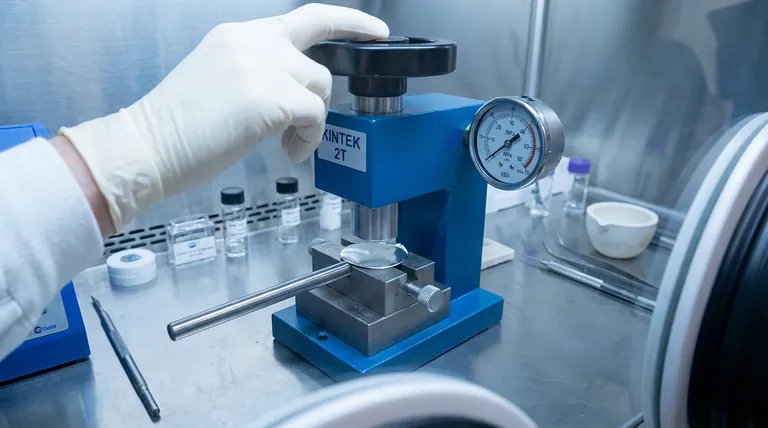
The primary purpose of using a hydraulic press in this context is to mechanically force the soft lithium or sodium metal to adhere perfectly to the steel current collector through plastic deformation. This process creates a flawless, wrinkle-free anode surface, which is the absolute prerequisite for establishing a uniform, low-resistance interface with the rigid solid electrolyte during final assembly.
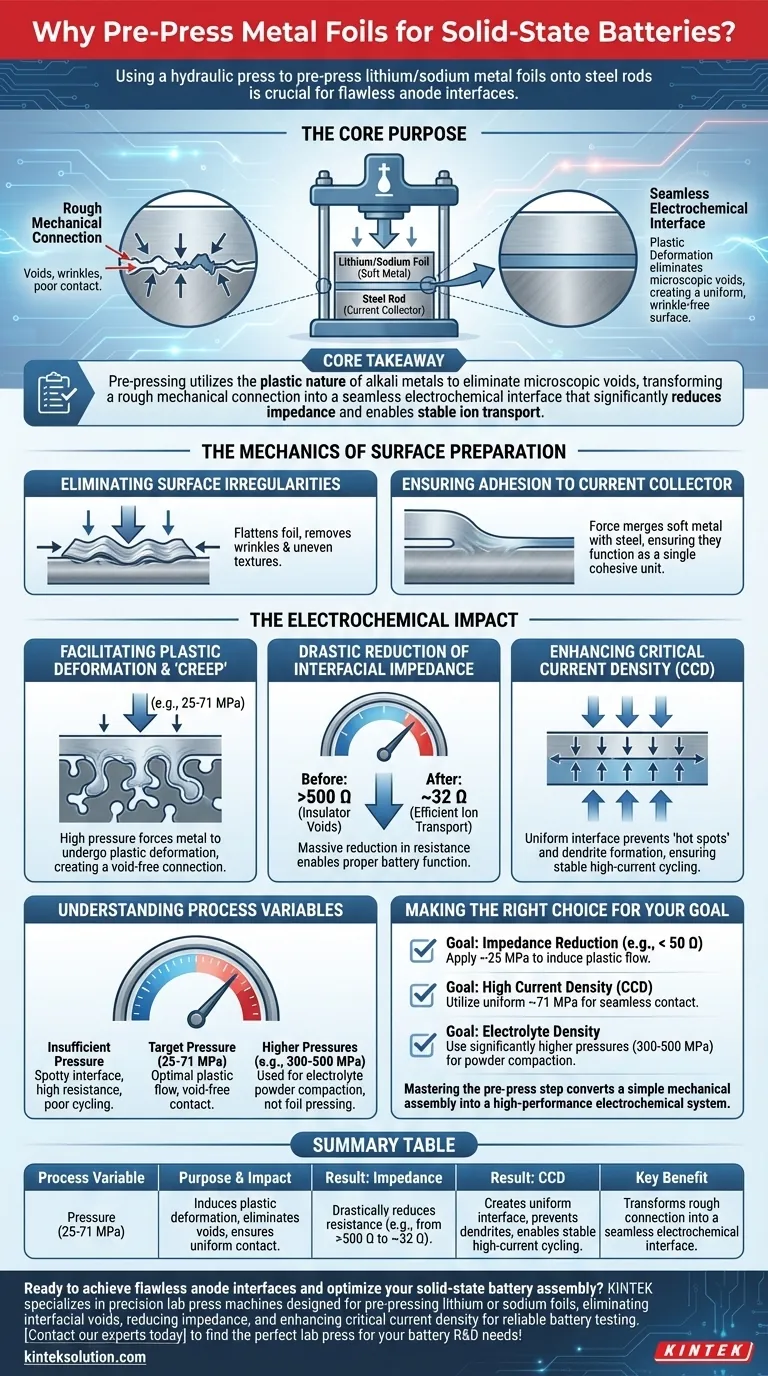
Core Takeaway Solid-state battery performance relies entirely on physical contact between rigid components. Pre-pressing utilizes the plastic nature of alkali metals to eliminate microscopic voids, transforming a rough mechanical connection into a seamless electrochemical interface that significantly reduces impedance and enables stable ion transport.
The Mechanics of Surface Preparation
Eliminating Surface Irregularities
The immediate physical goal of pre-pressing is to flatten the metal foil. Lithium and sodium foils often contain pre-existing wrinkles or uneven textures that prevent uniform contact.
By compressing the foil onto the steel rod, you eliminate these irregularities. This creates a perfectly flat, smooth geometry that is essential for the subsequent stacking steps.
Ensuring Adhesion to the Current Collector
The steel rod acts as the current collector, and it requires intimate contact with the active material (the foil) to facilitate electron flow.
The hydraulic press applies sufficient force to merge the soft metal with the steel surface. This ensures that the current collector and the anode function as a single, cohesive unit rather than two loose components.
The Electrochemical Impact
Facilitating Plastic Deformation and "Creep"
Rigid solids, such as solid-state electrolytes and metal anodes, naturally have poor interface contact. To overcome this, the metal must physically move to fill gaps.
Applying high pressure (e.g., 25 MPa to 71 MPa) forces the lithium or sodium to undergo plastic deformation. The metal effectively "creeps" into the microscopic pores and irregularities of the opposing surface, creating a void-free connection.
Drastic Reduction of Interfacial Impedance
The quality of the physical contact is directly measurable through electrical resistance. Voids and gaps act as insulators, impeding the flow of ions.
Data demonstrates that proper pressing can lower interfacial impedance from over 500 Ω to approximately 32 Ω. This massive reduction is critical for enabling efficient ion transport and proper battery function.
Enhancing Critical Current Density (CCD)
A uniform interface ensures that current is distributed evenly across the entire surface area, rather than concentrating at specific contact points.
Uniform distribution prevents "hot spots" that lead to dendrite formation or cell failure. This uniformity is fundamental for achieving high Critical Current Density (CCD) and ensuring stable, long-term cycling performance.
Understanding the Process Variables
The Role of Specific Pressure Targets
Pressure is not a "more is better" metric; it is a specific variable tailored to the material's yield point.
References indicate varying pressure requirements, such as 25 MPa for general contact improvement or up to 71 MPa for specific Li/LLZO interfaces. Conversely, electrolyte powder compaction requires significantly higher pressures (300–500 MPa), highlighting the need for precision based on the specific assembly step.
The Consequence of Insufficient Pressure
If the pressure applied is too low, the metal will not plastically deform enough to fill microscopic voids.
This results in a "spotty" interface where ion transport is bottlenecked. The resulting high resistance renders electrochemical evaluation inaccurate and leads to poor cycling stability.
Making the Right Choice for Your Goal
Correctly utilizing the hydraulic press is about matching the mechanical force to your specific electrochemical objectives.
- If your primary focus is Impedance Reduction: Apply sufficient pressure (e.g., 25 MPa) to induce plastic flow in the lithium, aiming to drop interfacial resistance below 50 Ω.
- If your primary focus is High Current Density (CCD): Utilize higher uniform pressures (e.g., ~71 MPa) to ensure a seamless, void-free contact that prevents current localization and dendrite nucleation.
- If your primary focus is Electrolyte Density: distinct from the foil pressing step, use significantly higher pressures (300–500 MPa) to compact powders into dense pellets before introducing the anode.
Mastering the pre-press step converts a simple mechanical assembly into a high-performance electrochemical system.
Summary Table:
| Process Variable | Purpose & Impact |
|---|---|
| Pressure (25-71 MPa) | Induces plastic deformation in the soft metal to eliminate voids and ensure uniform contact with the steel rod current collector. |
| Result: Impedance | Drastically reduces interfacial resistance (e.g., from >500 Ω to ~32 Ω), enabling efficient ion transport. |
| Result: Critical Current Density (CCD) | Creates a uniform interface for even current distribution, preventing dendrites and enabling stable, high-current cycling. |
| Key Benefit | Transforms a rough mechanical connection into a seamless electrochemical interface, which is a prerequisite for solid-state battery function. |
Ready to achieve flawless anode interfaces and optimize your solid-state battery assembly?
KINTEK specializes in precision lab press machines, including automatic and heated hydraulic presses, designed to deliver the exact pressures (e.g., 25 MPa to 71 MPa) required for pre-pressing lithium or sodium foils. Our equipment helps researchers like you eliminate interfacial voids, reduce impedance, and enhance critical current density for reliable, high-performance battery testing.
Contact our experts today to find the perfect lab press for your battery R&D needs!
Visual Guide
Related Products
- Automatic High Temperature Heated Hydraulic Press Machine with Heated Plates for Lab
- Manual Heated Hydraulic Lab Press with Integrated Hot Plates Hydraulic Press Machine
- Heated Hydraulic Press Machine with Heated Plates for Vacuum Box Laboratory Hot Press
- Laboratory Hydraulic Press 2T Lab Pellet Press for KBR FTIR
- Laboratory Hydraulic Press Lab Pellet Press Machine for Glove Box
People Also Ask
- Function of a Laboratory Hydraulic Press with Heated Platens in SSE? Enhance Battery Density & Conductivity
- What are the requirements for electrode pressing with high-viscosity ionic liquids like EMIM TFSI? Optimize Performance
- How does a laboratory heated hydraulic press facilitate PBN sample prep for WAXS? Achieve Precise X-Ray Scattering
- What are the industrial applications of heated hydraulic presses? Master Heat & Force for Precision Manufacturing
- Why is a laboratory hydraulic press with heating plates required for PLA/TEC films? Achieve Precise Sample Integrity



















