
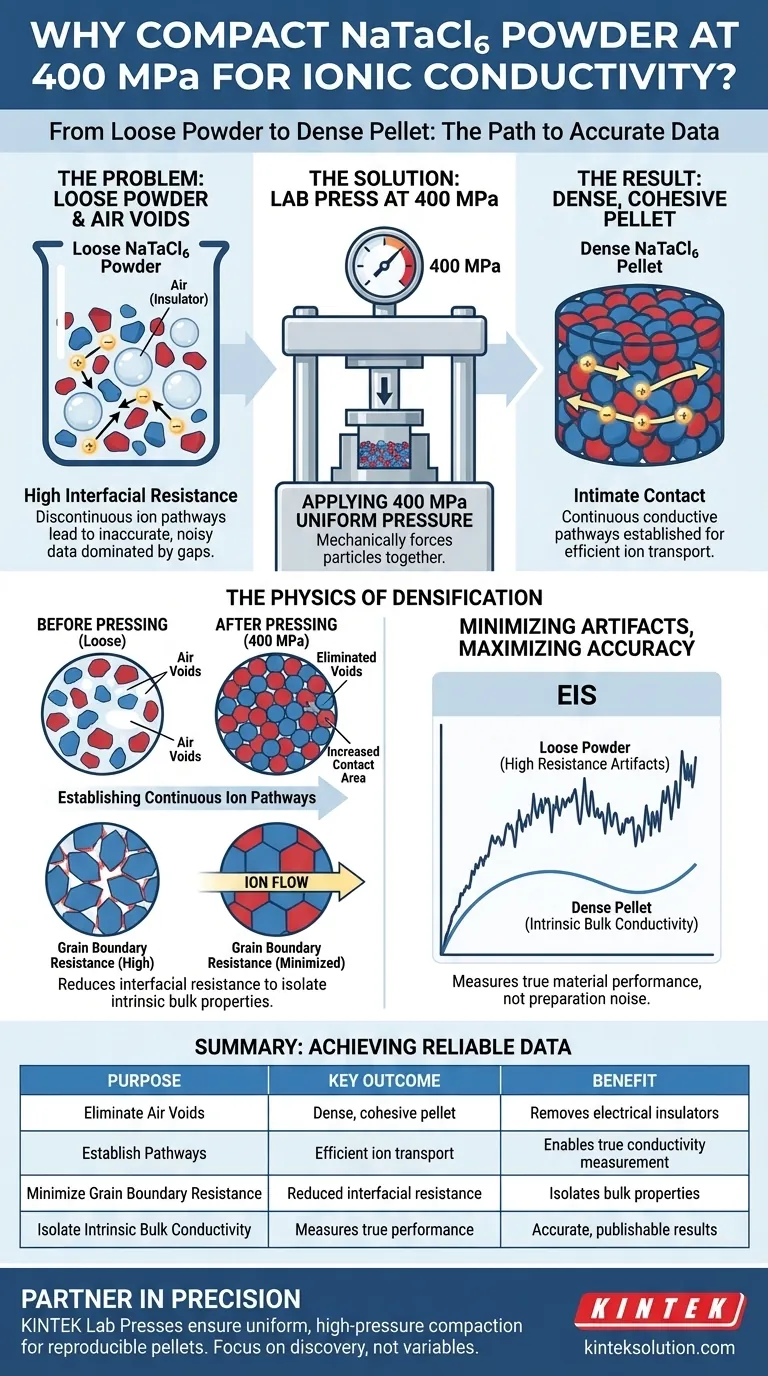
The primary purpose of using a lab press to compact NaTaCl6 powder at 400 MPa is to mechanically force loose particles into a cohesive, highly densified solid. This process eliminates air voids and creates "intimate contact" between individual grains.
By densifying the sample, you minimize the physical gaps that would otherwise impede ion movement. This ensures that the subsequent Electrochemical Impedance Spectroscopy (EIS) reading measures the material's actual properties, rather than the resistance caused by the air and poor contact between loose particles.
Core Insight: Measuring loose powder inevitably results in data dominated by high interfacial resistance (gaps between particles). High-pressure compaction creates a continuous conductive pathway, allowing you to isolate the intrinsic bulk conductivity of the electrolyte—the true measure of its performance.

The Physics of Densification
To understand why this step is non-negotiable, you must look at the microscopic structure of the sample before and after pressing.
Eliminating Voids and Porosity
Loose NaTaCl6 powder consists of discrete particles separated by pockets of air (voids). Air is an electrical insulator.
If you attempt to measure conductivity without pressing, the ions cannot travel effectively from one particle to the next. Applying 400 MPa of pressure crushes these voids, significantly increasing the packing density of the material.
Establishing Continuous Ion Pathways
For ions to move through a solid electrolyte, they require a physical bridge between particles.
The hydraulic press forces the particle surfaces together. This increases the active contact area, creating continuous pathways for lithium or sodium ions to transport through the sample. Without this mechanical bridge, ionic flow is physically interrupted.
Minimizing Resistance Artifacts
The goal of your experiment is to measure the electrolyte's chemistry, not the quality of your sample preparation. The lab press removes external variables that skew data.
Reducing Grain Boundary Resistance
In polycrystalline materials, "grain boundaries" are the interfaces where different crystals meet.
In a loose or strictly lightly pressed powder, these boundaries exhibit extremely high electrical resistance because the contact is poor. By applying high pressure, you minimize this interfacial contact resistance.
Isolating Intrinsic Bulk Conductivity
When the grain boundary resistance is minimized, the total resistance measured by the EIS is primarily determined by the bulk material itself.
This allows you to calculate the "intrinsic" conductivity. If the pressure is too low, the grain boundary resistance will overshadow the bulk resistance, leading to artificially low conductivity values that do not reflect the true potential of the NaTaCl6.
Critical Considerations for Consistency
While the pressure itself is vital, how it is applied affects the reproducibility of your data.
The Necessity of Uniform Pressure
The lab press does not just apply force; it applies it uniformly across the die.
Uneven pressure results in density gradients within the pellet. This means ions would travel faster through dense regions and slower through porous regions, resulting in noisy or unrepeatable data.
The Pressure Threshold
References indicate that pressures around 250 to 400 MPa are often required for these metal halide electrolytes.
Applying insufficient pressure (e.g., hand-tightening a cell) fails to reach the relative density (often >80%) required to mimic a solid ceramic body. The 400 MPa target is specifically chosen to maximize density without crushing the crystal structure of the electrolyte itself.
Making the Right Choice for Your Goal
To ensure your NaTaCl6 research is publishable and accurate, you must align your preparation method with your measurement goals.
- If your primary focus is determining material potential: You must use high pressure (approx. 400 MPa) to eliminate porosity artifacts and reveal the true intrinsic bulk conductivity.
- If your primary focus is comparing different electrolyte batches: You must maintain a strictly consistent pressure across all samples to ensure that variations in conductivity are due to chemical differences, not varying densities.
Summary: You use the lab press to mechanically remove the "noise" of inter-particle gaps, ensuring your data reflects the chemistry of the NaTaCl6 rather than the geometry of the powder.
Summary Table:
| Purpose | Key Outcome |
|---|---|
| Eliminate Air Voids | Creates a dense, cohesive pellet from loose powder |
| Establish Continuous Pathways | Enables efficient ion transport between particles |
| Minimize Grain Boundary Resistance | Reduces interfacial resistance that skews data |
| Isolate Intrinsic Bulk Conductivity | Ensures EIS measures the material's true performance, not preparation noise |
Accurate data starts with precise sample preparation.
Ensure your solid electrolyte research measures true material potential, not preparation artifacts. KINTEK's lab presses—including automatic, isostatic, and heated models—deliver the uniform, high-pressure compaction (up to 400 MPa and beyond) required to achieve dense, reproducible pellets for reliable ionic conductivity measurements.
Let KINTEK be your partner in precision. Our expertise in laboratory pressing solutions helps researchers like you eliminate variables and focus on discovery. Contact our team today to find the perfect press for your lab's needs.
Visual Guide
Related Products
- Laboratory Hydraulic Split Electric Lab Pellet Press
- Automatic Laboratory Hydraulic Press Lab Pellet Press Machine
- Manual Laboratory Hydraulic Pellet Press Lab Hydraulic Press
- Laboratory Hydraulic Press 2T Lab Pellet Press for KBR FTIR
- Manual Laboratory Hydraulic Press Lab Pellet Press
People Also Ask
- What are the emerging trends in the design and materials of lab pellet presses? Modernize Your Lab Efficiency
- How do lab pellet presses support customization and flexibility? Optimize Your Sample Prep for Any Material
- What are common lab pellet press issues? Expert Troubleshooting Guide for Reliable Material Research
- What are the common operational types of lab pellet presses? Choosing the Right Manual, Automatic, or Hydraulic System
- Why use a laboratory pellet press for solid-state battery evaluation? Ensure Accuracy in Interface Stability Testing















