
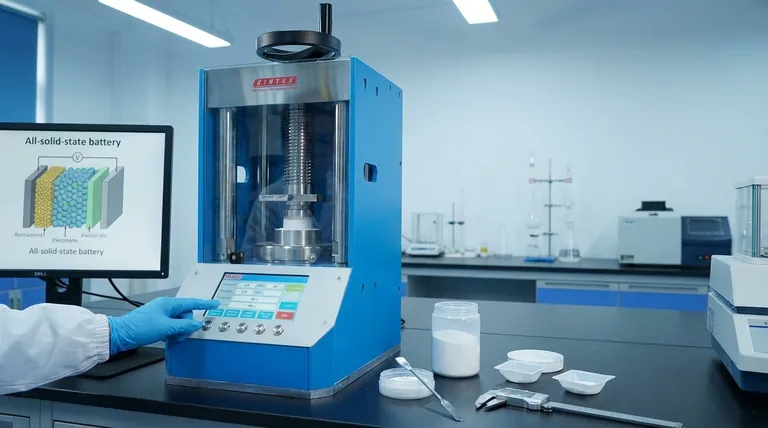
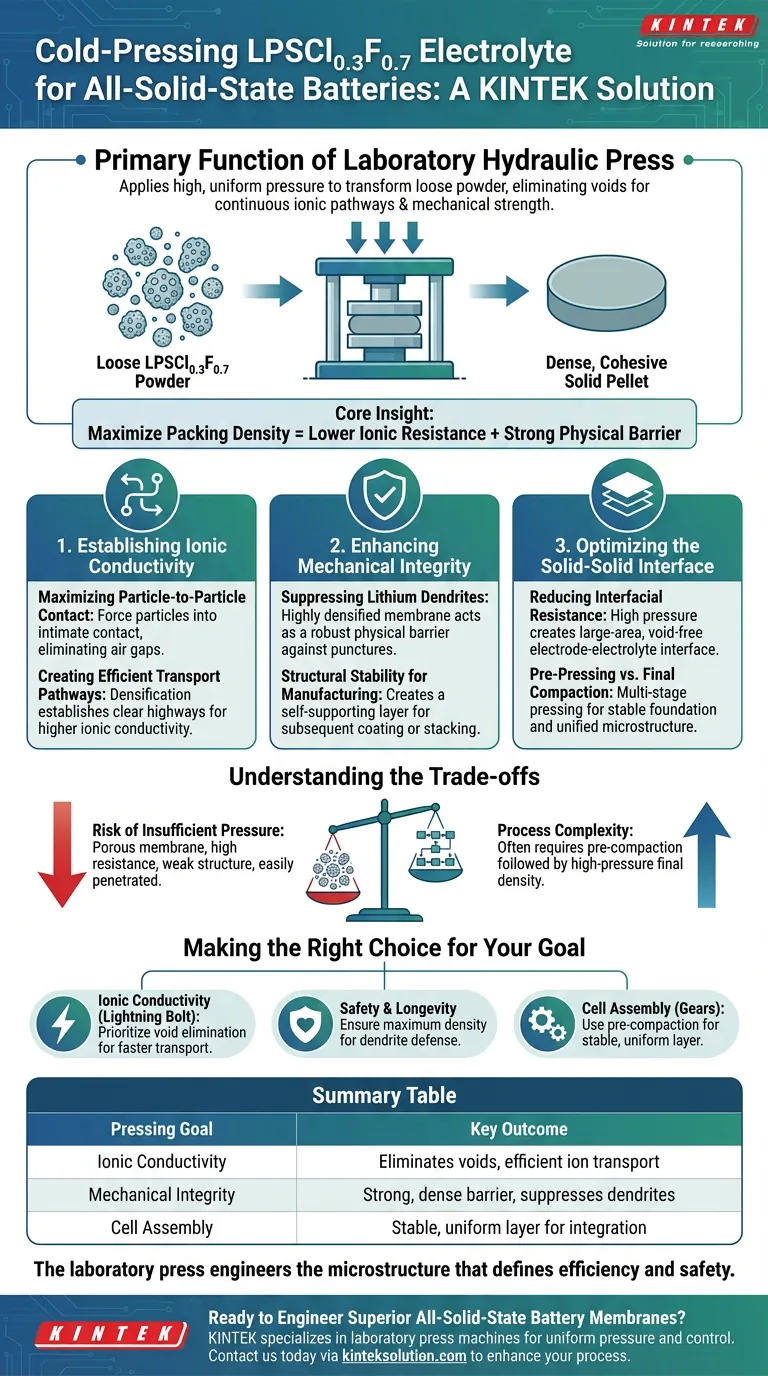
The primary function of using a laboratory hydraulic press for cold-pressing LPSCl₀.₃F₀.₇ electrolyte powder is to apply high, uniform pressure to transform loose powder into a dense, cohesive solid pellet. This process eliminates voids between particles, establishing the continuous ionic pathways and mechanical strength required for a functional all-solid-state battery membrane.
Core Insight: The hydraulic press serves as the bridge between raw material and functional device. By maximizing packing density, the press simultaneously lowers ionic resistance and creates a physical barrier strong enough to suppress lithium dendrite penetration, ensuring both battery performance and safety.
1. Establishing Ionic Conductivity
The most immediate goal of cold-pressing is to optimize the internal structure of the electrolyte layer.
Maximizing Particle-to-Particle Contact
Loose LPSCl₀.₃F₀.₇ powder contains significant air gaps and voids. These voids act as insulators, blocking the movement of lithium ions.
The hydraulic press applies sufficient pressure to force particles into intimate contact. This eliminates porosity and creates a continuous, void-free network essential for ion transport.
Creating Efficient Transport Pathways
High conductivity relies on a direct path.
By densifying the powder, you establish clear "highways" for ionic movement. This directly results in higher ionic conductivity for the membrane, which is a prerequisite for high-performance battery cells.
2. Enhancing Mechanical Integrity
Beyond conductivity, the physical strength of the membrane is critical for the battery's longevity and safety.
Suppressing Lithium Dendrites
A major failure mode in solid-state batteries is the growth of lithium dendrites—metallic filaments that can puncture the separator and cause short circuits.
A highly densified membrane acts as a robust physical barrier. The enhanced mechanical strength achieved through cold-pressing suppresses the initiation and penetration of these dendrites, significantly improving the safety profile of the battery.
Structural Stability for Manufacturing
The membrane must handle the stresses of subsequent manufacturing steps.
Pressing creates a self-supporting, mechanically stable layer. This allows for the subsequent coating of anode layers or the stacking of other components without the membrane crumbling or deforming.
3. Optimizing the Solid-Solid Interface
The hydraulic press is not just for making pellets; it is crucial for integrating the electrolyte with electrodes.
Reducing Interfacial Resistance
In solid-state batteries, the interface between the electrode and the electrolyte is a common bottleneck for energy flow.
Applying high pressure (e.g., up to 480 MPa in some assembly stages) creates a large-area, void-free interface. This ensures smooth lithium-ion transport between layers, which is vital for the battery's rate capability and cycling stability.
Pre-Pressing vs. Final Compaction
The process often involves multi-stage pressing.
For example, a "pre-press" step (such as at 125 MPa) prepares a stable foundation for layering. A final, higher-pressure compaction ensures that the cathode, electrolyte, and anode layers form a unified, dense microstructure with no interlayer mixing or shifting.
Understanding the Trade-offs
While pressure is essential, the application must be precise to avoid diminishing returns or damage.
The Risk of Insufficient Pressure
If the pressure is too low, the membrane remains porous.
This leads to high internal resistance and a weak structure that is easily penetrated by dendrites. The "green body" (the compacted powder) will lack the structural integrity needed for transfer to sintering furnaces or further assembly.
Process Complexity
Cold pressing is not always a "one-and-done" step.
Achieving the ideal density often requires a specific sequence: pre-compacting to settle the powder, followed by high-pressure uniaxial pressing to finalize the density. Skipping the pre-compaction step can lead to uneven layers or shifting components.
Making the Right Choice for Your Goal
To maximize the effectiveness of your LPSCl₀.₃F₀.₇ membrane, tailor your pressing strategy to your specific objective.
- If your primary focus is Ionic Conductivity: Prioritize eliminating voids to maximize particle contact; a denser pellet directly correlates to lower resistance and faster ion transport.
- If your primary focus is Safety and Longevity: Ensure you achieve high mechanical strength through maximum density, as this is your primary defense against lithium dendrite penetration.
- If your primary focus is Cell Assembly: Use a pre-compaction step to stabilize the layer, ensuring a flat, uniform surface for subsequent electrode coatings.
Ultimately, the laboratory press is not just shaping powder; it is engineering the microstructure that defines the efficiency and safety of your all-solid-state battery.
Summary Table:
| Pressing Goal | Key Outcome for LPSCl₀.₃F₀.₇ Membrane |
|---|---|
| Ionic Conductivity | Eliminates voids, creates continuous pathways for efficient ion transport. |
| Mechanical Integrity | Provides a strong, dense barrier to suppress lithium dendrite penetration. |
| Cell Assembly | Creates a stable, uniform layer for reliable integration with electrodes. |
Ready to Engineer Superior All-Solid-State Battery Membranes?
The precise, high-pressure compaction described is critical for your research success. KINTEK specializes in laboratory press machines—including automatic, isostatic, and heated lab presses—designed to deliver the uniform pressure and control needed to fabricate dense LPSCl₀.₃F₀.₇ electrolyte pellets with optimal ionic conductivity and mechanical strength.
Contact us today via our [#ContactForm] to discuss how our presses can enhance your battery development process and help you achieve breakthrough performance and safety.
Visual Guide
Related Products
- Laboratory Hydraulic Press Lab Pellet Press Machine for Glove Box
- Laboratory Hydraulic Press 2T Lab Pellet Press for KBR FTIR
- 24T 30T 60T Heated Hydraulic Lab Press Machine with Hot Plates for Laboratory
- Laboratory Hydraulic Press Lab Pellet Press Button Battery Press
- Laboratory Hydraulic Pellet Press for XRF KBR FTIR Lab Press
People Also Ask
- How does a laboratory hydraulic press contribute to the preparation of Li3-3xScxSb samples? Optimize Ionic Conductivity
- What is the function of a laboratory hydraulic press in FT-IR of curcumin-coated MWCNTs? Achieve Optical Clarity.
- Why is a laboratory hydraulic press required for compression molding boron-siloxane? Solve High-Loading Density Challenges
- What role does a laboratory hydraulic press play in reaction pellets? Optimizing Lunar Soil and Metal Fuel Density
- What role does a laboratory hydraulic press play in the preparation of piezoelectric ceramic discs for DC-PG? | KINTEK



















