
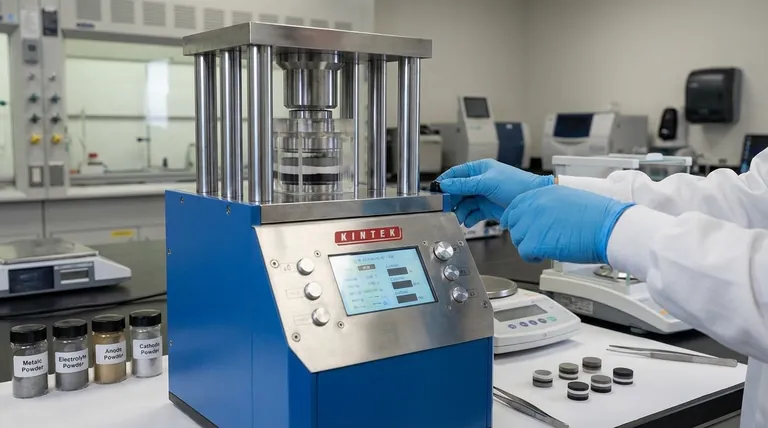
The primary purpose of utilizing a laboratory hydraulic press for pre-compaction is to transform loose, layered powders into a mechanically stable, cohesive structure known as a "green body." By applying precise initial pressure, the press increases packing density and locks the distinct functional layers (anode, electrolyte, cathode) into place, preventing material intermixing or shifting during subsequent handling.
Pre-compaction is not merely about shaping materials; it is the fundamental mechanism for eliminating voids and minimizing interfacial impedance. Without this mechanical densification, solid-state batteries suffer from poor "point contacts" that severely restrict ion transport and electrochemical performance.
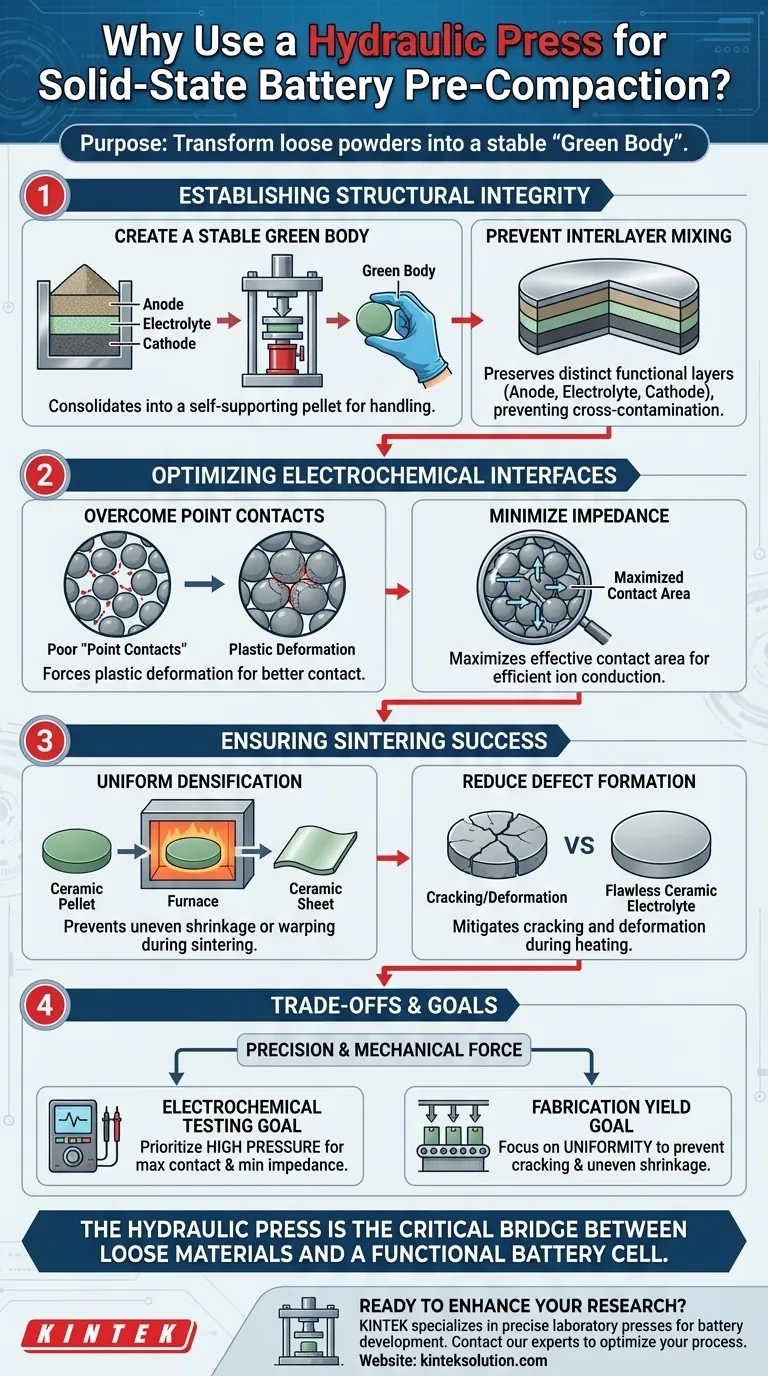
Establishing Structural Integrity
Creating a Stable Green Body
The immediate goal of pre-compaction is to consolidate loose powders into a self-supporting pellet, often referred to as a green body. This step provides the necessary mechanical strength for the assembly to withstand transfer to a sintering furnace without crumbling.
Preventing Interlayer Mixing
When building a multilayered cell, preserving the distinctness of each functional layer is critical. Pre-compacting the first layer creates a flat, defined substrate before the second powder layer is added. This ensures a sharp interface and prevents the materials from cross-contaminating or delaminating during the fabrication process.
Optimizing Electrochemical Interfaces
Overcoming Point Contact Limitations
Rigid materials, such as garnet electrolytes, naturally struggle to form connections with electrodes, leading to high-resistance "point contacts." Hydraulic pressing forces plastic deformation in softer materials (like lithium metal), making them flow into microscopic depressions on the electrolyte surface.
Minimizing Interfacial Impedance
The application of high pressure (often ranging from 40 to 250 MPa) is essential to maximize the effective contact area between particles. This intimate, void-free contact lowers the battery's total internal resistance, creating a continuous pathway for efficient ion conduction.
Ensuring Sintering Success
Uniform Densification
Applying precise pressure (e.g., 10 MPa for initial forming) ensures the "green pellet" has a uniform density profile before it enters high-temperature processing. A consistent initial density is vital for preventing uneven shrinkage or warping during the sintering phase.
Reducing Defect Formation
Proper pre-compaction mitigates common structural failures such as cracking or deformation during heating. By minimizing internal porosity early in the process, the hydraulic press sets the stage for obtaining a final ceramic electrolyte sheet that is both dense and highly conductive.
Understanding the Trade-offs
The Necessity of Precision
While high pressure is required to densify the material, the application must be highly controlled. The process aims to eliminate porosity, but the pressure must be uniform to avoid inducing stress gradients that could lead to fractures in brittle solid electrolytes.
Mechanical Force vs. Intrinsic Contact
It is important to recognize that solid-state batteries rely on mechanical force to substitute for the natural "wetting" action of liquid electrolytes. If the applied pressure is insufficient, the interface remains porous, leading to high impedance; however, this mechanical bonding is only a precursor to the chemical bonding achieved during sintering.
Making the Right Choice for Your Goal
- If your primary focus is electrochemical testing: Prioritize high-pressure compaction to maximize interfacial contact and minimize impedance for stable measurements.
- If your primary focus is fabrication yield: Focus on the uniformity of the pre-compaction step to prevent cracking, delamination, and uneven shrinkage during the sintering process.
Ultimately, the hydraulic press acts as the critical bridge between loose raw materials and a functional, high-performance solid-state battery cell.
Summary Table:
| Purpose of Pre-Compaction | Key Benefit |
|---|---|
| Establish Structural Integrity | Creates a self-supporting pellet (green body) for handling. |
| Prevent Interlayer Mixing | Ensures sharp, distinct interfaces between anode, electrolyte, and cathode layers. |
| Optimize Electrochemical Interfaces | Maximizes contact area to minimize impedance and enable efficient ion transport. |
| Ensure Sintering Success | Promotes uniform densification and reduces defects like cracking during heating. |
Ready to enhance your solid-state battery research with precise and reliable compaction?
KINTEK specializes in laboratory press machines, including automatic lab presses and heated lab presses, designed to meet the exacting demands of battery development. Our equipment delivers the uniform pressure control essential for creating stable, high-performance cells.
Contact our experts today to discuss how our lab presses can optimize your pre-compaction process and accelerate your R&D.
Visual Guide
Related Products
- Laboratory Hydraulic Press Lab Pellet Press Button Battery Press
- Warm Isostatic Press for Solid State Battery Research Warm Isostatic Press
- Laboratory Hydraulic Pellet Press for XRF KBR FTIR Lab Press
- Laboratory Hydraulic Press 2T Lab Pellet Press for KBR FTIR
- Laboratory Hydraulic Press Lab Pellet Press Machine for Glove Box
People Also Ask
- How is a laboratory hydraulic press used for HAP composite gels? Master Mineral Substrate Standardization
- What role does a laboratory hydraulic press play in the preparation of piezoelectric ceramic discs for DC-PG? | KINTEK
- What role does a laboratory hydraulic press play in reaction pellets? Optimizing Lunar Soil and Metal Fuel Density
- Why is a laboratory hydraulic press required for PBAT and PLA sample preparation? Achieve Flawless Characterization
- What role does a laboratory hydraulic press play in the assembly of all-solid-state battery test cells? Expert Guide



















