
The primary function of a laboratory hydraulic press in this context is to consolidate loose LATP powder into a cohesive, distinct shape known as a "green pellet" via cold pressing. This mechanical compaction is necessary to establish the initial density and structural integrity required for the material to survive and succeed during the subsequent high-temperature sintering process.
By applying precise uniaxial pressure, the hydraulic press minimizes void space between particles to ensure intimate physical contact. This pre-densification is the critical foundation for achieving a final ceramic electrolyte with high density, low porosity, and optimal lithium-ion conductivity.
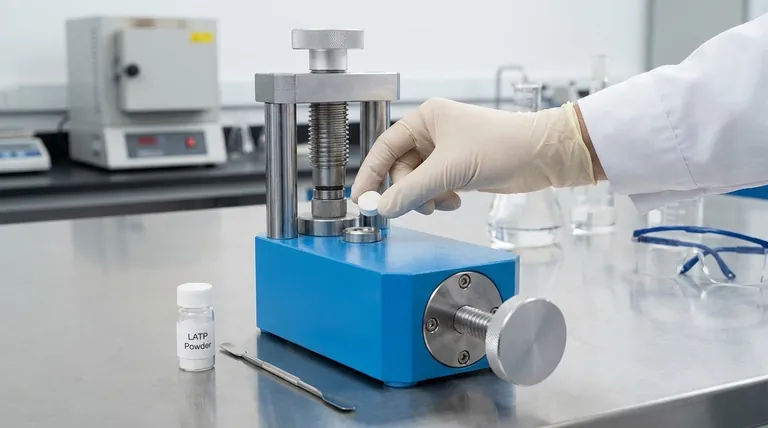
The Mechanics of Densification
The transformation from loose powder to a functional solid electrolyte begins with mechanical force. The hydraulic press serves as the bridge between raw chemical synthesis and physical application.
Particle Rearrangement and Void Reduction
When LATP powder is loaded into a die, the particles are loosely arranged with significant air gaps. The hydraulic press applies uniaxial pressure (often tens or hundreds of megapascals).
This pressure forces the particles to slide past one another into a tighter packing arrangement. As pressure increases, it significantly reduces the volume of inter-particle voids.
Plastic Deformation
At higher pressures, the powder particles may undergo plastic deformation. This means the particles physically deform to fill the remaining gaps, increasing the contact area between grains.
This "intimate contact" is vital for the material's cohesive strength. It ensures that the pellet holds its shape when removed from the die.
Establishing "Green Strength"
The immediate output of the press is a "green body" or "green pellet." It is not yet a ceramic; it is a compacted powder block.
The press ensures this green body has sufficient mechanical strength to be handled, measured, and transferred to a furnace without crumbling or breaking.
Optimizing for High-Temperature Sintering
The quality of the pressing step directly dictates the success of the sintering (heating) stage. You cannot fix a poorly pressed pellet in the furnace.
Controlling Shrinkage
During sintering, the material will shrink as it densifies further. If the initial pressing was uneven or too loose, the shrinkage will be unpredictable.
A uniform green pellet ensures uniform shrinkage. This prevents the final ceramic sheet from warping or becoming geometrically distorted.
Preventing Structural Defects
A primary cause of failure in solid electrolytes is cracking during the heating or cooling phases.
By creating a dense, uniform green body, the hydraulic press effectively reduces the risk of macroscopic defects, such as large cracks or laminations, that ruin the sample.
The Ultimate Goal: Ionic Conductivity
For LATP (a lithium-ion conductor), the physical structure is directly linked to its electrochemical performance.
Maximizing Final Density
The goal of LATP is to conduct ions. Ions travel through the material, not through air pockets.
A well-pressed pellet leads to a sintered ceramic with high relative density and low porosity. This provides a continuous "highway" for lithium ions to move efficiently.
Reducing Grain Boundary Resistance
The resistance to ion flow often occurs at the boundaries where particles meet.
By forcing intimate physical contact between grains during pressing, you facilitate better grain growth during sintering. This lowers the grain boundary resistance, enabling accurate measurement of the material's intrinsic conductivity.
Understanding the Trade-offs: Uniformity vs. Pressure
While high pressure is generally beneficial for density, it must be applied correctly to avoid damaging the sample.
The Risk of Density Gradients
Uniaxial pressing (pressure from one direction) can create density gradients. The edges of the pellet may be denser than the center due to friction with the die walls.
If the gradient is too steep, the pellet may warp during sintering as different parts shrink at different rates.
Over-Pressing and Capping
Applying excessive pressure can lead to "capping" or lamination. This occurs when air trapped inside the powder is compressed and then expands violently when the pressure is released.
This results in the top of the pellet shearing off or internal cracks forming perpendicular to the pressing direction. Finding the "sweet spot"—often around 10 MPa to several hundred MPa depending on the specific powder morphology—is essential.
Making the Right Choice for Your Goal
The specific pressure and technique you use should align with your end-goal for the LATP material.
- If your primary focus is Conductivity Testing: Prioritize higher pressures (within limits) to maximize relative density and minimize grain boundary resistance for the most accurate electrochemical data.
- If your primary focus is Material Stability: Focus on lower, more gradual pressure application to ensure a defect-free, uniform green body that will sinter without warping or cracking.
The hydraulic press is not just a shaping tool; it is a density-engineering device that sets the ceiling for the potential performance of your solid-state electrolyte.
Summary Table:
| Purpose | Key Outcome |
|---|---|
| Initial Densification | Creates a cohesive "green pellet" with structural integrity for sintering. |
| Void Reduction | Minimizes air gaps between particles for intimate contact. |
| Uniform Shrinkage | Ensures predictable, even densification during sintering to prevent warping. |
| Defect Prevention | Reduces risk of cracks and laminations for a flawless final ceramic. |
| Ionic Conductivity | Establishes a dense, continuous pathway for optimal lithium-ion flow. |
Ready to perfect your LATP pellet pressing process?
KINTEK's precision laboratory presses, including our automatic and heated lab presses, are engineered to deliver the uniform pressure and control essential for creating high-density, defect-free solid electrolytes. Our expertise ensures you achieve the optimal green density required for superior sintering results and maximum ionic conductivity.
Contact our lab press experts today to discuss how KINTEK can enhance your solid-state battery research.
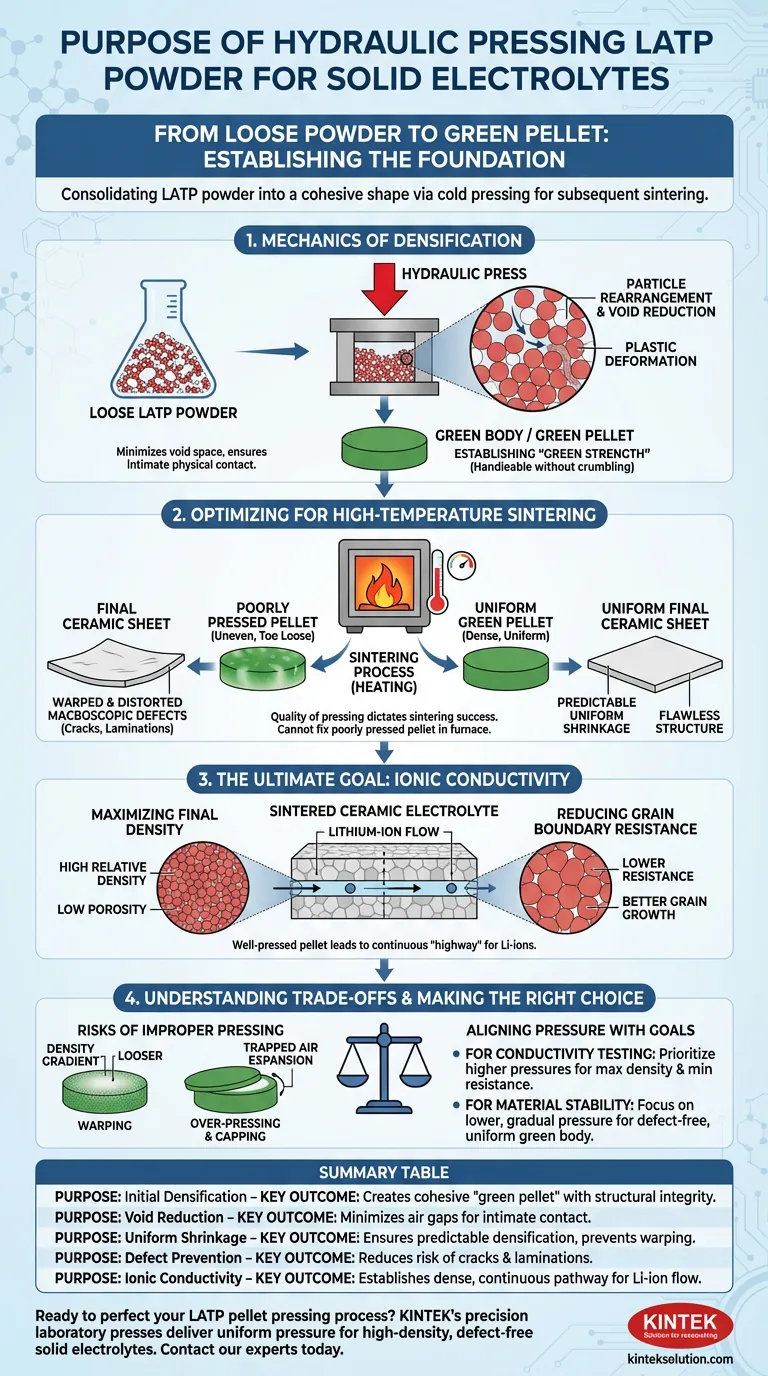
Visual Guide
Related Products
- Automatic Laboratory Hydraulic Press Lab Pellet Press Machine
- Manual Laboratory Hydraulic Pellet Press Lab Hydraulic Press
- Laboratory Hydraulic Pellet Press for XRF KBR FTIR Lab Press
- Laboratory Hydraulic Press Lab Pellet Press Machine for Glove Box
- Laboratory Hydraulic Press Lab Pellet Press Button Battery Press
People Also Ask
- What is the primary purpose of a manual lab hydraulic pellet press? Ensure Accurate Sample Prep for XRF and FTIR
- What is the primary purpose of manual lab hydraulic pellet presses? Achieve High-Precision Sample Preparation for Spectroscopy
- What are the technical advantages of an automatic laboratory hydraulic press for biomimetic surfaces?
- How does an automatic laboratory hydraulic press improve KBr pellet preparation? Achieve Precision IR Spectroscopy
- What are the advantages of using an automatic laboratory hydraulic press? Enhance Precision in Sample Preparation



















