
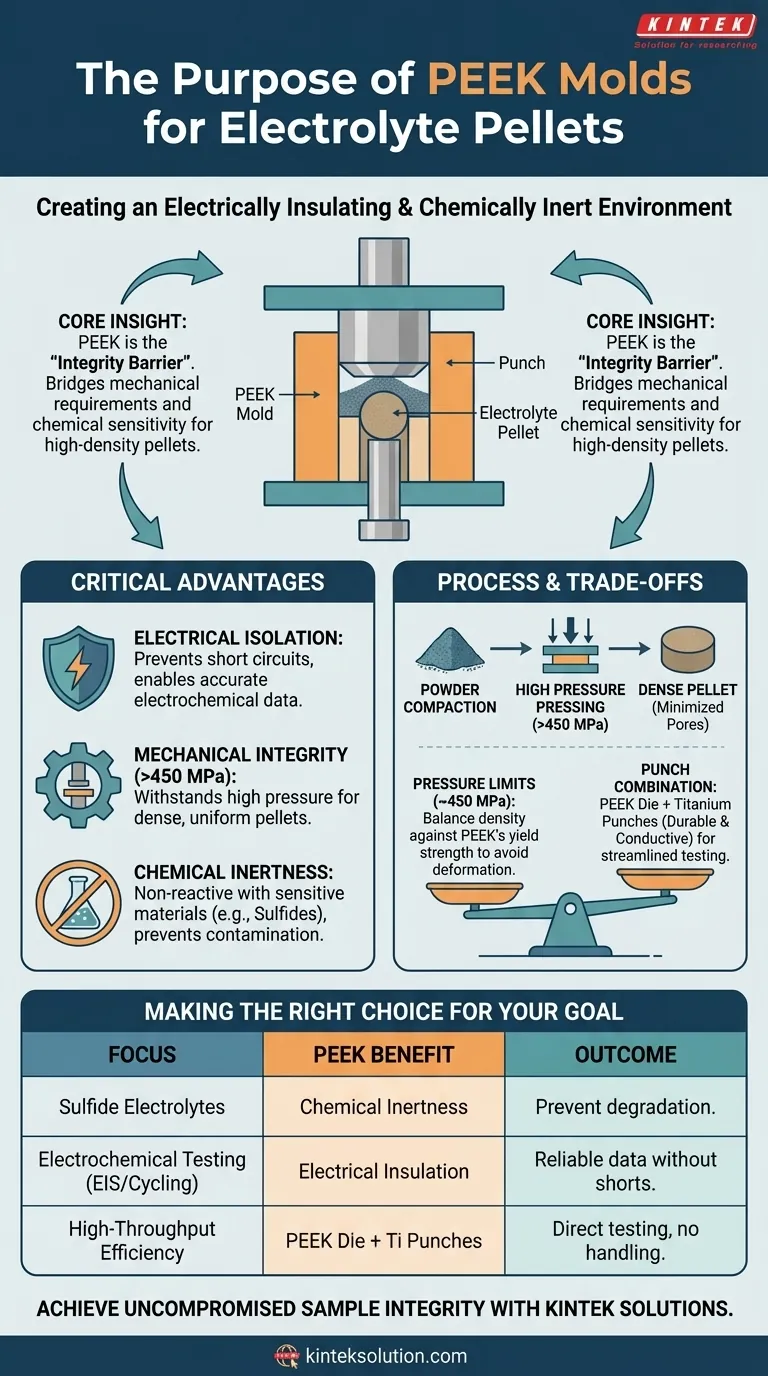
The primary purpose of using a Polyetheretherketone (PEEK) mold is to create an electrically insulating and chemically inert environment for pressing electrolyte pellets. It ensures that the high pressure required for densification—often exceeding 450 MPa—can be applied without causing short circuits, contaminating the sample, or chemically reacting with sensitive materials like sulfide electrolytes.
Core Insight: PEEK acts as a critical "integrity barrier" in electrochemical testing. It bridges the gap between mechanical requirements and chemical sensitivity, allowing researchers to achieve high-density pellets without the electrical interference or contamination risks inherent to metallic molds.
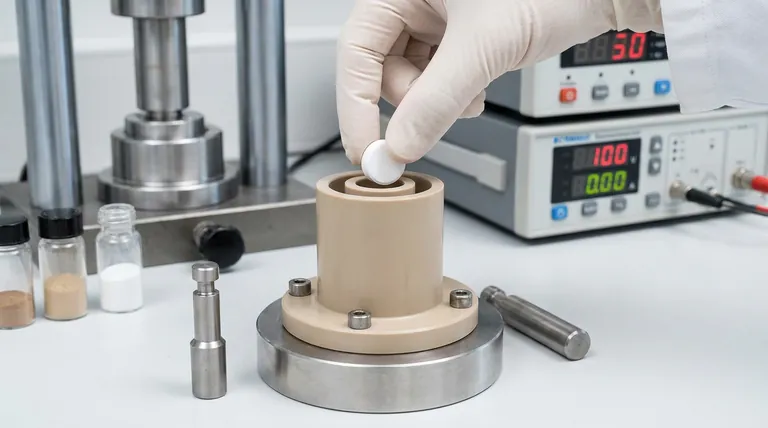
The Critical Advantages of PEEK
To understand why PEEK is the industry standard for this application, one must look at how it solves the specific challenges of solid-state battery research.
Electrical Isolation
The most immediate benefit of PEEK is its excellent electrical insulation.
When pressing pellets for electrochemical characterization, metal molds pose a significant risk of creating short circuits between the punches or the sample and the die.
PEEK eliminates this risk entirely, preventing unwanted electrochemical reactions during the compaction phase.
Mechanical Integrity Under Load
Despite being a polymer, PEEK possesses exceptional mechanical strength.
It can withstand the high-pressure forming processes required to densify electrolytes, commonly handling loads around 450 MPa without significant deformation or damage.
This rigidity ensures the mold maintains its geometry, producing a uniform pellet with consistent dimensions.
Chemical Inertness
PEEK is chemically stable and non-reactive, which is vital when working with highly active materials.
For example, sulfide electrolytes are notoriously reactive; a standard metal mold could degrade the sample surface or introduce metallic contaminants.
PEEK prevents this contamination, ensuring that the measured properties reflect the intrinsic behavior of the electrolyte, not a reaction byproduct.
The Role of High Pressure in Pellet Formation
The choice of mold material is dictated by the rigorous demands of the pressing process itself.
Minimizing Grain Boundary Resistance
To construct high-performance solid-state batteries, researchers use hydraulic presses to compact loose powder into a high-density pellet.
This process minimizes inter-particle pores and ensures intimate physical contact between grains.
Achieving this density is the only way to effectively reduce grain boundary resistance and accurately measure the material's ionic conductivity.
Creating Standalone Separators
Uniaxial pressing creates a dense, standalone separator pellet with sufficient structural integrity to be handled.
This allows the electrolyte to be assembled with a composite cathode later.
The goal is to isolate the cathode's performance, which requires a separator that is mechanically sound and free of defects.
Understanding the Trade-offs
While PEEK is superior for electrochemical compatibility, it requires specific handling compared to hardened steel dies.
Pressure Limitations
While PEEK is strong (handling up to ~450 MPa), it is not indestructible.
Extremely high pressures (e.g., pushing toward 600 MPa or higher for specific ceramics) may approach the material's yield strength.
Operators must balance the need for density against the mechanical limits of the polymer to avoid permanent deformation of the die.
The Role of Punches
PEEK is typically used as the die body (the sleeve), but it is often paired with Titanium punches.
Titanium is durable enough for effective pressure transmission but can also serve as a non-reactive current collector.
This combination allows the pellet to be pressed and immediately tested without removing it from the assembly, streamlining the experimental workflow.
Making the Right Choice for Your Goal
Selecting the correct mold configuration is essential for valid data.
- If your primary focus is working with Sulfide Electrolytes: Prioritize PEEK specifically for its chemical inertness to prevent immediate degradation of your sample.
- If your primary focus is Electrochemical Testing (EIS/Cycling): Rely on PEEK to provide the electrical insulation necessary to prevent short circuits during the pressing and testing phases.
- If your primary focus is High-Throughput Efficiency: Utilize PEEK dies with Titanium punches to transition directly from pressing to testing without handling the fragile pellet.
By using PEEK, you prioritize the chemical and electrical purity of your sample, ensuring your data represents the true performance of the material.
Summary Table:
| Feature | Benefit for Electrolyte Pellet Pressing |
|---|---|
| Electrical Insulation | Prevents short circuits during pressing and testing, ensuring accurate electrochemical data. |
| Chemical Inertness | Protects sensitive materials (e.g., sulfide electrolytes) from contamination and reaction with the mold. |
| High Mechanical Strength | Withstands pressures >450 MPa to create dense, uniform pellets without significant deformation. |
| Material Integrity | Produces standalone separator pellets with minimal grain boundary resistance for reliable conductivity measurements. |
Achieve Uncompromised Sample Integrity in Your Solid-State Battery Research
Accurate electrochemical testing starts with a perfectly pressed pellet. KINTEK specializes in laboratory press solutions, including configurations with PEEK molds and titanium punches, designed specifically for the demands of solid-state electrolyte research.
Our expertise ensures you can:
- Prevent Sample Contamination: Chemically inert PEEK molds protect sensitive materials like sulfide electrolytes.
- Eliminate Electrical Shorts: Insulating molds enable reliable EIS and cycling data.
- Streamline Your Workflow: Optimize your process from pressing to testing without handling fragile pellets.
Ready to enhance the reliability of your data? Contact KINTEK today to discuss your specific lab press and mold requirements.
Visual Guide
Related Products
- Laboratory Hydraulic Split Electric Lab Pellet Press
- Lab XRF Boric Acid Powder Pellet Pressing Mold for Laboratory Use
- Automatic Laboratory Hydraulic Press for XRF and KBR Pellet Pressing
- XRF KBR Plastic Ring Lab Powder Pellet Pressing Mold for FTIR
- Automatic Laboratory Hydraulic Press Lab Pellet Press Machine
People Also Ask
- What are the emerging trends in the design and materials of lab pellet presses? Modernize Your Lab Efficiency
- What are common lab pellet press issues? Expert Troubleshooting Guide for Reliable Material Research
- How do lab pellet presses support customization and flexibility? Optimize Your Sample Prep for Any Material
- What are the common operational types of lab pellet presses? Choosing the Right Manual, Automatic, or Hydraulic System
- Why use a laboratory pellet press for solid-state battery evaluation? Ensure Accuracy in Interface Stability Testing



















