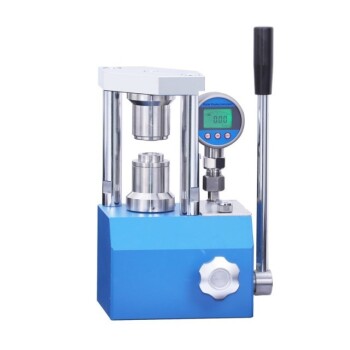
The primary purpose of precision stainless steel spacers is to function as mechanical limiters and reliable thickness gauges within a laboratory hydraulic press. By inserting spacers of a specific, known height into the assembly, you establish a physical stop point for the compression. This allows researchers to dictate the exact final thickness of a compacted cathode sheet rather than relying solely on applied pressure.
Core Takeaway Spacers transform electrode compaction from a variable process into a reproducible science. By mechanically locking the final thickness, they ensure the geometric consistency required for accurate calculations of volumetric energy density and interfacial impedance.
The Science of Controlled Compaction
Achieving Batch-to-Batch Consistency
In experimental research, reproducibility is paramount. Without spacers, slight variations in hydraulic pressure or material flow can lead to electrodes of varying thicknesses.
Using precision spacers eliminates this variable. They ensure that every electrode sheet produced across different batches maintains identical physical dimensions.
The Foundation for Energy Density Calculations
To calculate volumetric energy density, you must know the precise volume of your active material. Volume is a product of area and thickness.
If the thickness varies or is uncertain, your energy density data becomes unreliable. Spacers provide a fixed, known thickness value, ensuring your mathematical models are based on accurate physical inputs.
Evaluating Interfacial Impedance
The performance of a battery relies heavily on the interface between the electrode and the electrolyte.
Accurate evaluation of interfacial impedance requires a consistent electrode structure. By controlling the thickness using spacers, you ensure uniform compaction and contact, preventing geometric irregularities from skewing your impedance data.
Operational Considerations and Trade-offs
Mechanical Constraints
While spacers define the final thickness, they do not control the density of the material if the input mass varies.
You must still precisely weigh your starting material. If the mass varies but the volume (thickness) is fixed by the spacer, the resulting porosity and density will fluctuate.
Equipment Safety
Spacers are subjected to significant force in a hydraulic press.
It is critical to ensure the spacers are made of high-quality stainless steel to withstand the pressure without deforming. Additionally, the press plates and spacers must be kept meticulously clean; even small debris can cause uneven compression or damage the limiters.
Applying Precision to Your Research
To ensure your data is scientifically valid, choose your methodology based on your specific analytical goals:
- If your primary focus is calculating energy density: Use spacers to define a fixed geometric volume, eliminating thickness as a variable in your equations.
- If your primary focus is comparative material studies: Use spacers to ensure all samples have identical physical dimensions, so performance differences can be attributed to chemistry rather than fabrication errors.
By standardizing electrode thickness, you elevate your fabrication process from rough estimation to precise, quantifiable experimentation.
Summary Table:
| Feature | Function of Precision Spacers | Benefit to Laboratory Research |
|---|---|---|
| Mechanical Limiter | Provides a physical stop point during compression | Ensures absolute batch-to-batch consistency |
| Thickness Control | Defines the exact final height of the cathode sheet | Accurate calculation of volumetric energy density |
| Structural Uniformity | Prevents uneven material flow and compaction | Reliable evaluation of interfacial impedance |
| Data Validation | Standardizes geometric volume for all samples | Eliminates fabrication variables in comparative studies |
Elevate Your Battery Research with KINTEK Precision Solutions
Achieving scientific reproducibility requires more than just pressure; it requires precision. KINTEK specializes in comprehensive laboratory pressing solutions, offering manual, automatic, heated, multifunctional, and glovebox-compatible models, alongside cold and warm isostatic presses.
Whether you are refining cathode sheets or exploring advanced battery architectures, our high-quality hydraulic presses and precision accessories ensure your electrode compaction is a repeatable science. Contact us today to find the ideal pressing solution for your lab and unlock the accuracy your data deserves.
References
- Lowack, Ansgar, Michaelis Alexander. Feasibility study on high-energy-density almost-solid-state sodium batteries with thin ceramic Na 3.4 Zr 2 Si 2.4 P 0.6 O 12 separators. DOI: 10.34734/fzj-2025-04322
This article is also based on technical information from Kintek Solution Knowledge Base .
Related Products
- Lab Isostatic Pressing Molds for Isostatic Molding
- Warm Isostatic Press for Solid State Battery Research Warm Isostatic Press
- Split Automatic Heated Hydraulic Press Machine with Heated Plates
- Lab Double Plate Heating Mold for Laboratory Use
- Automatic High Temperature Heated Hydraulic Press Machine with Heated Plates for Lab
People Also Ask
- What is the purpose of incorporating cartridge heaters into a lab press mold for MLCC block compression? Optimize Results
- What is the function of an isostatic lab press in energy storage research? Achieve Superior Material Standardization
- How do laboratory press machines resolve increased impedance in solid-state batteries? Achieve Low-Resistance Interfaces
- How does controlling the parameters of a laboratory isostatic press contribute to reducing deformation in LTCC channels?
- What is the primary function of a laboratory isostatic press in the synthesis of nitride materials? Achieve High Density