
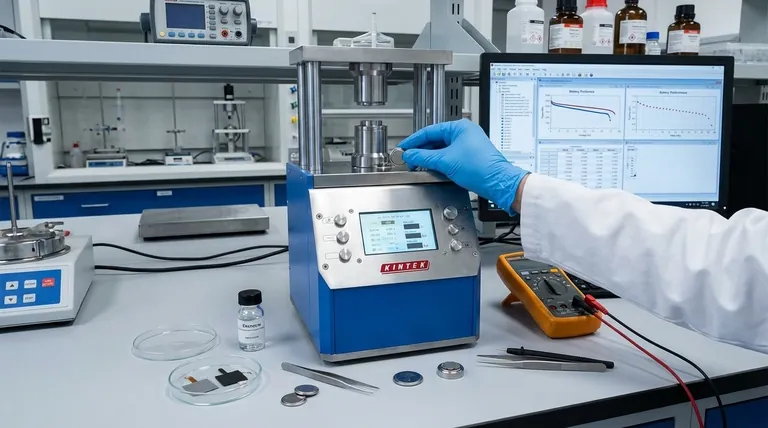
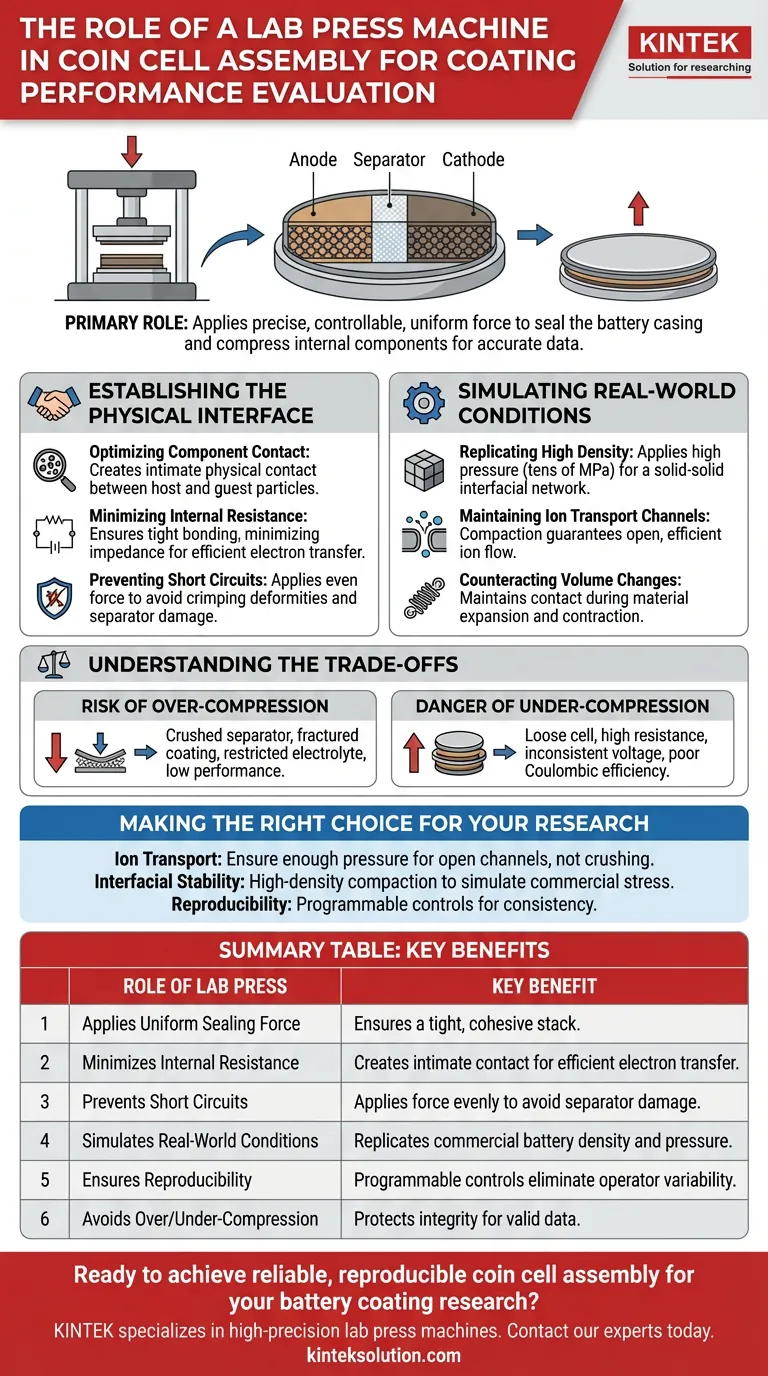
The primary role of a lab press machine in coin cell assembly is to apply precise, controllable, and uniform force to seal the battery casing while compressing the internal components. This mechanical action ensures the coated electrodes, separators, and electrolytes form a tight, cohesive stack, which is a prerequisite for generating accurate data on coating performance.
The lab press does more than simply close the cell; it eliminates variables caused by poor physical contact. By standardizing the internal pressure, the machine ensures that measured performance metrics—such as conductivity and cycling stability—reflect the true quality of your coating, rather than artifacts of a loose assembly.
Establishing the Physical Interface
Optimizing Component Contact
Reliable battery performance depends entirely on the movement of ions and electrons. A lab press applies sufficient force to create intimate physical contact between the host particles of the electrode and the guest particles of the coating.
Minimizing Internal Resistance
Without the uniform pressure provided by the press, gaps may exist between the active material and the current collector. These gaps create high impedance. The press ensures these layers are tightly bonded, minimizing internal resistance and allowing for efficient electron transfer.
Preventing Short Circuits
Precision is critical during the sealing process. The lab press applies force evenly across the cell surface. This prevents the "crimping" deformities that can pierce the separator and cause short circuits, which would immediately invalidate the test.
Simulating Real-World Conditions
Replicating High Density
To evaluate how a coating will perform in a commercial battery, you must simulate the dense, compacted state of a real electrode. The lab press can apply high pressure (often tens of megapascals) to force coated particles into a solid-solid interfacial network.
Maintaining Ion Transport Channels
During assembly, the pressure sets the baseline for the cell's internal structure. This compaction guarantees that ion transport channels remain open and efficient. This is particularly vital when testing solid-state interfaces, where rigidity can otherwise impede ion flow.
Counteracting Volume Changes
Battery materials often expand and contract during cycling. The initial pressure applied by the lab press helps maintain contact even as materials shift. This ensures that interface separation does not occur, maintaining the integrity of the cell over long-term testing.
Understanding the Trade-offs
The Risk of Over-Compression
While pressure is essential, excessive force can be detrimental. Over-compressing the cell during assembly can crush the porous structure of the separator or fracture the electrode coating. This leads to restricted electrolyte flow and artificially low performance data.
The Danger of Under-Compression
Conversely, insufficient pressure results in a "loose" cell. This causes high contact resistance and inconsistent voltage curves. If the press does not apply enough force, the resulting data will show poor Coulombic efficiency that is due to assembly error, not a failure of the coating itself.
Making the Right Choice for Your Research
To ensure your coin cell assembly validates your coating effectively, consider your specific testing goals:
- If your primary focus is Ion Transport: Ensure the press applies enough pressure to guarantee open transport channels without crushing the separator pores.
- If your primary focus is Interfacial Stability: Use the press to achieve a high-density compaction that simulates the mechanical stress of a commercial cell stack.
- If your primary focus is Reproducibility: Prioritize a machine with programmable, automated pressure controls to eliminate operator variability between batches.
The lab press is the gatekeeper of your data integrity; it transforms a collection of raw components into a standardized scientific instrument capable of delivering the truth about your materials.
Summary Table:
| Role of Lab Press | Key Benefit |
|---|---|
| Applies Uniform Sealing Force | Ensures a tight, cohesive stack of components. |
| Minimizes Internal Resistance | Creates intimate contact between layers for efficient electron transfer. |
| Prevents Short Circuits | Applies force evenly to avoid separator damage. |
| Simulates Real-World Conditions | Replicates commercial battery density and pressure. |
| Ensures Reproducibility | Programmable controls eliminate operator variability. |
| Avoids Over/Under-Compression | Protects electrode and separator integrity for valid data. |
Ready to achieve reliable, reproducible coin cell assembly for your battery coating research?
KINTEK specializes in high-precision lab press machines (including automatic, isostatic, and heated lab presses) designed specifically for laboratory environments. Our equipment provides the precise, controllable pressure essential for generating accurate data on coating performance, helping you validate your materials with confidence.
Contact our experts today to discuss how a KINTEK lab press can enhance your research integrity and efficiency.
Visual Guide
Related Products
- 24T 30T 60T Heated Hydraulic Lab Press Machine with Hot Plates for Laboratory
- Manual Heated Hydraulic Lab Press with Integrated Hot Plates Hydraulic Press Machine
- Laboratory Split Manual Heated Hydraulic Press Machine with Hot Plates
- Automatic Heated Hydraulic Press Machine with Hot Plates for Laboratory
- Automatic High Temperature Heated Hydraulic Press Machine with Heated Plates for Lab
People Also Ask
- Function of a Laboratory Hydraulic Press with Heated Platens in SSE? Enhance Battery Density & Conductivity
- Why is a laboratory hydraulic press with heating plates required for PLA/TEC films? Achieve Precise Sample Integrity
- What role does a laboratory heated hydraulic press play in LTCC? Essential for High-Density Ceramic Lamination
- What is the primary function of a laboratory heated hydraulic press? Mastering Thermoplastic Carbon Fiber Composites
- Why is a laboratory heated hydraulic press utilized during the lamination stage of NASICON green tapes?



















