
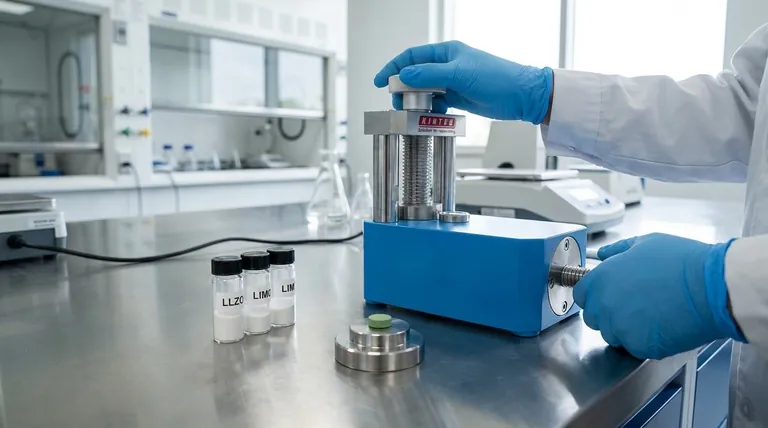
The primary function of a laboratory hydraulic press in solid-state battery research is to transform loose powders—such as LLZO, LIM, or LATP—into dense, mechanically stable "green" pellets through precise uniaxial compaction. By applying high pressure, often reaching 370 MPa or approximately 8 tons, the press mechanically eliminates void spaces to establish the physical connectivity required for electrochemical performance.
The critical engineering objective is not just shaping the material, but achieving maximum densification. Without the uniform elimination of porosity at this stage, it is impossible to create the continuous particle networks necessary for high ionic conductivity.
The Mechanics of Densification
Eliminating Internal Porosity
The immediate goal of applying hydraulic pressure is to force loose powder particles into a tightly packed configuration.
This process significantly reduces the voids (air pockets) between particles. Minimizing these voids is the first step in creating a solid electrolyte that approaches the theoretical density of the material.
Maximizing Contact Area
For a solid-state battery to function, lithium ions must move physically from one particle to the next.
High-pressure compaction increases the inter-particle contact area. This replaces point-to-point contacts with broader surface connections, reducing the interfacial resistance that typically bottlenecks performance.
Creating Transport Pathways
The reduction of voids and increase in contact area create efficient, continuous pathways for lithium-ion transport.
Whether processing sulfide-based materials like Li6PS5Cl or oxide ceramics, this network is fundamental to achieving high ionic conductivity in the final cell.
The Role in the Fabrication Workflow
Formation of the "Green Pellet"
Before any thermal treatment, the press creates a "green pellet"—a compacted sample with sufficient mechanical strength to be handled.
This is a critical intermediate state. It ensures the sample remains intact and maintains its geometry during transfer to a furnace or other processing equipment.
Prerequisite for Sintering
For ceramic electrolytes like LATP or LLZO, the hydraulic press prepares the material for high-temperature sintering.
A high-density green pellet is a prerequisite for a successful sinter. If the initial packing density is too low or uneven, the final ceramic will likely suffer from cracks, warping, or residual porosity after heating.
Non-Sintered Composites
In specific applications, such as LLZTO@Polymer composites, the press fabricates the final electrolyte structure without high-temperature sintering.
Here, the pressure forces polymer-coated ceramic particles into a dense network. This establishes a conduction mechanism purely through mechanical consolidation, making the press the defining tool for the material's final electrochemical properties.
Common Pitfalls to Avoid
Inconsistent Pressure Application
The references emphasize the need for uniform pressure distribution.
If pressure is applied unevenly, the pellet will have density gradients. This leads to weak spots that impede ion flow and creates structural vulnerabilities that can cause failure during battery cycling.
Insufficient Compaction Force
Achieving high ionic conductivity requires substantial force (e.g., 350–370 MPa).
Using a press incapable of reaching these specific thresholds will result in a "soft" pellet with high internal porosity. This directly correlates to poor lithium-ion transport and high internal resistance.
Making the Right Choice for Your Goal
To maximize the utility of your hydraulic press, align your pressing parameters with your downstream processing requirements:
- If your primary focus is High-Temperature Sintering: Prioritize achieving a high-density "green pellet" to prevent cracking and defects during the subsequent heating phase.
- If your primary focus is Non-Sintered/Polymer Composites: Focus on applying maximum uniform pressure to force particle coating contact, as this mechanical network determines your final conductivity.
- If your primary focus is Material Handling: Ensure the press delivers enough force to provide the mechanical strength needed to move samples without breakage, even if full densification occurs later.
The laboratory hydraulic press is not merely a shaping tool; it is the instrument that defines the microstructural integrity and ultimate efficiency of your solid-state electrolyte.
Summary Table:
| Aspect | Role of the Hydraulic Press | Key Benefit |
|---|---|---|
| Densification | Applies high pressure (up to 370 MPa) to eliminate porosity | Creates continuous ion transport pathways |
| Green Pellet Formation | Compacts powders into mechanically stable pre-sintered pellets | Ensures sample integrity for handling and sintering |
| Contact Area | Maximizes inter-particle contact by forcing tight packing | Reduces interfacial resistance for higher ionic conductivity |
| Workflow Integration | Serves as a critical step before sintering or for composite fabrication | Defines the final microstructure and electrochemical performance |
Ready to fabricate high-performance solid-state electrolyte pellets with precision? KINTEK's advanced laboratory hydraulic presses—including automatic, isostatic, and heated models—are engineered to deliver the uniform, high-pressure compaction (up to 370 MPa) required for dense, ion-conductive materials like LLZO and LIM. Whether you're sintering ceramics or developing polymer composites, our presses ensure maximum densification and reproducibility. Contact our experts today to discuss how KINTEK can optimize your solid-state battery research workflow.
Visual Guide

Related Products
- Laboratory Hydraulic Press 2T Lab Pellet Press for KBR FTIR
- Automatic Laboratory Hydraulic Press for XRF and KBR Pellet Pressing
- Laboratory Hydraulic Pellet Press for XRF KBR FTIR Lab Press
- Laboratory Hydraulic Split Electric Lab Pellet Press
- Manual Laboratory Hydraulic Pellet Press Lab Hydraulic Press
People Also Ask
- What is the role of a laboratory pressure machine and KBr in FTIR? Master Sample Preparation for Flame Retardants
- What is the role of a laboratory hydraulic press in high-loading NCM811 cathode prep for solid-state batteries?
- Why is a laboratory hydraulic press necessary for sample preparation? Precise Pelleting for Spiro Heterocyclic Analysis
- What role does a laboratory hydraulic press play in reaction pellets? Optimizing Lunar Soil and Metal Fuel Density
- How does a laboratory hydraulic press ensure repair performance? Master Self-Healing CFRP Molding with Precision



















