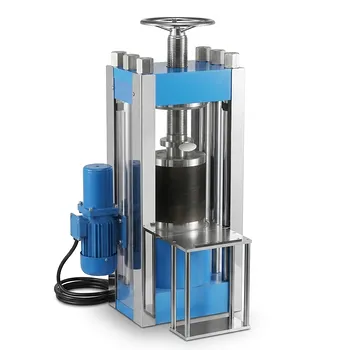
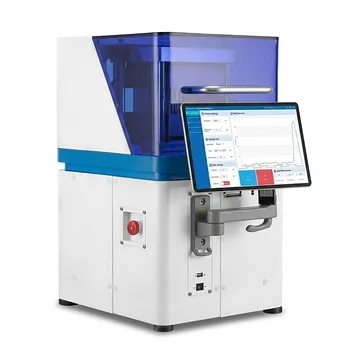
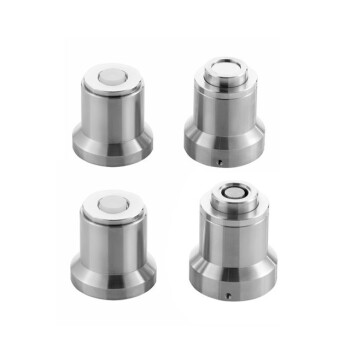
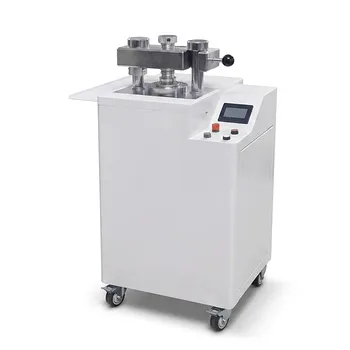
The laboratory press is the critical instrument used to transform loose powder materials into dense, functional solid electrolyte films and to establish the necessary physical contact between battery layers. By applying precise, uniform axial pressure—often reaching several hundred megapascals—the press eliminates internal voids and forces solid particles into intimate contact. This mechanical compaction is essential for creating the low-resistance pathways required for efficient ion transport and long-term electrochemical stability.
The primary role of a laboratory press in battery fabrication is to maximize material density and minimize interfacial impedance through controlled mechanical force. This process ensures that the solid-state battery can function as a coherent electrochemical system rather than a collection of isolated particles.
Achieving Material Densification and Structural Integrity
Eliminating Internal Porosity
Solid electrolyte powders, such as LLZO or LAGP, naturally contain significant air gaps and voids when first placed in a mold. A laboratory press applies high static pressure to compact these powders into dense ceramic pellet membranes or green bodies. This reduction in porosity is fundamental to lowering grain boundary resistance and preventing the growth of lithium dendrites through the electrolyte.
Creating Continuous Ion Transport Channels
For a solid-state battery to function, ions must have a continuous path to move from the anode to the cathode. High-pressure environment—sometimes exceeding 500 MPa—induces plastic deformation in the electrolyte particles. This deformation allows particles to merge and establish tight physical boundaries, creating efficient, high-speed channels for lithium-ion transport.
Establishing Uniform Film Thickness
The precision of an automatic laboratory press ensures that the resulting electrolyte film has a uniform thickness across its entire surface. Inconsistency in thickness can lead to uneven current distribution during battery operation, which shortens the cell's lifespan. Repeatable pressure application allows researchers to produce standardized components for reliable experimental data.
Optimizing the Solid-Solid Interface
Reducing Interfacial Impedance
One of the greatest challenges in solid-state battery design is the "point contact" problem, where solid particles only touch at small areas. The laboratory press uses physical extrusion to force the active material particles and the electrolyte layer into atomic-level or micron-level contact. This maximizes the surface area for charge transfer, significantly reducing the interfacial impedance that often hinders performance.
The Role of Thermal Pressing
During the cell assembly stage, a heated laboratory press can be used to perform thermal pressing. The combination of heat and pressure further enhances the physical bond at the interface between the solid electrolyte and the electrode. This integrated approach improves the cycling stability of the battery by ensuring the layers do not delaminate during the expansion and contraction of charging cycles.
Enhancing Rate Performance
By establishing intimate physical contact between the LATP composite solid-state electrolyte and both electrodes, the press enables higher rate performance. When the interface is tightly packed, ions can cross the boundary between materials with minimal energy loss. This allows the battery to charge and discharge more quickly without significant voltage drops.
Understanding the Trade-offs and Technical Challenges
Pressure Limits and Material Damage
While high pressure is necessary for densification, exceeding the mechanical limits of the material can cause Micro-cracking or structural failure. Brittle ceramic electrolytes may fracture if the pressure is applied too rapidly or unevenly. Finding the specific "sweet spot" for pressure is a critical step in the material characterization process.
The Risk of Non-Uniform Loading
If the press platens are not perfectly parallel or if the powder is distributed unevenly, the resulting film will have density gradients. These gradients create areas of high and low resistance within the same cell, leading to localized "hot spots" during cycling. High-quality laboratory presses mitigate this through self-leveling mechanisms and high-precision pressure control.
How to Apply This to Your Battery Project
Effective battery assembly requires matching your pressing parameters to your specific material chemistry and cell architecture.
- If your primary focus is maximizing ionic conductivity: Prioritize a high-pressure hydraulic press capable of at least 500 MPa to ensure the highest possible densification of ceramic powders.
- If your primary focus is reducing interface resistance: Utilize a heated laboratory press to facilitate thermal pressing, which encourages better adhesion between the electrolyte and the electrode layers.
- If your primary focus is prototype consistency: Invest in an automatic lab press with programmable pressure profiles to ensure every test cell is assembled with identical, repeatable force.
Mastering the mechanical compression of solid-state components is as vital to battery performance as the chemical composition of the materials themselves.
Summary Table:
| Key Role | Impact on Battery Performance |
|---|---|
| Material Densification | Eliminates porosity and prevents lithium dendrite growth. |
| Interfacial Contact | Reduces impedance by creating atomic-level contact between layers. |
| Film Uniformity | Ensures consistent current distribution and longer cell lifespan. |
| Thermal Pressing | Improves cycling stability and adhesion via heat and pressure. |
| Ion Transport | Creates continuous channels for faster lithium-ion movement. |
Elevate Your Battery Research with KINTEK Precision
Mastering mechanical compression is critical for high-performance solid-state batteries. KINTEK specializes in comprehensive laboratory pressing solutions designed for the most demanding research environments.
Our range includes:
- Manual & Automatic Hydraulic Presses for precise densification.
- Heated & Multifunctional Models to optimize interfacial bonding.
- Glovebox-Compatible Systems for air-sensitive materials.
- Cold & Warm Isostatic Presses for uniform material density.
Ready to eliminate internal voids and minimize interfacial impedance in your battery cells? Contact KINTEK today to find the perfect pressing solution for your lab!
References
- Elia Giuseppe Antonio, Zavala Sánchez, Luz. D1.2 - MATERIAL, COMPONENT AND CELL/MODULE TESTING PROTOCOLS. DOI: 10.5281/zenodo.17608902
This article is also based on technical information from Kintek Solution Knowledge Base .
Related Products
- Warm Isostatic Press for Solid State Battery Research Warm Isostatic Press
- Lab Button Battery Tablet Press Sealing Mold
- Laboratory Hydraulic Press Lab Pellet Press Button Battery Press
- Lab Infrared Press Mold for Laboratory Applications
- Carbide Lab Press Mold for Laboratory Sample Preparation
People Also Ask
- Why must composite cathodes be sealed in vacuum lamination bags for WIP? Ensure Battery Stability and Density
- How do sacrificial volume materials (SVM) maintain microchannels in isostatic pressing? Ensure Structural Integrity
- What is the function of elastic molds in warm isostatic pressing? Achieve Uniform Density in Composite Particles
- What is the process involved in warm isostatic pressing? Mastering Uniform Density with WIP Technology
- What are the advantages of using a Warm Isostatic Press (WIP) for batteries? Achieve Superior Interface Contact