
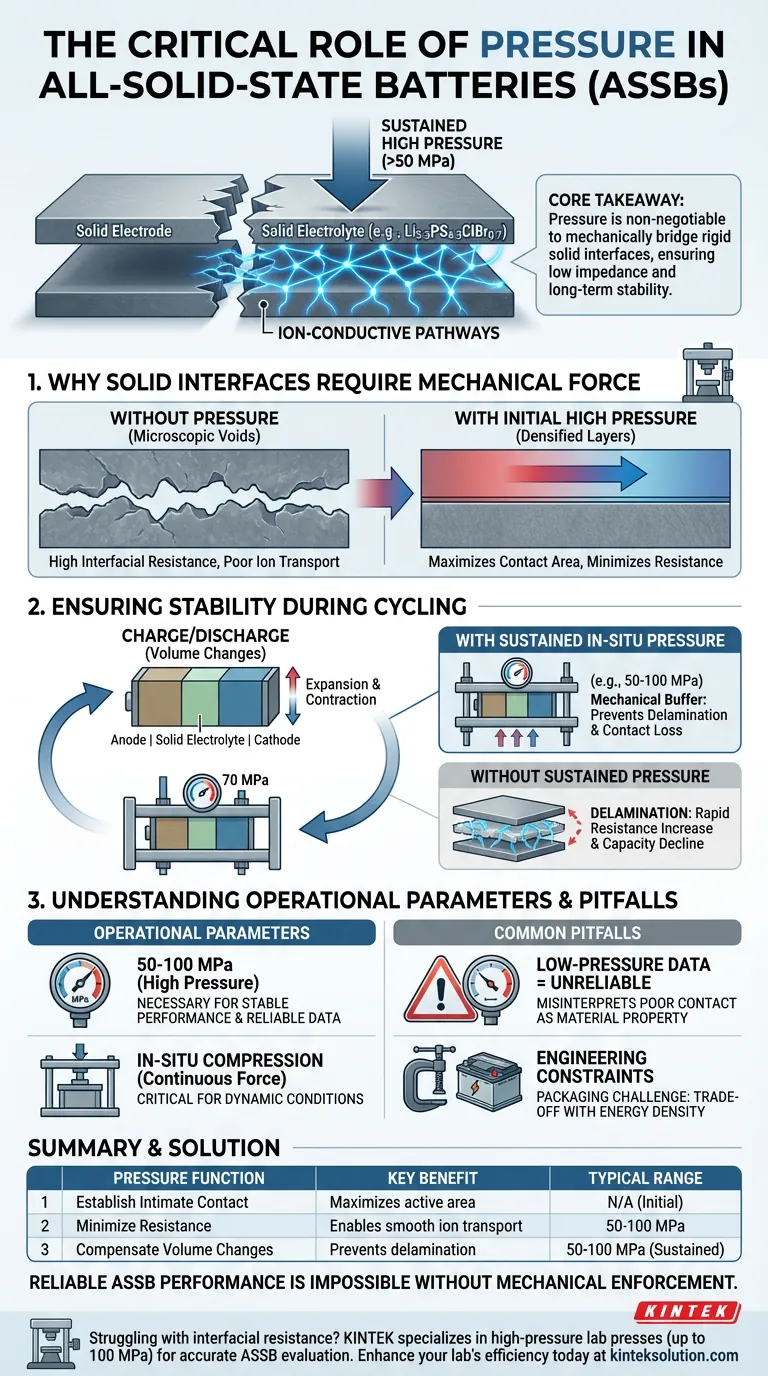
The application and maintenance of pressure is the single most critical mechanical factor in ensuring the functionality of all-solid-state batteries (ASSBs). Whether using a specific electrolyte like Li5.3PS4.3ClBr0.7 or a generic sulfide-based system, pressure forces the rigid components into intimate physical contact, minimizing interfacial resistance and compensating for electrode volume changes during cycling.
Core Takeaway Unlike liquid electrolytes that naturally wet surfaces, solid-state materials possess rigid interfaces that do not spontaneously bond. Sustained, high external pressure (often exceeding 50 MPa) is non-negotiable to mechanically bridge these gaps, ensuring the ion-conductive pathways necessary for low impedance and long-term cycle stability.
Why Solid Interfaces Require Mechanical Force
Establishing Intimate Contact
In a liquid battery, the electrolyte flows into the porous electrodes. In an ASSB, the cathode, anode, and solid electrolyte are rigid solids.
Without external force, these components merely touch at microscopic points, creating vast voids. Initial high-pressure pressing (often using a lab press) is required to densify the layers and maximize the active contact area.
Minimizing Interfacial Resistance
The primary enemy of solid-state performance is interfacial impedance.
If the solid particles are not pressed tightly together, lithium ions cannot easily hop from the electrode to the electrolyte. Applying pressure drastically reduces this resistance, enabling the smooth transport of ions required for efficient charging and discharging.
Ensuring Stability During Cycling
Compensating for Volume Changes
Battery electrodes "breathe"—they expand and contract—as lithium ions enter and exit the structure during charge and discharge cycles.
These volumetric changes can cause the electrode materials to physically pull away from the solid electrolyte. Sustained stack pressure acts as a mechanical buffer, compressing the stack to accommodate these shifts without losing connection.
Preventing Delamination
If pressure is not maintained, the repeated expansion and contraction will lead to contact loss or delamination.
Once the interface separates, the ion path is broken. This results in a rapid increase in resistance and a significant, often permanent, decline in battery capacity.
Understanding the Operational Parameters
The Necessity of High Pressure
The pressure required is substantial. References indicate that stable performance often requires pressures in the range of 50 MPa to 100 MPa.
To put this in perspective, this is significantly higher than the pressure used in conventional lithium-ion cells. This level of force is necessary to simulate the operational conditions inside a commercial package and ensure the data collected is reliable.
In-Situ Compression
Testing protocols must utilize an in-situ compression setup.
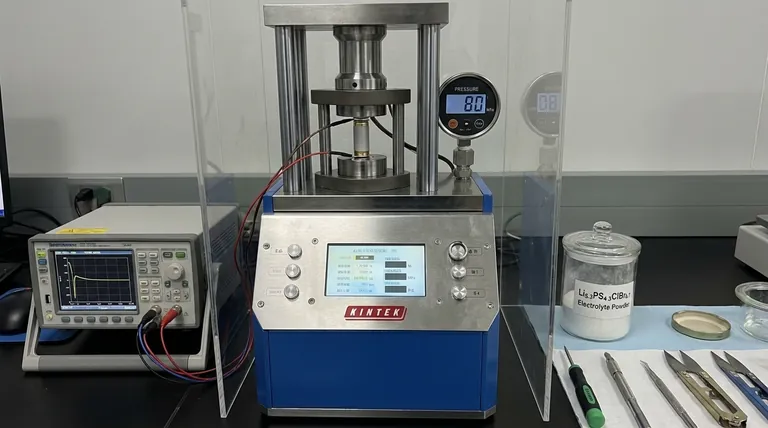
This equipment applies continuous force (e.g., 70-80 MPa) throughout the entire testing duration. Relying solely on the initial cold press is insufficient; the pressure must be active to counteract the dynamic changes occurring inside the cell during operation.
Common Pitfalls and Trade-offs
Misinterpreting Low-Pressure Data
Testing an ASSB without sufficient stack pressure yields unreliable data.
High impedance readings in a low-pressure test often reflect poor physical contact rather than the intrinsic properties of the materials (like the Li5.3PS4.3ClBr0.7 electrolyte). You cannot accurately evaluate electrochemical performance if the mechanical interface is compromised.
Engineering Constraints
While 100 MPa ensures excellent contact, maintaining such high pressure presents a packaging challenge.
In a lab setting, heavy steel clamps and hydraulic presses are used. Translating this requirement to a commercial vehicle battery pack adds weight and complexity, forcing a trade-off between optimal electrochemical performance and practical energy density.
Making the Right Choice for Your Goal
To ensure your data is valid and your device performs as intended, apply these principles:
- If your primary focus is material evaluation: Ensure you apply high initial pressure to eliminate contact resistance, so you are measuring the chemistry, not the gap.
- If your primary focus is cycle life: You must use an in-situ compression rig capable of maintaining constant pressure (e.g., 50-100 MPa) to prevent delamination caused by volume expansion.
- If your primary focus is commercial viability: Test the minimum pressure required to maintain performance, as lowering the pressure requirement reduces the engineering burden on the final battery pack.
Reliable solid-state performance is impossible without the mechanical enforcement of the electrode-electrolyte interface.
Summary Table:
| Pressure Function | Key Benefit | Typical Pressure Range |
|---|---|---|
| Establish Intimate Contact | Maximizes active contact area, reduces initial impedance | N/A (Initial Pressing) |
| Minimize Interfacial Resistance | Enables smooth ion transport for efficient charging/discharging | 50-100 MPa |
| Compensate for Volume Changes | Prevents contact loss and delamination during cycling | 50-100 MPa (Sustained) |
Struggling to achieve reliable data from your solid-state battery research due to interfacial resistance? KINTEK specializes in laboratory press machines, including automatic lab presses and isostatic presses, designed to deliver the precise, sustained high pressure (up to 100 MPa) required for accurate material evaluation and long-term cycle testing. Our equipment ensures you are measuring your electrolyte's true performance, not artifacts from poor contact. Contact us today to discuss how our solutions can enhance your lab's efficiency and accelerate your ASSB development. Reach out via our Contact Form
Visual Guide
Related Products
People Also Ask
- Why must composite cathodes be sealed in vacuum lamination bags for WIP? Ensure Battery Stability and Density
- What is the function of elastic molds in warm isostatic pressing? Achieve Uniform Density in Composite Particles
- How do sacrificial volume materials (SVM) maintain microchannels in isostatic pressing? Ensure Structural Integrity
- What is the process involved in warm isostatic pressing? Mastering Uniform Density with WIP Technology
- What is the mechanism of a Warm Isostatic Press (WIP) on cheese? Master Cold Pasteurization for Superior Safety
