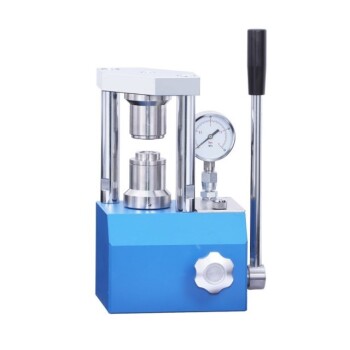
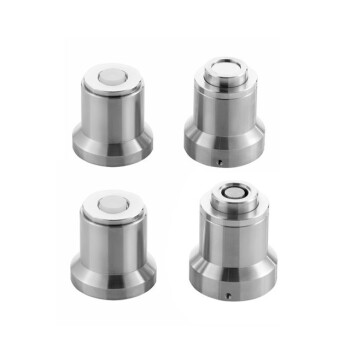
Laboratory-scale pressing and grinding equipment serves as the critical strategic bridge between theoretical material science and viable industrial manufacturing. While industrial machinery focuses on volume and consistency, laboratory-scale tools offer the agility required to rapidly prototype new battery compositions, optimize specific variables like pressure and duration, and define the foundational parameters necessary for scaling up.
The core significance lies in the distinction between discovery and production. Laboratory equipment allows researchers to isolate and perfect the "recipe"—controlling complex reaction pathways and material behaviors at a low cost—before locking those processes into the rigid, high-volume workflows of industrial machinery.
The Strategic Value of Flexibility
Rapid Prototyping and Iteration
In the early stages of battery research, the ability to pivot is essential. Laboratory-scale equipment is designed with a smaller footprint and engineered for frequent adjustments. This allows research teams to quickly test a hypothesis, analyze the result, and immediately modify the experiment without significant downtime.
Seamless Material Switching
Unlike industrial production presses or injection molding machines, which are often cumbersome to reconfigure, lab-scale tools excel at handling diverse sample types. Researchers can switch between different material compositions with minimal setup time. This capability drastically reduces the friction involved in exploring new chemistries.
Precise Parameter Optimization
The primary function of these tools is to establish the "physics" of the battery production process. They allow for the granular control of critical variables such as grinding speed, pressing pressure, and process duration. By tweaking these inputs in a controlled environment, researchers determine the optimal settings that yield the highest performance.
Cost-Effective Exploration
Low-Risk Experimentation
Industrial machinery requires significant raw material input to function correctly, making experimental failures expensive. Laboratory-scale equipment enables the exploration of complex reaction pathways using minimal material quantities. This allows for high-risk, high-reward experimentation without the financial burden of wasted bulk resources.
Establishing the Industrial Foundation
The data gathered at the laboratory scale does not stay in the lab; it dictates the specifications for the factory floor. By successfully identifying the ideal process parameters on a small scale, researchers create a data-backed roadmap. This ensures that the eventual transition to large-scale production is based on proven, optimized metrics rather than theoretical assumptions.
Understanding the Trade-offs
Throughput vs. Agility
It is important to recognize that laboratory equipment is not designed for volume. While an industrial press offers high throughput and unyielding consistency, it lacks the adaptability to change settings quickly. Conversely, lab equipment prioritizes agility over output, making it unsuitable for pilot runs where statistical volume is required.
The "Scale-Up" Gap
Perfecting a process on a lab press does not guarantee immediate success on an industrial line. While lab tools establish the foundational parameters, subtle physical differences—such as heat dissipation or pressure distribution over larger surface areas—can alter results. Researchers must treat lab data as the baseline for scaling, not the final manufacturing specification.
How to Apply This to Your Project
If your primary focus is Material Discovery:
- Prioritize laboratory equipment that offers the widest range of adjustable settings (speed, pressure) to maximize your ability to test novel compositions.
If your primary focus is Process Definition:
- Use laboratory tools to rigorously test the limits of your materials, documenting the exact "failure points" to inform future industrial safety margins.
If your primary focus is Pre-Production Scaling:
- Begin mimicking the constraints of your target industrial machinery on your lab equipment to identify potential bottlenecks before the transition.
Success in battery research depends not just on finding the right chemistry, but on defining the precise mechanical processes that make that chemistry perform.
Summary Table:
| Feature | Laboratory-Scale Equipment | Industrial-Scale Machinery |
|---|---|---|
| Primary Goal | Material discovery & optimization | High-volume production & consistency |
| Flexibility | High (Rapid prototyping & parameter tweaking) | Low (Fixed for specific workflows) |
| Material Usage | Minimal (Cost-effective experimentation) | Large quantities (High-risk for failure) |
| Throughput | Low (Small sample sizes) | High (Mass production) |
| Setup Time | Fast (Easy to switch materials) | Slow (Complex reconfiguration) |
Elevate Your Battery Research with KINTEK
Transitioning from theoretical materials to viable battery technology requires precision and agility. KINTEK specializes in comprehensive laboratory pressing solutions tailored for the rigorous demands of modern energy research.
Our range includes manual, automatic, heated, multifunctional, and glovebox-compatible models, alongside advanced cold and warm isostatic presses designed to define the foundational parameters of your production process. Whether you are in the discovery phase or optimizing for scale, our equipment provides the granular control needed to turn hypotheses into high-performance realities.
Ready to optimize your lab's capabilities? Contact us today to find the perfect pressing solution for your research goals.
References
- Muaz, Mubashir Hassan. Mechanochemical Approaches for Advancing Lithium-Ion Battery Materials: Synthesis, Processing, and Performance Enhancement. DOI: 10.21776/ub.memi.2025.002.01.5
This article is also based on technical information from Kintek Solution Knowledge Base .
Related Products
- Warm Isostatic Press for Solid State Battery Research Warm Isostatic Press
- Lab Infrared Press Mold for Laboratory Applications
- Carbide Lab Press Mold for Laboratory Sample Preparation
- Laboratory Hydraulic Press Lab Pellet Press Button Battery Press
- Button Battery Sealing Press Machine for Lab
People Also Ask
- Why must composite cathodes be sealed in vacuum lamination bags for WIP? Ensure Battery Stability and Density
- What is the function of elastic molds in warm isostatic pressing? Achieve Uniform Density in Composite Particles
- How do sacrificial volume materials (SVM) maintain microchannels in isostatic pressing? Ensure Structural Integrity
- What are the advantages of using a Warm Isostatic Press (WIP) for batteries? Achieve Superior Interface Contact
- What is the mechanism of a Warm Isostatic Press (WIP) on cheese? Master Cold Pasteurization for Superior Safety