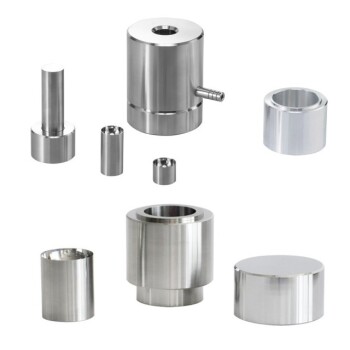
Precise pressure control is the mechanical foundation of reliable electrochemical testing. In the assembly of lithium or magnesium coin cells—particularly when using advanced materials like Melem-PDI coated electrodes—a laboratory press ensures tight physical contact between the active material, separator, and metal foil current collector. This mechanical standardization is essential for minimizing ohmic internal resistance and establishing a hermetic seal.
The core function of standardized assembly pressure is to eliminate contact resistance as a variable, ensuring that your test data reflects the true intrinsic properties of your active materials rather than the quality of the assembly.
The Physics of Interface Contact
Minimizing Ohmic Internal Resistance
The primary goal of the laboratory press is to force the battery components into a unified stack.
By applying precise pressure, you ensure the active material and the current collector maintain tight physical contact. This directly reduces contact resistance, facilitating efficient charge transfer during operation.
Enhancing Electrolyte Wetting
Effective assembly is not just about dry components touching; it involves the electrolyte as well.
The physical compression process helps the electrolyte sufficiently wet the porous framework structure of the electrodes. This ensures that ion transport channels are fully established before testing begins.
Managing Magnetic Interference
In specialized setups, such as magnetic-field-assisted batteries, external magnets can cause internal components to shift.
A high-precision press counters this magnetic attraction, maintaining uniform mechanical contact despite the interference. This prevents internal structural displacement that would otherwise skew performance data.
Data Integrity and Reproducibility
Isolating Intrinsic Material Performance
Your testing goal is usually to evaluate the chemistry of a specific material, such as a Melem-PDI coated electrode.
If assembly pressure varies between cells, the resulting data on specific capacity and cycle stability will fluctuate. Standardized pressure ensures the results reflect the intrinsic electrochemical performance of the material, not the inconsistency of the crimp.
Ensuring Structural Stability
During long-term cycling, battery components can experience physical stress and volume changes.
Stable pressure ensures the cathode, separator, and anode remain tightly bonded throughout the battery's life. This prevents "structural loosening," which is a common cause of premature failure in cycle life tests.
Hermetic Sealing and Environmental Protection
Preventing Electrolyte Leakage
The sealing machine applies radial pressure to the battery casing to deform the gasket and lock the case.
Precise control here provides a rigorous seal that prevents the volatile electrolyte from evaporating or leaking out. Loss of electrolyte immediately degrades cell performance and renders test data void.
Blocking Moisture and Air Ingress
Lithium and magnesium are highly reactive to moisture and oxygen.
A proper crimp creates a hermetic barrier that isolates internal components from the external environment. This is critical for preventing side reactions that occur when external air or moisture breaches the cell.
Understanding the Trade-offs
The Risk of Inconsistency
While pressure is vital, inconsistent pressure is detrimental.
If the pressure applied by the press fluctuates, it introduces a hidden variable into your experiment. One cell may have low resistance while another has high resistance simply due to crimping force, making comparative analysis impossible.
Mechanical Deformation
It is possible to apply too much pressure or apply it unevenly.
Excessive force can deform the battery casing or crush the internal separator, leading to short circuits. The pressure must be constant and uniform to bond the layers without mechanically damaging the delicate porous structures within.
Making the Right Choice for Your Goal
To ensure your assembly process supports your specific research objectives, consider the following:
- If your primary focus is Intrinsic Material Analysis: Prioritize pressure consistency to minimize ohmic resistance, ensuring capacity data reflects the chemistry alone.
- If your primary focus is Long-Term Cycle Life: Ensure your sealing pressure is optimized to prevent structural loosening and electrolyte evaporation over weeks of testing.
- If your primary focus is Operando or Magnetic Testing: Use a high-precision press capable of maintaining uniform contact forces to counteract external physical or magnetic interference.
Ultimately, precise pressure control transforms a loose stack of components into a stable, unified electrochemical system capable of delivering repeatable data.
Summary Table:
| Key Factor | Impact on Battery Performance | Importance for Research |
|---|---|---|
| Ohmic Resistance | Reduces contact resistance between active materials and collectors. | Ensures data reflects intrinsic material properties. |
| Electrolyte Wetting | Forces electrolyte into porous frameworks. | Establishes efficient ion transport channels. |
| Hermetic Sealing | Prevents electrolyte evaporation and air/moisture ingress. | Protects reactive materials and maintains cell longevity. |
| Structural Stability | Maintains tight bonding during volume changes. | Prevents premature failure during long-term cycling. |
| Pressure Uniformity | Avoids casing deformation and separator damage. | Guarantees test reproducibility and prevents short circuits. |
Elevate Your Battery Research with KINTEK Precision
Don't let assembly variables compromise your electrochemical data. KINTEK specializes in comprehensive laboratory pressing solutions designed for the rigorous demands of battery innovation. From manual and automatic models to heated and glovebox-compatible presses, our equipment ensures the constant, uniform pressure required for reliable lithium and magnesium coin cell assembly.
Our value to your lab:
- Precision Control: Minimize ohmic resistance and eliminate assembly-related noise in your results.
- Versatile Solutions: Choose from manual, automatic, or isostatic presses (Cold/Warm) tailored for specialized battery research.
- Built for the Future: Optimized for advanced materials and specialized environments, including magnetic-field-assisted testing.
Ready to standardize your assembly process? Contact KINTEK today to find the perfect press for your laboratory!
References
- Ruth Gomes, Max von Delius. Melem‐Perylene Diimide Polymer Network as Efficient Positive Electrode for Rechargeable Lithium and Magnesium Batteries. DOI: 10.1002/cssc.202500967
This article is also based on technical information from Kintek Solution Knowledge Base .
Related Products
- Button Battery Sealing Press Machine for Lab
- Lab Button Battery Tablet Press Sealing Mold
- Laboratory Hydraulic Press Lab Pellet Press Button Battery Press
- Lab Infrared Press Mold for Laboratory Applications
- Carbide Lab Press Mold for Laboratory Sample Preparation
People Also Ask
- Why use standardized CR2032 components & high-precision presses? Ensure reliability in lithium metal battery research.
- Why is a laboratory battery sealing press essential for desolvation energy testing? Ensure Reliable Kinetic Data
- Why is a laboratory hydraulic press or battery sealing machine essential? Ensure Coin Cell Data Integrity
- How do laboratory battery sealing machines ensure performance consistency? Master Your Lithium and LFP Battery Assembly
- What role does a laboratory sealing press play in thermal analysis of solid dispersion films? Ensure Data Integrity