
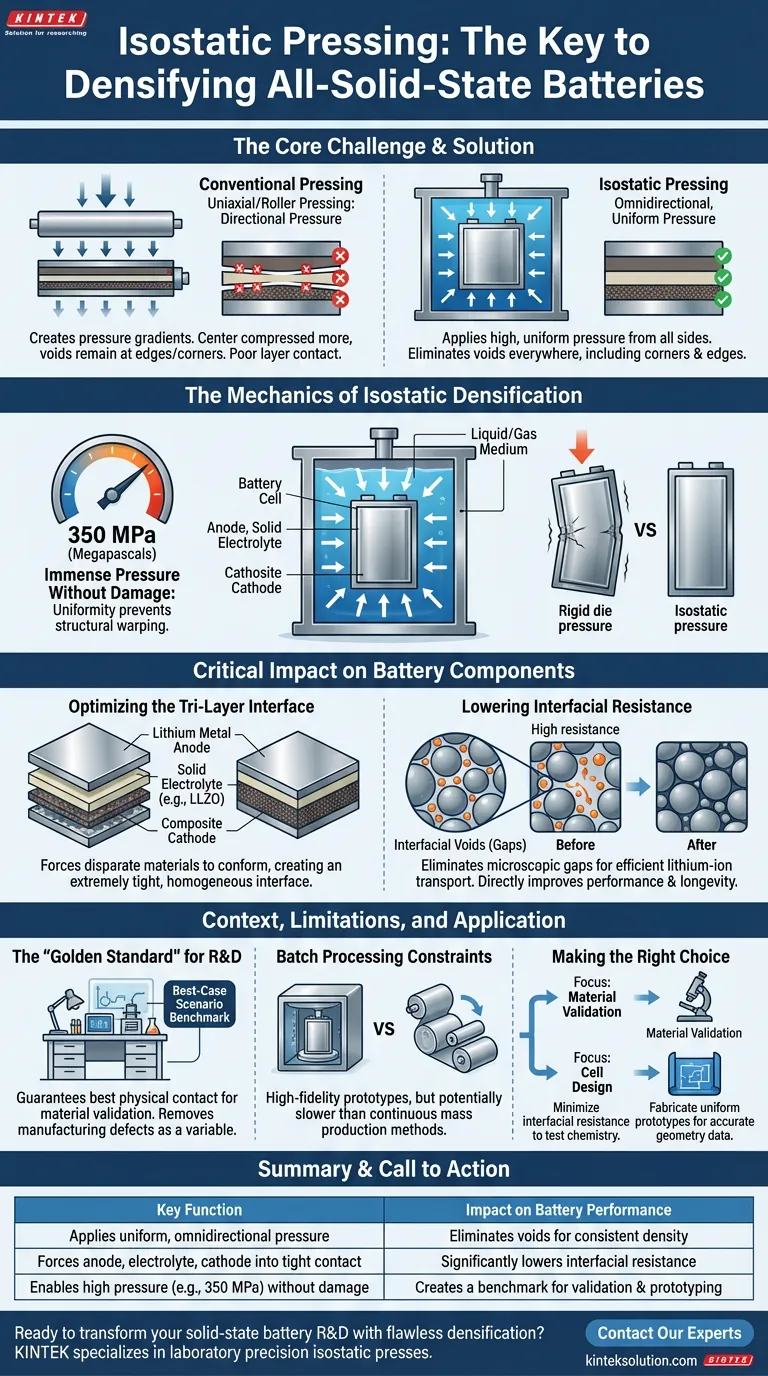
The primary function of an isostatic press in all-solid-state battery fabrication is to apply high, uniform, and omnidirectional pressure to a sealed cell to achieve maximum density. Unlike uniaxial or roller pressing, which apply force from a single direction, isostatic pressing uses a liquid or gas medium to compress the cell equally from all sides, effectively eliminating voids even at the corners and edges.
The Core Challenge: Solid-state batteries fail when there is poor contact between layers. Isostatic pressing solves this by forcing the anode, solid electrolyte, and cathode into an extremely tight, homogeneous interface, which is required to lower resistance and enable stable ion transport.

The Mechanics of Isostatic Densification
Omnidirectional vs. Directional Pressure
Standard manufacturing methods, such as roller pressing, can create pressure gradients where the center of a cell is compressed more than the edges.
Isostatic pressing submerges the sealed cell in a pressurized fluid or gas chamber. This ensures that every square millimeter of the cell surface receives the exact same amount of force simultaneously.
Achieving High Pressure Without Damage
These systems can generate immense pressure, often reaching levels such as 350 megapascals (MPa).
Despite this intensity, the uniformity of the pressure prevents the structural damage or warping that often occurs when attempting to apply similar forces using rigid mechanical dies.
Critical Impact on Battery Components
Optimizing the Tri-Layer Interface
For an all-solid-state battery to function, ions must physically move between solid materials. Isostatic pressing creates a tight physical contact between the lithium metal anode, the solid electrolyte (such as LLZO), and the composite cathode.
This process forces these disparate materials to conform to one another, essentially knitting them together at a microscopic level.
Lowering Interfacial Resistance
The primary enemy of solid-state performance is interfacial voids—microscopic gaps where materials do not touch.
By eliminating these voids, isostatic pressing significantly lowers interfacial resistance. This allows for efficient lithium-ion transport, which is directly responsible for high-performance cycling and battery longevity.
Understanding the Context and Limitations
The "Golden Standard" for R&D
Because it guarantees the best possible physical contact, isostatic pressing is particularly valuable during research, development, and performance validation.
It creates a "best-case scenario" benchmark for the materials being tested, removing manufacturing defects as a variable in the experiment.
Batch Processing Constraints
While excellent for quality, isostatic pressing is typically a batch process involving sealed molds or bags.
This differs from continuous roll-to-roll manufacturing, making it highly effective for producing high-fidelity prototypes but potentially slower than continuous roller pressing methods used in mass production.
Making the Right Choice for Your Goal
To maximize the value of isostatic pressing in your battery development process, consider your immediate objective:
- If your primary focus is Material Validation: Use isostatic pressing to minimize interfacial resistance, ensuring that any failure is due to material chemistry rather than poor physical contact.
- If your primary focus is Cell Design: Rely on this method to fabricate uniform prototypes with consistent density at the corners and edges, which provides accurate data on cell geometry performance.
Isostatic pressing is not just a compression step; it is the critical enabler that transforms loose layers of material into a unified, high-performance electrochemical system.
Summary Table:
| Key Function | Impact on Battery Performance |
|---|---|
| Applies uniform, omnidirectional pressure | Eliminates voids at edges and corners for consistent density |
| Forces anode, electrolyte, and cathode into tight contact | Significantly lowers interfacial resistance for efficient ion transport |
| Enables high pressure (e.g., 350 MPa) without damage | Creates a benchmark for material validation and high-fidelity prototyping |
Ready to transform your solid-state battery R&D with flawless densification? KINTEK specializes in high-performance isostatic presses designed for laboratory precision. Our machines help you achieve the perfect layer contact essential for validating materials and prototyping reliable cells. Contact our experts today to discuss how our isostatic press solutions can accelerate your development cycle.
Visual Guide
Related Products
- Warm Isostatic Press for Solid State Battery Research Warm Isostatic Press
- Electric Lab Cold Isostatic Press CIP Machine
- Automatic Lab Cold Isostatic Pressing CIP Machine
- Manual Cold Isostatic Pressing CIP Machine Pellet Press
- Lab Isostatic Pressing Molds for Isostatic Molding
People Also Ask
- Why must composite cathodes be sealed in vacuum lamination bags for WIP? Ensure Battery Stability and Density
- How do sacrificial volume materials (SVM) maintain microchannels in isostatic pressing? Ensure Structural Integrity
- What is the function of elastic molds in warm isostatic pressing? Achieve Uniform Density in Composite Particles
- What is the role of the flexible material in warm isostatic pressing? Key to Uniform Density & Precision
- How does Warm Isostatic Pressing differ from traditional pressing methods? Unlock Uniform Density for Complex Parts



















