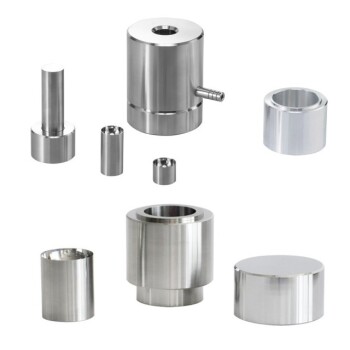
The technical significance of stainless steel mold extrusion lies in its ability to transform mixed clay paste into highly precise, honeycomb-like columnar structures. By forcing the material through specifically designed channels, this manufacturing method creates a monolith with regular geometry—often featuring multiple through-holes, such as 40 individual channels—to ensure structural uniformity.
The primary value of this technique is the production of uniform fluid channels that minimize pressure drop during water treatment operations. Simultaneously, the inherent durability of stainless steel ensures long-term dimensional consistency, preventing the variations that can compromise filtration efficiency.
The Engineering Behind the Extrusion Process
Creating the Honeycomb Architecture
The core function of this process is to shape the clay paste into a complex columnar form. The mold utilizes precisely designed extrusion channels to generate a honeycomb structure.
Achieving Geometric Regularity
This mechanical forming process ensures that every unit produced maintains a regular geometric shape. This regularity is critical for applications requiring standardized performance across multiple units.
Specific Channel Configuration
The molds are capable of forming intricate internal features, such as 40 individual through-holes within a single monolith. This high density of channels maximizes the surface area available for interaction with fluids.
Operational Impact on Water Treatment
Establishing Uniform Fluid Channels
The precision of the stainless steel mold guarantees that the internal channels are uniform throughout the structure. This uniformity is essential for predicting and controlling how fluid moves through the adsorbent.
Minimizing Pressure Drop
A key performance metric in water treatment is the resistance the filter creates against the flow of water. The uniform channels created by this extrusion method significantly lower the pressure drop across the system.
Enhancing Flow Efficiency
By reducing physical resistance, the honeycomb structure allows for more efficient fluid dynamics. This ensures that the water treatment operation remains energy-efficient while maintaining high throughput.
Manufacturing Consistency and Reliability
The Role of Material Stiffness
Stainless steel is selected for these molds specifically for its durability and rigidity. Unlike softer materials, stainless steel resists deformation under the high pressures required to extrude thick clay paste.
Ensuring Dimensional Precision
The durability of the mold directly translates to the consistency of the final product's dimensions. This ensures that the first unit produced and the last unit produced meet the same strict size specifications.
Critical Considerations
Dependence on Mold Integrity
While the resulting structure offers low pressure drop, this performance relies entirely on the condition of the mold. If the mold lacks the durability of stainless steel, the channel dimensions would fluctuate, immediately increasing flow resistance.
The Link Between Material and Geometry
The use of mixed clay paste requires a mold material that can withstand abrasion and pressure. Without the hardness of stainless steel, maintaining the precise geometry of 40 individual channels would be technically difficult over long production runs.
Making the Right Choice for Your Goal
This manufacturing method is not merely about shaping clay; it is about guaranteeing the hydraulic performance of the final system.
- If your primary focus is Operational Efficiency: Prioritize this extrusion method to ensure uniform channels that minimize pressure drop, thereby reducing energy consumption in water treatment pumps.
- If your primary focus is Product Standardization: Rely on stainless steel molds to guarantee dimensional precision, ensuring every adsorbent unit fits perfectly and performs identically.
The integration of stainless steel tooling with honeycomb extrusion provides the critical bridge between raw clay material and high-performance fluid dynamics.
Summary Table:
| Feature | Technical Benefit | Impact on Water Treatment |
|---|---|---|
| SS Mold Durability | Prevents deformation under high pressure | Ensures consistent dimensional precision |
| Honeycomb Geometry | Creates 40+ individual through-holes | Maximizes surface area for adsorption |
| Channel Uniformity | Regular internal architecture | Minimizes pressure drop and energy loss |
| Mechanical Forming | Standardized columnar structures | Guaranteed throughput and flow efficiency |
Optimize Your Laboratory Pressing & Extrusion Success with KINTEK
Precision in honeycomb structures starts with the right equipment. KINTEK specializes in comprehensive laboratory pressing solutions, offering manual, automatic, heated, multifunctional, and glovebox-compatible models, alongside cold and warm isostatic presses widely applied in battery research and advanced material shaping.
Whether you are extruding clay monoliths for water treatment or researching next-generation battery materials, our technical experts are ready to provide the high-performance tools you need for dimensional consistency and structural integrity.
Ready to elevate your lab's efficiency? Contact KINTEK Today to Find Your Custom Pressing Solution
References
- Darmadi Darmadi, Aula Chairunnisak. Advancing Environmental Protection: Monolithic Bentonite and Zeolite-Clay Adsorbents for Fe<sup>2+</sup> Ion Removal. DOI: 10.4028/p-j4atcj
This article is also based on technical information from Kintek Solution Knowledge Base .
Related Products
- XRF KBR Steel Ring Lab Powder Pellet Pressing Mold for FTIR
- Lab Anti-Cracking Press Mold
- Lab Polygon Press Mold
- Square Lab Press Mold for Laboratory Use
- Lab XRF Boric Acid Powder Pellet Pressing Mold for Laboratory Use
People Also Ask
- What considerations are important regarding the die size of an XRF pellet press? Optimize for Your XRF Spectrometer and Sample
- Why are pellets used in XRF analysis, and what is their limitation? Boost Accuracy and Speed in Your Lab
- What is the general process for preparing a sample pellet for XRF? Master Consistency for Accurate Analysis
- What are the differences between manual and automatic XRF pellet presses? Choose the Right Press for Your Lab's Needs
- What are the different types of XRF pellet preparation methods available? Manual, Hydraulic, and Automated Presses Explained