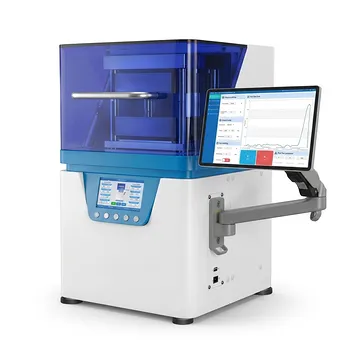
Laboratory hydraulic presses typically generate pressures up to 1,000 pounds per square inch (psi). This specific force capacity allows them to process a diverse array of materials, primarily including powders, sheet materials, and polymer beads, for applications ranging from sample creation to durability testing.
Core Takeaway While compact in size, laboratory presses offer the precise force control required to condense and mold materials for research. They are essential for creating uniform pellets for analysis and investigating material behavior under stress without the massive footprint of industrial machinery.
Operating Capacity and Mechanics
The Standard Pressure Limit
Most general-purpose laboratory presses are engineered to deliver a maximum force of 1,000 psi. This level of pressure is sufficient for compacting loose materials into solid forms without damaging delicate laboratory environments.
The Mechanism of Action
These machines utilize a hydraulic ram to generate force. This ram is typically powered by either an electric motor or hand-operated levers, depending on the required precision and frequency of use.
Precision Over Power
Unlike industrial forging presses, the value of a lab press lies in control rather than raw tonnage. High-precision variations can apply pressure at constant loading rates (e.g., 150 N/s), allowing researchers to measure exact failure points in materials like mortar specimens.
Material Compatibility and Applications
Powders and Granular Materials
The most frequent application is processing powders into solid pellets. This is a critical step for preparing samples for spectroscopic analysis, ensuring the sample is uniform and dense.
Polymers and Laminates
These presses are compatible with polymer beads and sheet materials. They are frequently used to laminate layers together or mold polymers into specific shapes for physical property testing.
Advanced Composites and Ceramics
When equipped with heating elements (known as hot pressing), these units can process metals, ceramics, and composites. This capability is vital for industries researching advanced ceramics for electronics or metal matrix composites for automotive parts.
Understanding the Trade-offs
Limited Force for Harder Materials
While versatile, the 1,000 psi limit generally restricts these presses to sample preparation and testing of softer or smaller specimens. They are not suitable for heavy industrial forming or shaping large, high-strength metal components.
Throughput Limitations
These are designed for batch processing of individual samples. They are not intended for high-speed mass production; attempting to use them for high-volume manufacturing will likely result in equipment strain and inefficiency.
Environmental Constraints
While compact, precise operation often requires controlled environments. Some applications, such as processing air-sensitive samples, may require the press to be operated inside a vacuum glove box, adding to the complexity of the setup.
Making the Right Choice for Your Goal
To select the correct equipment configuration, evaluate your primary research objective:
- If your primary focus is analytical sample preparation: A standard hand-operated or electric press with a 1,000 psi capacity is ideal for turning powders into pellets.
- If your primary focus is material development (ceramics/composites): You specifically require a Hydraulic Heat Lab Press (hot press) to manipulate phase changes and bonding in metals and ceramics.
- If your primary focus is destructive testing: Ensure the press offers controlled loading rates to accurately measure compressive strength and durability limits.
Success relies on matching the press's maximum force rating directly to the density and yield strength of the materials you intend to study.
Summary Table:
| Feature | Specification / Detail |
|---|---|
| Standard Max Pressure | Up to 1,000 psi |
| Primary Materials | Powders, polymer beads, sheet materials, and composites |
| Key Applications | Pellet pressing, lamination, durability testing, and spectroscopy prep |
| Pressure Source | Manual hand-operated lever or electric motor-driven hydraulic ram |
| Specialized Options | Heated platens for ceramics/metals; vacuum glovebox compatibility |
Elevate Your Material Research with KINTEK
Precision is the foundation of scientific discovery. KINTEK specializes in comprehensive laboratory pressing solutions tailored to your specific research needs. Whether you are performing analytical sample preparation or developing advanced battery technologies, our range of manual, automatic, heated, and multifunctional models provides the exact force control you require.
From glovebox-compatible presses for air-sensitive samples to cold and warm isostatic presses for uniform material density, KINTEK delivers the durability and precision laboratory experts trust.
Ready to optimize your lab’s pressing capabilities? Contact our experts today to find the perfect press for your application!
Related Products
- Laboratory Hydraulic Press Lab Pellet Press Button Battery Press
- Laboratory Hydraulic Press 2T Lab Pellet Press for KBR FTIR
- Laboratory Hydraulic Press Lab Pellet Press Machine for Glove Box
- 24T 30T 60T Heated Hydraulic Lab Press Machine with Hot Plates for Laboratory
- Automatic Laboratory Hydraulic Press Lab Pellet Press Machine
People Also Ask
- How is a laboratory hydraulic press used for HAP composite gels? Master Mineral Substrate Standardization
- What role does a laboratory hydraulic press play in reaction pellets? Optimizing Lunar Soil and Metal Fuel Density
- What role does a laboratory hydraulic press play in the preparation of piezoelectric ceramic discs for DC-PG? | KINTEK
- What role does a laboratory hydraulic press play in the assembly of all-solid-state battery test cells? Expert Guide
- Why is a laboratory hydraulic press required for PBAT and PLA sample preparation? Achieve Flawless Characterization