
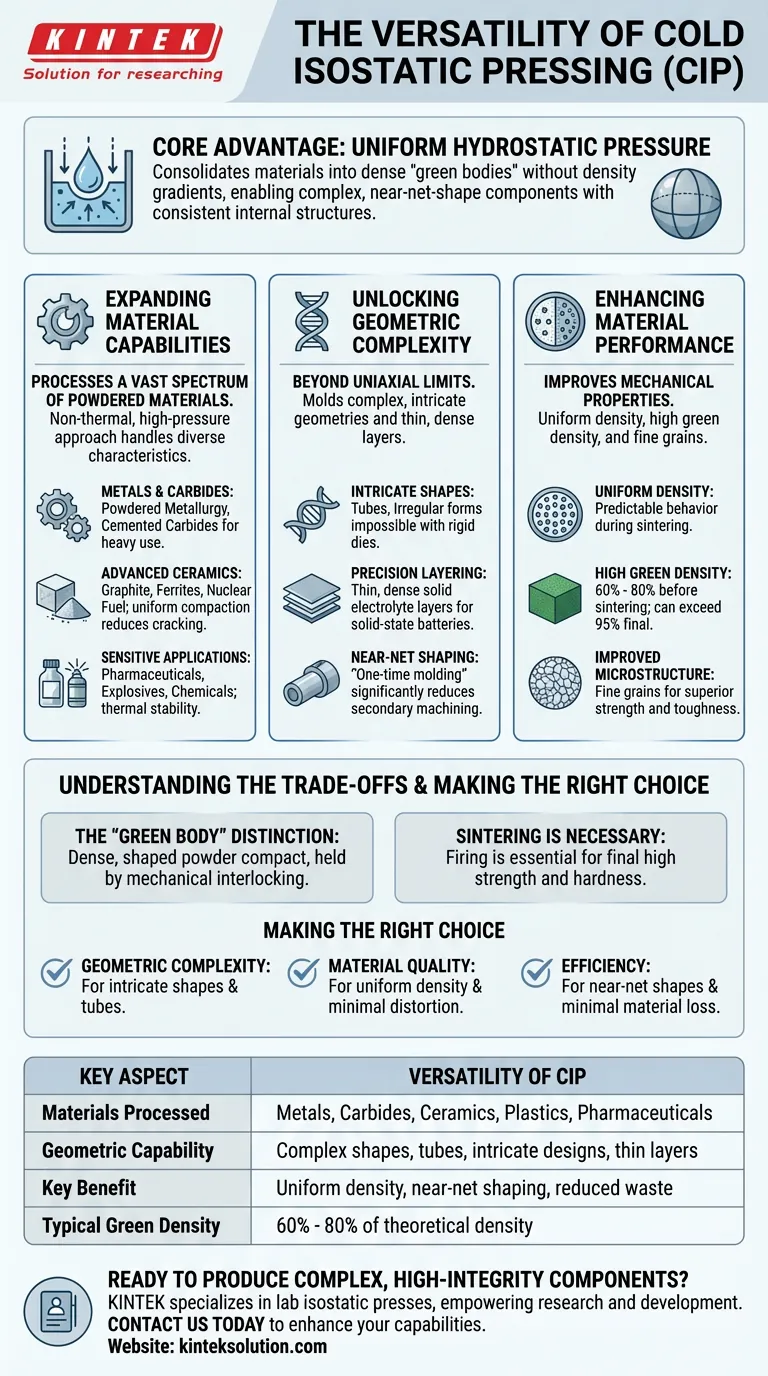
Cold Isostatic Pressing (CIP) is a highly versatile manufacturing technique capable of processing a vast spectrum of powdered materials—from metals and carbides to ceramics and plastics—into complex, high-integrity shapes. Because it applies uniform pressure from all directions using a fluid medium, it effectively consolidates materials into dense "green bodies" without the density gradients or geometric limitations common in conventional uniaxial pressing.
The Core Advantage While standard pressing methods struggle with complex geometries and uneven density, CIP solves this by applying hydrostatic pressure uniformly. This allows for the precise manufacturing of intricate, near-net-shape components with consistent internal structures, drastically reducing material waste and machining costs across industries ranging from aerospace to medical technology.
Expanding Material Capabilities
CIP is not limited to a single class of materials. Its non-thermal, high-pressure approach allows it to handle materials with vastly different physical characteristics.
Processing Metals and Carbides
CIP is a cornerstone technology in powdered metallurgy. It is extensively used to consolidate cemented carbides and refractory materials, creating durable components for heavy industrial use.
Advanced Ceramics and Refractories
The process is ideal for ceramic powders, including graphite, ferrites, and nuclear fuel. It ensures these brittle materials are compacted uniformly, reducing the risk of cracking during the subsequent firing process.
Sensitive and Specialty Applications
Because CIP does not rely on heat to bond the particles initially, it is suitable for chemically sensitive materials. The references highlight its use in pharmaceuticals, explosives, and chemicals, where thermal stability during shaping is critical.
Unlocking Geometric Complexity
Beyond material variety, CIP offers exceptional versatility in the shapes it can produce.
Intricate, Non-Linear Shapes
Unlike uniaxial pressing, which is limited to simple vertical shapes, CIP can mold complex, intricate geometries. This includes components like tubes and irregular forms that would be impossible to press in a rigid die.
Precision Layering
The technology is capable of extreme precision, such as creating very thin, dense layers. A prime example is the production of solid electrolyte layers required for modern solid-state batteries.
Near-Net Shaping
CIP allows for "one-time molding." This produces a part that is very close to its final dimensions, significantly reducing the complexity and cost of secondary machining or processing.
Enhancing Material Performance
The versatility of CIP extends to the mechanical properties it imparts to the final product.
Eliminating Density Gradients
In standard pressing, friction creates uneven density. CIP utilizes a fluid medium to apply low-friction, isostatic pressure. This results in uniform powder density throughout the part, ensuring predictable behavior during sintering.
High Green Density
The process yields parts with 60% to 80% of their theoretical density before sintering. In optimized setups, the final material can exceed 95% density, offering superior hardness and wear resistance.
Improved Microstructure
High pressure induces plastic deformation and recrystallization. This results in fine grains, which directly translates to improved strength and toughness in the finished component.
Understanding the Trade-offs
While CIP is a powerful tool, it is essential to understand its specific role in the manufacturing chain to avoid misconceptions.
The "Green Body" Distinction
CIP is primarily a powder-compacting process. It produces a "green body" that is dense and shaped but essentially held together by mechanical interlocking.
The Necessity of Sintering
To achieve the final high strength and hardness described (such as wear resistance), the part must undergo sintering (firing) after pressing. CIP optimizes the material for this step, ensuring minimal distortion, but it does not replace the heating phase entirely.
Making the Right Choice for Your Goal
CIP is a strategic choice when material integrity and shape complexity are paramount.
- If your primary focus is Geometric Complexity: Choose CIP to produce intricate shapes, tubes, or parts with undercuts that standard rigid-die pressing cannot manufacture.
- If your primary focus is Material Quality: Use CIP to eliminate internal density gradients, ensuring your components do not warp, crack, or distort during the sintering phase.
- If your primary focus is Efficiency: Leverage CIP to achieve near-net shapes with minimal material loss (waste), reducing the cost of raw materials and post-process machining.
CIP transforms the processing of powdered materials by decoupling shape complexity from internal structural integrity, offering a reliable path to high-performance components.
Summary Table:
| Key Aspect | Versatility of CIP |
|---|---|
| Materials Processed | Metals, Carbides, Ceramics, Plastics, Pharmaceuticals |
| Geometric Capability | Complex shapes, tubes, intricate designs, thin layers |
| Key Benefit | Uniform density, near-net shaping, reduced waste |
| Typical Green Density | 60% - 80% of theoretical density |
Ready to produce complex, high-integrity components with uniform density?
KINTEK specializes in lab isostatic presses, including Cold Isostatic Pressing (CIP) systems, designed for research and development laboratories. Our presses empower you to process a wide range of powdered materials into intricate shapes with consistent results, reducing material waste and machining costs.
Contact us today to discuss how a KINTEK isostatic press can enhance your material processing capabilities and bring your most challenging designs to life.
Visual Guide
Related Products
- Automatic Lab Cold Isostatic Pressing CIP Machine
- Electric Split Lab Cold Isostatic Pressing CIP Machine
- Electric Lab Cold Isostatic Press CIP Machine
- Manual Cold Isostatic Pressing CIP Machine Pellet Press
- Lab Isostatic Pressing Molds for Isostatic Molding
People Also Ask
- What are the key features of automated laboratory Cold Isostatic Press (CIP) systems? Achieve Precise, High-Pressure Powder Consolidation
- Why is an Isostatic Press (CIP) Necessary After Uniaxial Pressing? Achieve Transparency in Nd:Y2O3 Ceramics
- What is the primary function of a Cold Isostatic Press (CIP) in NASICON preparation? Achieve 96% Theoretical Density
- How does a Cold Isostatic Press (CIP) facilitate the preparation of CaO-doped silicon carbide (SiC) green bodies?
- How does a Cold Isostatic Press (CIP) increase Bi-2223/Ag current density? Boost Superconductivity with Uniform Pressure










