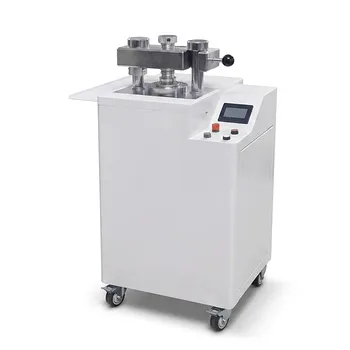
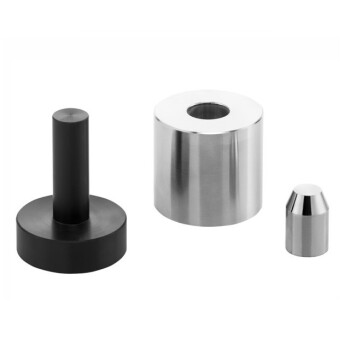
The material composition of a pellet press die fundamentally dictates its operational lifespan and production quality. Commonly used materials include high chrome stainless steel (x46Cr13), alloy steel (20MnCr5), and high-alloy steel (18NiCrMo5). Selecting the correct grade is essential, as the material determines the die's hardness, strength, and ability to withstand specific types of wear and corrosion.
The durability and efficiency of your pellet press depend heavily on matching the die material to the characteristics of the raw ingredients. Harder, corrosion-resistant steels are required for abrasive materials, while standard alloy steels provide structural integrity for general applications.
Common Die Materials and Their Applications
Pellet press dies are precision tools that must endure immense pressure. Manufacturers utilize specific steel grades to address different processing challenges.
High Chrome Stainless Steel (x46Cr13)
This is a premium choice often selected for processing abrasive or aggressive materials.
Its primary advantage is excellent corrosion resistance.
Additionally, this grade offers superior hardness, making it capable of withstanding the friction caused by tough raw ingredients without degrading quickly.
Alloy Steel (20MnCr5)
Alloy steel represents a standard, robust option for many pelletizing operations.
This material provides a balanced combination of structural strength and durability.
It is typically used in applications where extreme corrosion resistance is less critical, but mechanical reliability is paramount.
High-Alloy Steel (18NiCrMo5)
This grade is engineered for high-stress environments requiring exceptional toughness.
The inclusion of nickel, chromium, and molybdenum enhances the steel's fatigue resistance.
It is an ideal choice for operations that require the die to maintain integrity under heavy, continuous loads.
Why Material Selection is Critical
The die is the heart of the pelletizing process. Choosing the wrong material can lead to frequent downtime and inconsistent product quality.
Maximizing Durability
Every raw material exerts a different physical toll on the die.
If a standard steel die is used to process highly abrasive biomass, it will wear down rapidly.
Proper material selection ensures the die retains its geometry longer, reducing the frequency of costly replacements.
Ensuring Process Efficiency
A worn die consumes more energy and produces more "fines" (dust) rather than solid pellets.
Using a high-quality material like high chrome steel maintains the die holes' smoothness.
This reduces friction during extrusion, allowing the press to operate at optimal capacity with lower energy consumption.
Understanding the Trade-offs
While it may be tempting to always choose the hardest or most alloyed steel, there are objective trade-offs to consider.
Cost vs. Lifespan
High chrome and high-alloy steels are generally more expensive upfront than standard alloy steels.
However, for high-volume or abrasive operations, the lower cost-per-ton over the die's life often justifies the initial investment.
Hardness vs. Brittleness
Materials that are extremely hard offer great wear resistance but can sometimes be more brittle.
If the operation involves significant shock loads or foreign objects entering the press, a tougher, slightly softer alloy might actually outlast a harder, more brittle option.
Making the Right Choice for Your Goal
To select the right die material, you must evaluate your specific raw materials and production goals.
- If your primary focus is processing abrasive or corrosive materials: prioritize High Chrome Stainless Steel (x46Cr13) for its superior hardness and resistance to chemical wear.
- If your primary focus is general reliability under heavy mechanical load: consider High-Alloy Steel (18NiCrMo5) for its exceptional strength and fatigue resistance.
- If your primary focus is cost-effective standard production: utilize Alloy Steel (20MnCr5) for a balanced performance in non-corrosive environments.
Aligning your die material with your specific processing needs is the single most effective way to extend equipment life and maintain consistent output.
Summary Table:
| Material Type | Steel Grade | Key Characteristics | Best Application |
|---|---|---|---|
| High Chrome Stainless | x46Cr13 | High corrosion & wear resistance | Abrasive or corrosive materials |
| Alloy Steel | 20MnCr5 | Balanced strength & reliability | Standard, non-corrosive production |
| High-Alloy Steel | 18NiCrMo5 | Superior toughness & fatigue resistance | High-stress, continuous heavy loads |
Maximize Your Lab’s Pelletizing Efficiency with KINTEK
Don't let poor material choice lead to costly downtime or inconsistent results. KINTEK specializes in comprehensive laboratory pressing solutions, offering manual, automatic, heated, multifunctional, and glovebox-compatible models, as well as cold and warm isostatic presses widely applied in battery research.
Our experts are ready to help you select the ideal die materials and press configurations to ensure your research or production meets the highest standards of precision. Contact us today to optimize your pelletizing process!
Related Products
- Lab XRF Boric Acid Powder Pellet Pressing Mold for Laboratory Use
- XRF KBR Plastic Ring Lab Powder Pellet Pressing Mold for FTIR
- Laboratory Hydraulic Split Electric Lab Pellet Press
- Lab Ring Press Mold for Sample Preparation
- Lab Infrared Press Mold for No Demolding
People Also Ask
- Why are pellets used in XRF analysis, and what is their limitation? Boost Accuracy and Speed in Your Lab
- What are the primary factors to consider when deciding between a manual and an automatic XRF pellet press? Optimize Your Lab's Efficiency
- What are the differences between manual and automatic XRF pellet presses? Choose the Right Press for Your Lab's Needs
- What are the different pellet pressing options for XRF sample preparation? Choose the Best Method for Accurate Analysis
- What are specialized XRF pellet preparation presses designed for? Boost Lab Efficiency with High-Throughput Automation