
The flexible container (mold) in Cold Isostatic Pressing (CIP) is almost exclusively manufactured from elastomers, specifically urethane, rubber, or polyvinyl chloride (PVC).
These materials are selected for their ability to create a leak-proof barrier while remaining flexible enough to transmit hydrostatic pressure uniformly from the surrounding fluid (oil or water) to the metal or ceramic powder inside.
Core Insight The success of the CIP process relies on the principle of isostatic pressure, where force is applied equally from all directions. Consequently, the container material must possess sufficient elasticity to deform under pressures up to 150,000 psi (1000 MPa) without rupturing, ensuring the powder compacts into a dense, uniform "green" body.
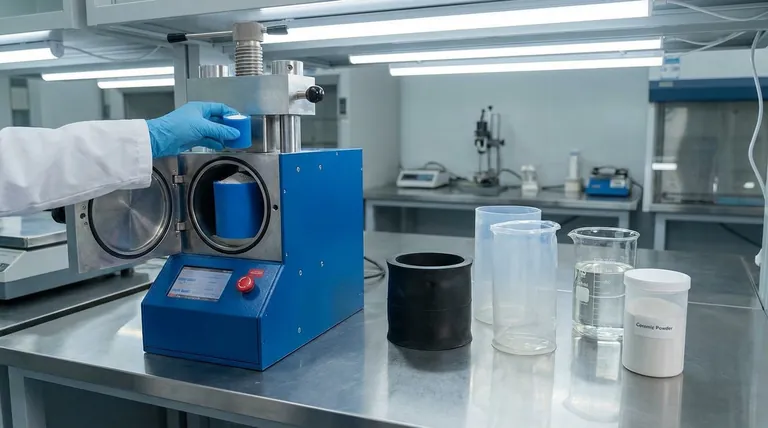
The Role of the Flexible Container
To understand why specific materials are chosen, it is vital to understand the container's function. In CIP, the mold serves as a deformable barrier between the hydraulic fluid and the raw powder.
Transmitting Pressure
The container acts as a pressure transmitter. Because the process occurs at room temperature, thermal resistance is not the primary concern.
Instead, the material must handle extreme compressive forces ranging from 60,000 to 150,000 psi. A rigid container would shield the powder from this pressure; a flexible elastomer ensures the pressure is transferred directly to the powder.
Preventing Contamination
The mold must be chemically compatible with two distinct substances simultaneously.
On the outside, it must resist degradation from the pressurized fluid, typically oil or water. On the inside, it must not chemically react with or contaminate the high-purity powders being compacted.
Primary Material Options
The industry relies on three main categories of elastomers for these molds.
Urethane
Urethane is a frequent choice due to its high abrasion resistance and durability. It is often used for reusable tooling where the mold must survive multiple compression cycles without losing its shape or integrity.
Rubber
Various rubber formulations are used depending on the specific compatibility requirements of the hydraulic fluid. Rubber offers excellent elasticity, allowing the mold to return to its original shape after the pressure is released and the part is removed.
Polyvinyl Chloride (PVC)
PVC is utilized as a versatile option for mold construction. It is generally cost-effective and provides the necessary impermeability to separate the hydraulic fluid from the powder compact.
Understanding the Trade-offs
While the materials listed above are the standard, selecting the wrong one can lead to process failure. It is critical to distinguish between the tooling and the workpiece.
Tooling vs. Workpiece Confusion
A common point of confusion in CIP literature arises when sources list "metals, ceramics, and graphite" as materials used in the process.
It is crucial to note that metals, ceramics, and graphite are the powders being compacted inside the mold, not the material of the mold itself. Using a rigid material like metal for the container would result in a "canning" process (often used in Hot Isostatic Pressing), not the flexible tooling method characteristic of CIP.
Material Memory and Deformation
The "memory" of the elastomer is a critical trade-off.
A material with high elasticity (like certain rubbers) allows for easy ejection of the pressed part and reuse of the bag. However, materials that are too soft may deform unevenly if the powder packing is inconsistent, leading to geometric inaccuracies in the final part.
Making the Right Choice for Your Goal
The choice of container material dictates the efficiency of your production cycle and the quality of the final compact.
- If your primary focus is high-volume production: Prioritize urethane or high-durability rubber molds that can withstand repeated high-pressure cycles (up to 1000 MPa) without tearing or permanent deformation.
- If your primary focus is cost-efficiency for short runs: Consider polyvinyl chloride (PVC), which offers a reliable barrier at a generally lower cost for less intensive cycling requirements.
- If your primary focus is complex geometry: Ensure your elastomer selection has sufficient flexibility to strip away from undercuts or complex shapes without damaging the "green" (uncured) part.
Select the elastomer that balances the chemical constraints of your pressure fluid with the mechanical abrasion of your powder.
Summary Table:
| Material | Key Properties | Common Use Case |
|---|---|---|
| Urethane | High abrasion resistance, durability | High-volume production, reusable tooling |
| Rubber | Excellent elasticity, chemical compatibility | Applications requiring easy part ejection |
| Polyvinyl Chloride (PVC) | Cost-effective, good impermeability | Short production runs, cost-sensitive projects |
Optimize Your CIP Process with the Right Equipment
Choosing the correct flexible container material is crucial for achieving uniform density and complex geometries in your pressed parts. KINTEK specializes in lab press machines, including isostatic presses, serving precise laboratory needs.
Our experts can help you select the ideal press and tooling for your specific powder and production goals. Contact us today to discuss how our solutions can enhance your compaction quality and efficiency!
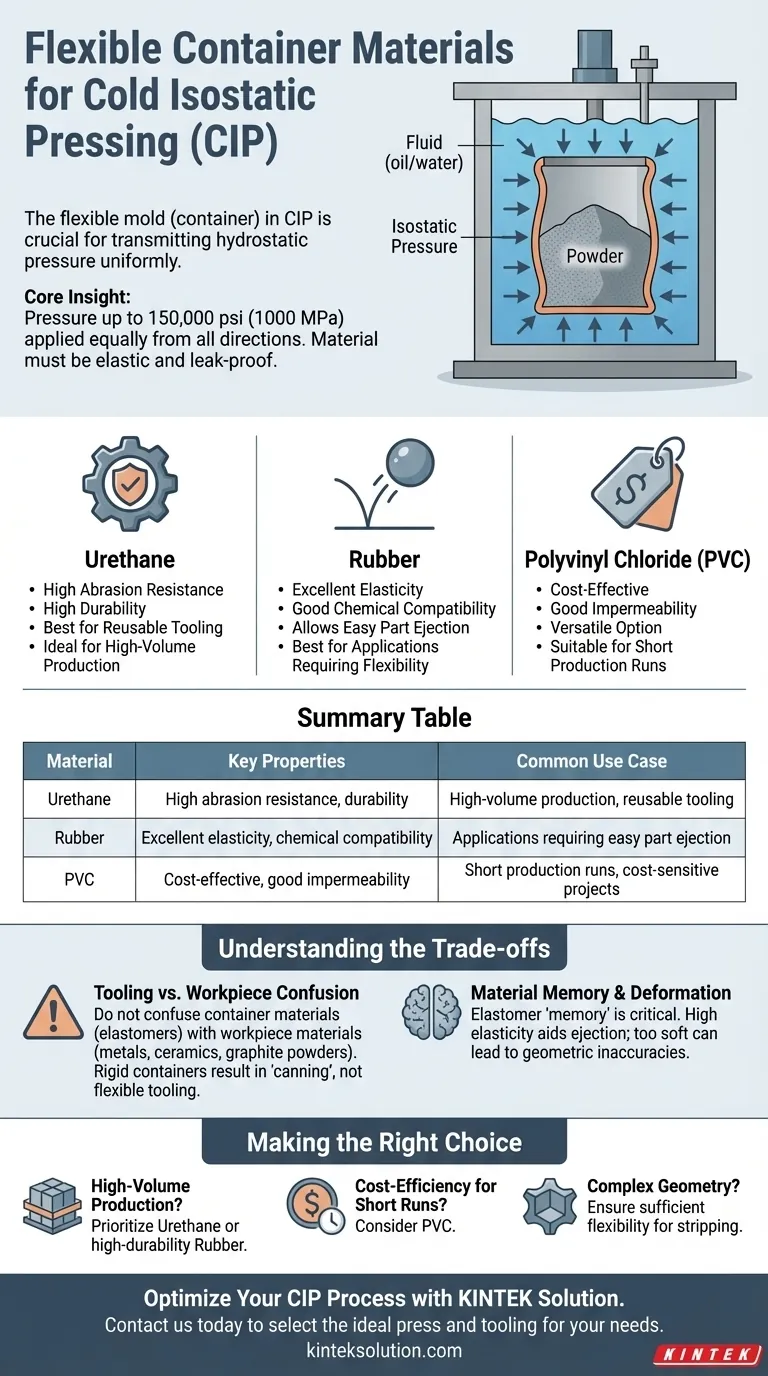
Visual Guide
Related Products
- Electric Split Lab Cold Isostatic Pressing CIP Machine
- Automatic Lab Cold Isostatic Pressing CIP Machine
- Manual Cold Isostatic Pressing CIP Machine Pellet Press
- Electric Lab Cold Isostatic Press CIP Machine
- Lab Isostatic Pressing Molds for Isostatic Molding
People Also Ask
- What role do electric lab cold isostatic presses play in industrial contexts? Bridge R&D and Manufacturing with Precision
- What are the applications of electric lab cold isostatic presses in research settings? Advance Material R&D with High-Pressure CIPs
- What advantages does electrical Cold Isostatic Pressing (CIP) have over manual CIP? Boost Efficiency and Consistency
- What are the process advantages of using Cold Isostatic Pressing (CIP) for LSMO? Achieve Defect-Free Density
- Why is Cold Isostatic Pressing (CIP) applied after uniaxial pressing? Optimize Superconductor Precursor Density




