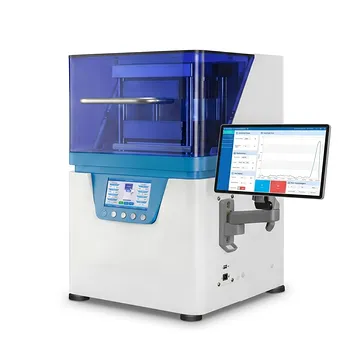
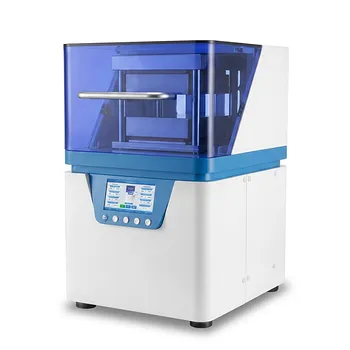
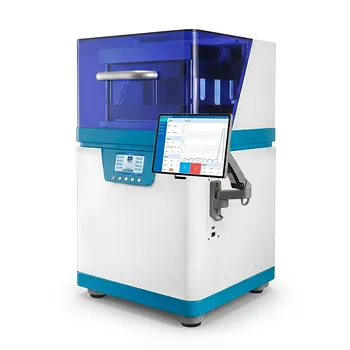
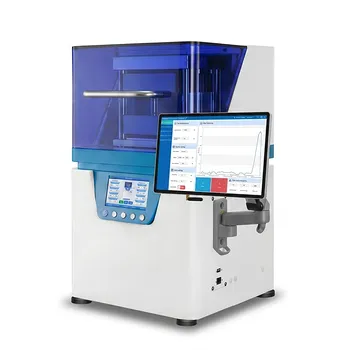
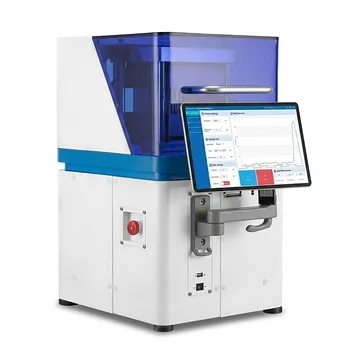
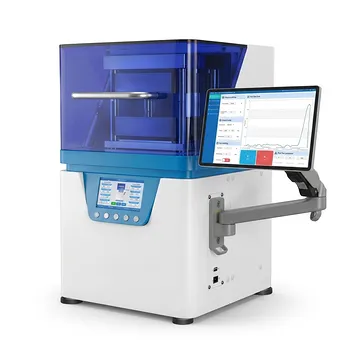
A heated hydraulic press acts as the critical transformational tool in compression molding (CM). It simultaneously applies precise thermal energy and mechanical force to convert raw material granules, powders, or elastomers into a dense, homogeneous solid. This dual-action process ensures that the resulting test specimens are free of internal defects and possess the consistent physical properties required for accurate analytical testing.
The primary function of a heated hydraulic press in compression molding is to remelt and consolidate materials under controlled high-pressure conditions. This process eliminates porosity and internal gases, ensuring the production of high-density specimens with superior structural integrity and surface finishes.
The Mechanics of Consolidation
Thermal Energy for Material Remelting
The press uses heated plates to reach specific temperatures, such as 195 °C or 220 °C, depending on the polymer or composite being processed. This heat provides the necessary thermal energy to remelt granules or soften powders into a flowable state. Proper temperature control is vital to ensure the material remelts and bonds tightly without reaching the point of thermal degradation.
Mechanical Force for Density and Void Removal
Once the material is molten, the hydraulic system applies high pressure, often ranging from 15 MPa to 29 MPa. This mechanical force drives the material into every corner of the mold, ensuring it fully fills the cavities. More importantly, continuous pressure eliminates internal gases and air bubbles, which significantly reduces porosity compared to other methods like 3D printing.
Ensuring Specimen Quality for Research
Achieving Uniformity and Dimensional Stability
For materials like carbon black filled elastomers, the press provides the heat necessary for vulcanization or cross-linking. By maintaining a consistent temperature (e.g., 160 °C), the press ensures a uniform degree of vulcanization throughout the entire specimen. This uniformity is essential for producing standardized test plates with high dimensional stability.
Surface Finish and Edge Adhesion
The high-pressure environment creates specimens with smoother surfaces and better edge adhesion. In metallographic mounting, for example, the press ensures the molten polymer fills all gaps around a sample. This results in high-density mounts that prevent "edge rounding" during subsequent polishing or microscopic analysis.
Specialized Applications in Material Science
Preparation for Spectroscopic Analysis
In laboratory settings, heated presses are indispensable for creating samples for FTIR or XRF analysis. They compact materials into uniform pellets, such as KBr pellets, where consistency is key to obtaining accurate spectral data. The combination of heat and pressure ensures the pellet is transparent and free of light-scattering voids.
Bonding and Curing Composites
The press is also used to bond layers of material or cure resins in the manufacturing of wooden panels or rubber sheets. The heated plates facilitate the chemical reactions needed to create strong, durable bonds between different phases of a composite. This role is vital for researching how materials behave under extreme environmental conditions.
Understanding the Trade-offs
Thermal Degradation vs. Consolidation
One of the primary challenges is balancing temperature and "dwell time." While high heat is required to ensure a tight bond, excessive exposure can degrade the polymer chains, altering the very mechanical properties you intend to measure.
Pressure Management and Flash
Applying too much pressure can result in "flash," where material is squeezed out of the mold, potentially leading to specimens that are thinner than the target specification. Conversely, insufficient pressure leaves micro-voids that act as stress concentrators, causing the specimen to fail prematurely during strength testing.
Making the Right Choice for Your Goal
To achieve the best results with a heated hydraulic press, you must align your parameters with your specific research objective.
- If your primary focus is mechanical strength testing: Prioritize high-pressure consolidation to eliminate internal voids and ensure maximum specimen density.
- If your primary focus is chemical or spectroscopic analysis: Focus on precise temperature control to ensure uniform cross-linking or pellet transparency without degrading the chemical structure.
- If your primary focus is metallographic mounting: Use continuous pressure during the cooling phase to ensure perfect edge adhesion and prevent gaps between the sample and the resin.
By mastering the balance of heat and pressure, you can produce standardized specimens that provide a true representation of your material's performance.
Summary Table:
| Feature | Function in Compression Molding | Benefit for Test Specimens |
|---|---|---|
| Thermal Energy | Remelts material & facilitates vulcanization | Ensures homogeneous bonding & dimensional stability |
| Mechanical Force | High-pressure consolidation (15-29 MPa) | Eliminates internal voids, gases, and micro-bubbles |
| Controlled Cooling | Gradual temperature reduction under pressure | Prevents edge rounding and ensures perfect surface finish |
| Precision Control | Balancing dwell time and pressure | Prevents thermal degradation and mold flash |
Elevate Your Material Research with KINTEK Precision
Achieving high-density, defect-free specimens requires more than just pressure—it requires absolute control. KINTEK specializes in comprehensive laboratory pressing solutions tailored for demanding research environments. Whether you are conducting advanced battery research or routine material testing, our diverse range of equipment ensures your samples meet the highest analytical standards.
Our Specialized Solutions Include:
- Heated & Automatic Presses: For precise thermal consolidation and repeatability.
- Multifunctional & Glovebox-Compatible Models: Designed for sensitive environments.
- Cold & Warm Isostatic Presses: Ideal for uniform density in complex materials.
- Manual Presses: Reliable, entry-level solutions for standard pellet preparation.
Don't let internal voids or thermal degradation compromise your data. Contact KINTEK today to find the perfect pressing solution for your lab and ensure the structural integrity of every specimen you produce.
References
- Nasır Narlıoğlu. Comparison of mechanical properties of 3D-printed and compression-molded wood-polylactic acid (PLA) composites. DOI: 10.15376/biores.17.2.3291-3302
This article is also based on technical information from Kintek Solution Knowledge Base .
Related Products
- Heated Hydraulic Press Machine with Heated Plates for Vacuum Box Laboratory Hot Press
- Automatic High Temperature Heated Hydraulic Press Machine with Heated Plates for Lab
- Automatic Heated Hydraulic Lab Press with Programmable Touch Screen Controls and Precision Temperature Regulation
- Automatic Hydraulic Heat Press Machine with Multi Stage Programmable Control and Integrated Water Cooling Plate Size 180x180mm
- Automatic Hydraulic Hot Press with Large Plate and Precision Temperature Control for Advanced Material Sample Preparation and Industrial Research
People Also Ask
- How does a laboratory heated hydraulic press facilitate PBN sample prep for WAXS? Achieve Precise X-Ray Scattering
- What are the requirements for electrode pressing with high-viscosity ionic liquids like EMIM TFSI? Optimize Performance
- What are the industrial applications of heated hydraulic presses? Master Heat & Force for Precision Manufacturing
- Function of a Laboratory Hydraulic Press with Heated Platens in SSE? Enhance Battery Density & Conductivity
- How are heated hydraulic presses utilized in the preparation of thin films? Key Mechanisms and Applications