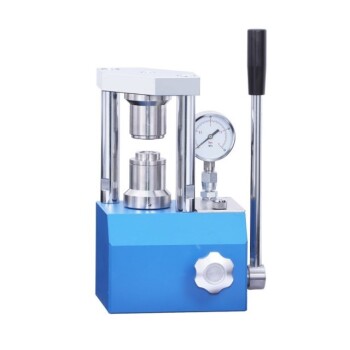
The primary role of a lab press machine in the evaluation of all-solid-state batteries (ASSBs) is to enforce intimate physical contact between rigid solid components. Unlike liquid electrolytes that naturally wet electrode surfaces, solid electrolytes require significant external mechanical pressure to eliminate voids, reduce impedance, and establish the continuous pathways necessary for ion transport.
In a solid-state system, performance is dictated by the quality of physical contact between particles. The lab press machine is not merely an assembly tool; it is a critical instrument for impedance management and structural stabilization, ensuring that the internal resistance remains low enough to capture accurate performance data.
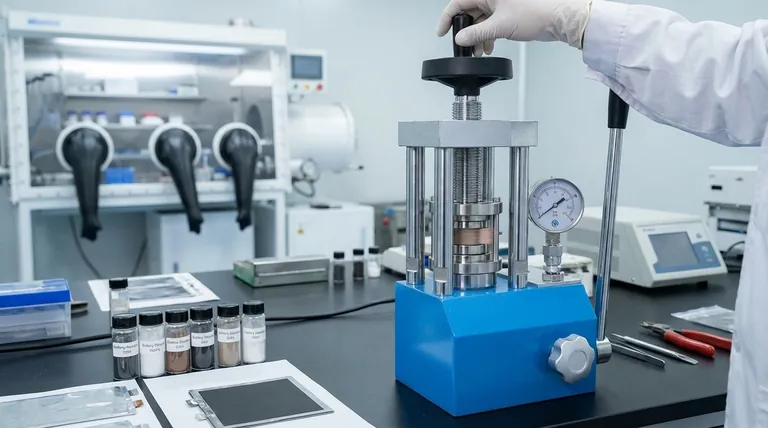
Overcoming the Physics of Solid Interfaces
The Challenge of Rigidity
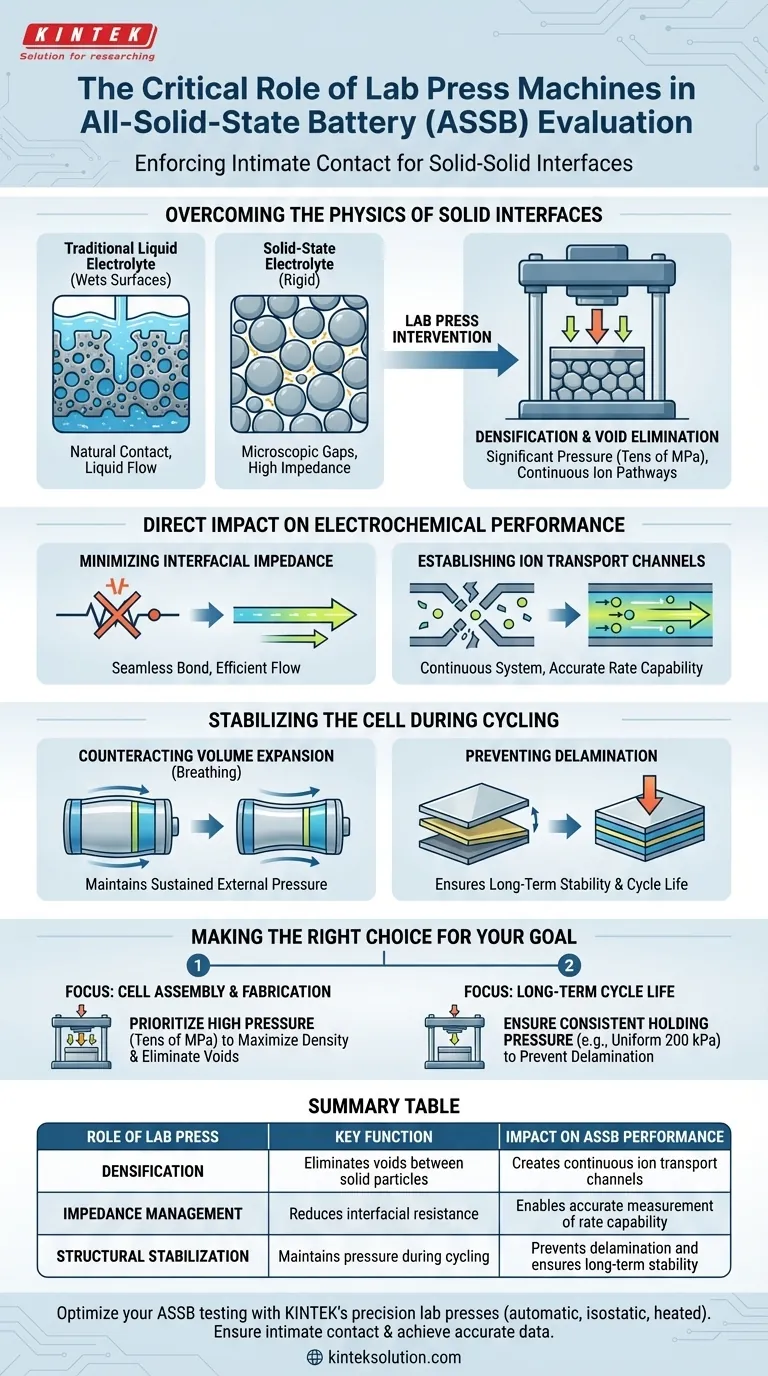
In traditional batteries, liquid electrolytes flow into porous electrodes, creating contact naturally. In ASSBs, the interfaces are solid-solid.
These components are inherently rigid. Without external intervention, microscopic gaps exist between the active material and the solid electrolyte particles.
Eliminating Voids via Densification
A lab press applies significant pressure—often in the range of tens of megapascals—to compress these particles together.
This process eliminates voids within the cell structure. By pressing the particles into a dense network, the machine ensures that the ion transport system is continuous rather than fragmented.
Direct Impact on Electrochemical Performance
Minimizing Interfacial Impedance
The most immediate impact of proper pressure application is a drastic reduction in interfacial impedance.
If the contact is poor, resistance spikes, effectively choking the battery's performance. The press creates a physically seamless bond between layers, allowing electricity to flow efficiently.
Establishing Ion Transport Channels
Ion transport in these cells relies entirely on direct physical contact.
By creating a high-density structure, the lab press guarantees open and efficient ion transport channels. This allows lithium ions to move rapidy through the cell, which is essential for evaluating the battery's true rate capability.
Stabilizing the Cell During Cycling
Counteracting Volume Expansion
Battery materials often change volume during charging and discharging (swelling and shrinking).
In a solid environment, this "breathing" can lead to contact loss. The lab press maintains sustained external pressure throughout the testing cycle to counteract these shifts.
Preventing Delamination
If pressure is released or insufficient, the layers may separate or delaminate.
Maintained pressure ensures that interface separation caused by material volume changes is overcome. This is vital for assessing long-term cell stability and cycle life, rather than just initial capacity.
Understanding the Trade-offs
High Pressure Requirements
The pressure required for ASSBs is substantial. While some contexts may utilize lower pressures (e.g., 200 kPa) for specific bonding phases, densification often requires much higher force.
This necessitates robust equipment capable of delivering and holding tens of megapascals safely.
The Complexity of "In-Operando" Pressure
Applying pressure during assembly is different from maintaining it during operation.
Evaluating performance requires the press to maintain consistent pressure while the cell is cycling. This adds complexity to the testing setup, as the equipment must account for the cell's slight mechanical shifts without losing the critical intimate contact.
Making the Right Choice for Your Goal
To properly evaluate all-solid-state cells, you must align your pressure strategy with your specific testing objectives.
- If your primary focus is Cell Assembly and Fabrication: Prioritize high-pressure capabilities (tens of megapascals) to maximize density and eliminate all internal voids before testing begins.
- If your primary focus is Long-Term Cycle Life: Ensure your setup can maintain consistent, lower-range holding pressure (e.g., uniform 200 kPa or higher) to prevent delamination caused by volume expansion over time.
Ultimately, the lab press converts a collection of rigid particles into a unified electrochemical system, acting as the fundamental enabler of solid-state ion transport.
Summary Table:
| Role of Lab Press | Key Function | Impact on ASSB Performance |
|---|---|---|
| Densification | Eliminates voids between solid particles | Creates continuous ion transport channels |
| Impedance Management | Reduces interfacial resistance | Enables accurate measurement of rate capability |
| Structural Stabilization | Maintains pressure during cycling | Prevents delamination and ensures long-term stability |
Ready to optimize your all-solid-state battery testing? KINTEK's precision lab press machines (including automatic, isostatic, and heated lab presses) are engineered to deliver and maintain the exact pressure required for reliable cell assembly and long-term cycling. Ensure intimate contact, minimize impedance, and achieve accurate performance data. Contact our experts today to discuss how our solutions can enhance your laboratory's capabilities!
Visual Guide
Related Products
- Warm Isostatic Press for Solid State Battery Research Warm Isostatic Press
- Button Battery Sealing Press Machine for Lab
- Laboratory Hydraulic Press Lab Pellet Press Button Battery Press
- Lab Infrared Press Mold for Laboratory Applications
- Lab Cylindrical Press Mold for Laboratory Use
People Also Ask
- Why must composite cathodes be sealed in vacuum lamination bags for WIP? Ensure Battery Stability and Density
- What is the function of elastic molds in warm isostatic pressing? Achieve Uniform Density in Composite Particles
- How do sacrificial volume materials (SVM) maintain microchannels in isostatic pressing? Ensure Structural Integrity
- What is the process involved in warm isostatic pressing? Mastering Uniform Density with WIP Technology
- How does Warm Isostatic Pressing differ from traditional pressing methods? Unlock Uniform Density for Complex Parts