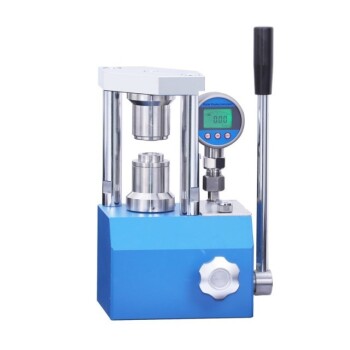
A laboratory press or crimper acts as the decisive mechanical interface in coin cell assembly. It applies precise, controlled pressure to permanently join the outer battery casing with the internal stack of components, including the spring, gasket, and electrodes. This process transforms a collection of loose materials into a sealed, unified electrochemical device ready for testing.
The press performs a dual function: it creates a hermetic seal to prevent leakage and environmental contamination, while simultaneously forcing internal layers into tight contact to minimize electrical resistance and ensure accurate data.
The Mechanics of Structural Integrity
Precise Pressure Application
The primary function of the press is to deliver uniform mechanical pressure. Unlike manual methods, a laboratory press controls the force applied to the battery casing, ensuring the metal deforms exactly enough to grip the sealing gasket without crushing delicate internal structures.
Component Integration
The crimping process physically binds the external battery case to the internal "stack." This stack typically includes the active material, separator, current collectors, and springs. The press compresses the spring within the assembly, which maintains internal tension even after the crimping force is removed.
Impact on Electrochemical Performance
Minimizing Contact Resistance
A battery cannot function efficiently if electricity cannot flow easily between layers. The press ensures tight physical contact between the active materials and the current collectors. This significantly reduces interface contact resistance (ohmic resistance), which is vital for high-performance operation.
Ensuring Data Accuracy
For researchers, the crimper is a tool for data integrity. By guaranteeing consistent contact pressure across different samples, the press eliminates variables caused by poor assembly. This ensures that electrochemical testing data reflects the true chemistry of the battery, not assembly errors.
Support for Advanced Chemistries
In specialized applications like solid-state batteries, the role of the press is even more critical. It forces the cathode, solid-state electrolyte, and anode into intimate contact, improving ion transport efficiency where liquid electrolytes are not present to bridge the gap.
Sealing and Isolation
Hermetic Encapsulation
The press deforms the coin cell case against a polymer gasket to create an airtight seal. This hermetic encapsulation prevents the liquid electrolyte inside from leaking or volatilizing (evaporating), which would otherwise lead to rapid cell failure.
Environmental Protection
The seal created by the crimper acts as a barrier against the external environment. It prevents the ingress of moisture and air, both of which can react with sensitive electrode materials (like lithium or sodium metal) and compromise the experiment.
Common Pitfalls to Avoid
While the role of the press is straightforward, the application of pressure involves critical trade-offs that affect success.
- Under-Crimping: Insufficient pressure fails to compress the gasket fully. This leads to electrolyte leakage, high internal resistance due to poor contact, and eventual cell failure during long-term cycling.
- Over-Crimping: Excessive pressure can deform the battery can too severely or crush the internal separator. This frequently causes internal short circuits, rendering the cell useless immediately.
- Misalignment: If the components are not perfectly centered before the press is engaged, the pressure will be uneven. This results in a "lopsided" crimp that seals on one side but leaks on the other.
Making the Right Choice for Your Goal
To maximize the utility of your laboratory press, tailor your focus to your specific testing objectives:
- If your primary focus is Fundamental Research: Prioritize repeatability in your crimping pressure to ensure that variations in your data are due to material changes, not assembly inconsistencies.
- If your primary focus is Long-Term Cycling: Prioritize seal integrity to prevent electrolyte evaporation or moisture ingress, which are the leading causes of failure in extended tests.
Ultimately, the laboratory press is the gatekeeper of your experiment, converting raw materials into a testable device where the only variable is the chemistry you designed.
Summary Table:
| Function | Key Role in Assembly | Impact on Battery Performance |
|---|---|---|
| Pressure Application | Compresses internal components & spring | Lowers ohmic resistance for better conductivity |
| Hermetic Sealing | Deforms casing against the gasket | Prevents electrolyte leakage and moisture ingress |
| Component Binding | Unifies case, gasket, and electrodes | Ensures data consistency across multiple test samples |
| Structural Support | Maintains internal tension post-crimp | Enables long-term cycling and stable ion transport |
Precision Solutions for Your Battery Research
At KINTEK, we understand that your research data is only as good as the integrity of your cell assembly. Our specialized laboratory pressing solutions—ranging from manual and automatic models to heated and glovebox-compatible designs—are engineered to deliver the repeatable pressure and hermetic sealing required for cutting-edge battery innovation.
Whether you are working on fundamental chemistry or advanced solid-state and isostatic pressing applications, our equipment ensures your cells are leak-proof and performance-optimized. Partner with KINTEK today for superior lab efficiency and get the technical support your research deserves.
References
- Y. Bhaskara Rao, C. André Ohlin. T‐Nb <sub>2</sub> O <sub>5</sub> (Orthorhombic)/C: An Efficient Electrode Material for Na‐Ion Battery Application. DOI: 10.1002/batt.202500134
This article is also based on technical information from Kintek Solution Knowledge Base .
Related Products
- Button Battery Sealing Press Machine for Lab
- Lab Button Battery Tablet Press Sealing Mold
- Warm Isostatic Press for Solid State Battery Research Warm Isostatic Press
- Laboratory Hydraulic Press Lab Pellet Press Button Battery Press
- Button Battery Sealing Machine for Button Batteries
People Also Ask
- Why use standardized CR2032 components & high-precision presses? Ensure reliability in lithium metal battery research.
- Why is a laboratory battery sealing press essential for desolvation energy testing? Ensure Reliable Kinetic Data
- Why is a laboratory hydraulic press or battery sealing machine essential? Ensure Coin Cell Data Integrity
- How do laboratory battery sealing machines ensure performance consistency? Master Your Lithium and LFP Battery Assembly
- What role does a laboratory sealing press play in thermal analysis of solid dispersion films? Ensure Data Integrity