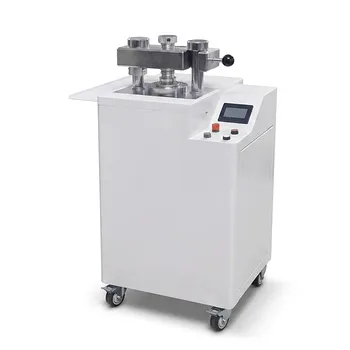
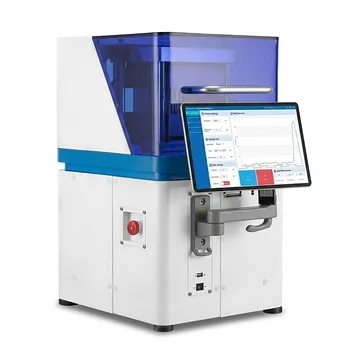
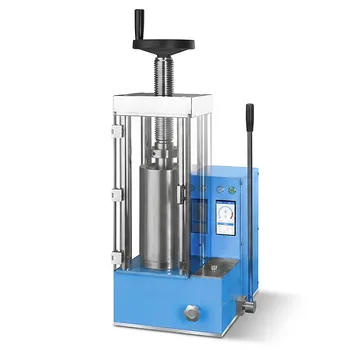
A servo-controlled laboratory press serves as the critical tool for quantifying how corrosive environments compromise the mechanical integrity of geopolymer materials. It provides the precise, constant loading rates necessary to measure compressive strength before and after exposure to acidic or sewage conditions. By comparing these failure loads, researchers can establish a standardized metric for structural durability relative to traditional Portland cement.
The servo-controlled lab press bridges the gap between material synthesis and structural validation by providing a controlled environment for both high-density specimen fabrication and high-precision failure analysis. In durability studies, it acts as the primary tool for quantifying the actual strength loss caused by chemical degradation.
Precision Molding: Creating a Controlled Baseline
Optimizing Particle Packing and Density
Before a geopolymer can be tested in a corrosive environment, it must be fabricated without internal flaws. A laboratory press applies uniform pressure to compact geopolymer slurries, which forcibly removes residual air and optimizes particle packing density. This high-precision molding process is essential for creating a "green body" that is dense enough to resist premature infiltration by corrosive agents.
Eliminating Structural Micro-Inconsistencies
The use of a press helps eliminate internal pores and density gradients that could skew durability results. By providing stable pressure control during the molding of test blocks, the equipment prevents the formation of micro-cracks during the hardening and drying stages. This ensures that any subsequent cracking observed after chemical exposure is due to the environment rather than manufacturing defects.
Analytical Validation in Corrosive Environments
The Role of Servo-Control in Mechanical Testing
The "servo" aspect of the press is vital because it allows for an extremely precise and constant loading rate during destructive testing. Unlike manual systems, a servo-controlled press maintains a steady application of force until the point of failure. This precision is necessary to isolate the effects of acidic or sewage exposure on the material's structural bonds.
Quantifying Chemical Attack via Load Comparison
By testing specimens at various intervals—ranging from 3 to 90 days of exposure—researchers use the press to measure the "failure load." This data allows for the quantification of mechanical property degradation over time. These results provide the empirical evidence needed for AI prediction models to forecast the long-term lifespan of geopolymers in harsh infrastructure settings.
Understanding the Trade-offs and Limitations
Laboratory Scale vs. Real-World Application
While a laboratory press provides high-precision data, it typically operates on standardized, small-scale test blocks. These results may not always account for the structural complexity or the varied "dwell times" of chemicals in large-scale industrial sewage systems. Furthermore, the specialized nature of servo-controlled equipment requires rigorous calibration to ensure that data remains consistent across different batches and testing environments.
How to Apply This to Your Project
When integrating a laboratory press into your geopolymer durability research, consider your specific analytical objectives:
- If your primary focus is material benchmarking: Use the servo-controlled press to compare the failure loads of geopolymers against traditional concrete after identical exposure to acidic media.
- If your primary focus is resource utilization: Leverage the press to determine the optimal molding pressure and dwell time for converting industrial tailings into dense, durable structural blocks.
The precision of a servo-controlled press transforms qualitative observations of corrosion into the quantitative data required for professional engineering specifications.
Summary Table:
| Phase | Function of Servo Press | Structural Benefit |
|---|---|---|
| Fabrication | Uniform compression & particle packing | Eliminates internal pores and micro-cracks |
| Mechanical Testing | Precise, constant loading rates | Isolates chemical impact from manufacturing defects |
| Data Analysis | Quantitative failure load measurement | Enables AI models to forecast long-term lifespan |
Elevate Your Material Research with KINTEK Precision
Reliable durability data starts with consistent specimen preparation and high-precision testing. KINTEK specializes in comprehensive laboratory pressing solutions designed to meet the rigorous demands of geopolymer and battery research.
Our extensive lineup includes:
- Manual & Automatic Presses for versatile lab needs.
- Heated & Multifunctional Models for complex material synthesis.
- Glovebox-Compatible Systems for air-sensitive research.
- Cold and Warm Isostatic Presses (CIP/WIP) for superior density control.
Ensure your structural validation is backed by world-class precision. Contact KINTEK today to find the ideal pressing solution for your laboratory!
References
- Shriram Marathe, Murugan Muthu. Degradation Potential of Metakaolin-Based Geopolymer Composites Immersed in Real and Simulated Acidic Environments. DOI: 10.3390/su17020468
This article is also based on technical information from Kintek Solution Knowledge Base .
Related Products
- Automatic Heated Hydraulic Lab Press with Programmable Touch Screen Controls and Precision Temperature Regulation
- Automatic Laboratory Hydraulic Press Lab Pellet Press Machine
- Automatic Heated Hydraulic Lab Press 120x120mm Plate Fully Automated Material Research Press
- Automatic XRF Pellet Press for Laboratory Spectrometry Sample Preparation
- Automatic Hydraulic Hot Press with Large Plate and Precision Temperature Control for Advanced Material Sample Preparation and Industrial Research
People Also Ask
- What are the recommended cleaning procedures for a heated lab press? Ensure Precision and Longevity in Your Lab
- Role of Laboratory Heated Hydraulic Presses in Solid Electrolyte Fabrication: Enhance Density & Ionic Conductivity
- Why is a heated laboratory hydraulic press necessary for producing controlled-release fertilizer tablets? Gain Precision.
- What role does a Laboratory Heated Hydraulic Press play in rubber vulcanization? Master Precision Specimen Molding
- What is the necessity of a laboratory hydraulic press with heating functions? Master Rubber Vulcanization Precision