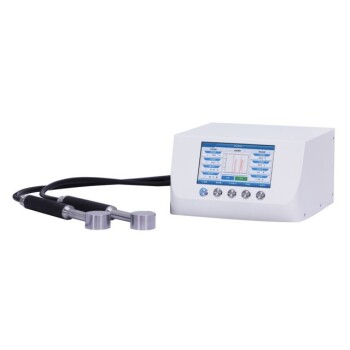
An industrial-grade electric furnace functions as a precision instrument for tailoring the surface properties of zeolite through controlled thermal treatment. By maintaining a high-temperature environment between 400°C and 1000°C, the furnace performs the dual role of removing adsorbed water and chemically restructuring the material's surface sites.
The core value of the electric furnace lies in its ability to regulate the population of silanol groups on the zeolite structure. By controlling the density of these weak acid sites, researchers can directly influence and verify the material's contribution to the conductivity of aqueous solutions.
The Mechanics of Thermal Treatment
Elimination of Surface Moisture
The primary function of the furnace is to create a thermal environment ranging from 400°C to 1000°C.
This intense heat is necessary to drive off adsorbed water that naturally adheres to the porous surface of the zeolite.
Precise Process Control
Achieving the desired chemical properties requires more than just high heat; it demands stability.
The furnace allows for the precise management of both the specific heating temperature and the duration of the treatment.
Modifying Surface Chemistry
Regulating Silanol Groups
The thermal treatment process directly impacts the chemical topography of the zeolite.
By adjusting the heat parameters, researchers can increase or decrease the number of silanol groups present on the surface.
Linking Structure to Conductivity
These silanol groups serve a specific functional purpose: they act as weak acid sites.
The furnace enables researchers to verify the correlation between the density of these sites and the electrical conductivity of aqueous solutions containing the treated zeolite.
Critical Factors in Process Control
The Importance of Duration
The length of time the zeolite spends in the furnace is as critical as the temperature itself.
Variations in heating duration can alter the final count of silanol groups, potentially changing the material's conductive behavior.
Balancing Temperature Variables
Operating within the 400°C to 1000°C window requires careful selection based on the specific outcome desired.
Improper temperature settings may result in incomplete water removal or unintended alterations to the weak acid sites, skewing verification results.
Optimizing the Calcination Strategy
To maximize the utility of your industrial furnace for zeolite treatment, align your settings with your specific research or production goals.
- If your primary focus is baseline purification: Target the temperature range specifically required to fully eliminate adsorbed water without altering the underlying structure.
- If your primary focus is conductivity analysis: Prioritize the precise modulation of heating duration to systematically vary the number of silanol groups for comparative testing.
The electric furnace is not merely a heating vessel, but a tool for tuning the electrochemical potential of the zeolite surface.
Summary Table:
| Process Function | Temperature Range | Key Outcome |
|---|---|---|
| Elimination of Surface Moisture | 400°C – 1000°C | Complete removal of adsorbed water from porous structures |
| Chemical Restructuring | Precision Controlled | Regulation of silanol groups and weak acid site density |
| Performance Verification | Application Specific | Correlation of surface chemistry to aqueous conductivity |
| Process Stability | Variable Duration | Consistent electrochemical potential and material purity |
Elevate Your Material Research with KINTEK Precision
Ready to achieve unmatched control over your zeolite calcination and thermal treatment processes? KINTEK specializes in comprehensive laboratory pressing and thermal solutions, offering a robust range of manual, automatic, heated, and multifunctional models. Whether you are conducting advanced battery research or exploring electrochemical potential, our equipment provides the stability and precision your lab requires.
Unlock the full potential of your materials—Contact KINTEK today for a consultation!
References
- Koichiro Hojo, Shigeo Satokawa. Enhancement of ionic conductivity of aqueous solution by silanol groups over zeolite surface. DOI: 10.1016/j.micromeso.2020.110743
This article is also based on technical information from Kintek Solution Knowledge Base .
Related Products
- Automatic High Temperature Heated Hydraulic Press Machine with Heated Plates for Lab
- Lab Double Plate Heating Mold for Laboratory Use
- Infrared Heating Quantitative Flat Plate Mold for Precise Temperature Control
- Split Automatic Heated Hydraulic Press Machine with Heated Plates
- Manual Heated Hydraulic Lab Press with Integrated Hot Plates Hydraulic Press Machine
People Also Ask
- Function of a Laboratory Hydraulic Press with Heated Platens in SSE? Enhance Battery Density & Conductivity
- How does a laboratory heated hydraulic press facilitate PBN sample prep for WAXS? Achieve Precise X-Ray Scattering
- What are the requirements for electrode pressing with high-viscosity ionic liquids like EMIM TFSI? Optimize Performance
- What are the industrial applications of heated hydraulic presses? Master Heat & Force for Precision Manufacturing
- Why is a laboratory hydraulic press with heating plates required for PLA/TEC films? Achieve Precise Sample Integrity