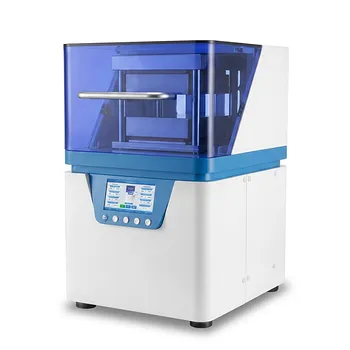
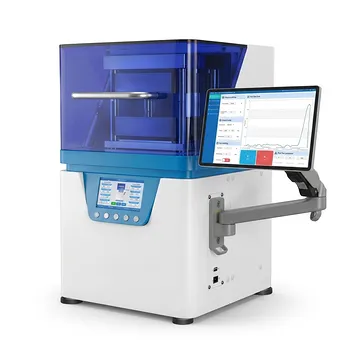
The hydraulic cylinder acts as the primary force generator within a laboratory press, directly responsible for converting hydraulic fluid pressure into the mechanical force needed to compress samples. It operates by utilizing a confined fluid to deliver a high-magnitude, linear force that molds materials, eliminates voids, and ensures structural integrity.
The Core Takeaway The hydraulic cylinder is not merely a crushing tool; it is a precision instrument that leverages Pascal’s Law to apply uniform pressure. This uniformity is critical for eliminating microscopic defects like air bubbles or pores, ensuring that scientific samples possess the consistent density required for reproducible experimental data.
The Mechanics of Force Application
Operating on Pascal's Law
The fundamental operation of the cylinder relies on Pascal’s Law. This physical principle states that pressure applied to a confined fluid—typically oil in these systems—is transmitted undiminished and equally in all directions.
Translating Fluid Pressure to Motion
The cylinder contains a piston or ram that acts as the moving interface. As pressurized fluid enters the cylinder, it pushes against this ram, converting hydraulic energy into linear mechanical motion.
Generating High-Pressure Output
Through this mechanism, the press can generate immense force, such as 250 MPa, sufficient to compress powders or mold rubber. This capability allows the system to achieve high-pressure output while remaining relatively compact and easy to operate.
Critical Functions in Sample Preparation
Ensuring Uniform Compression
The cylinder is crucial for applying pressure evenly throughout the sample material. This consistency prevents density gradients, ensuring that one part of the sample is not more compressed than another.
Eliminating Structural Defects
In applications like rubber molding or powder compaction, the cylinder's force prevents common defects. It ensures the expulsion of trapped air, preventing air bubbles, overflow, or lack of adhesion (glue) in the final product.
Inducing Plastic Deformation
For powder samples, the high pressure applied by the cylinder forces particles to rearrange and undergo plastic deformation. This eliminates gaps between particles, resulting in a dense, solid pellet with high mechanical strength and low impedance.
Operational Considerations and Trade-offs
Maintenance of Hydraulic Integrity
The system's efficiency relies entirely on the fluid being perfectly confined. Seal wear or fluid leaks within the cylinder immediately disrupt the application of Pascal’s Law, leading to pressure drops and inconsistent sample quality.
Balancing Speed and Control
While the cylinder provides the force, the speed of actuation involves a trade-off. Systems often employ dual mechanisms: a rapid advance for positioning and a slower, high-pressure mode for the actual compression to ensure accurate control without damaging the sample.
Energy Storage and Responsiveness
Ideally, the cylinder works in tandem with an accumulator to maintain pressure without running the pump continuously. Without this support, the cylinder relies solely on active pumping, which can lead to increased mechanical wear and energy inefficiency during long hold times.
Making the Right Choice for Your Goal
When evaluating the performance of a laboratory press cylinder, consider your specific experimental requirements.
- If your primary focus is quantitative analysis (XRF/Spectroscopy): Prioritize a cylinder system capable of precise pressure holding to ensure high reproducibility and uniform pellet density.
- If your primary focus is material synthesis (Rubber/Polymers): Focus on a system that guarantees even force distribution to prevent air bubbles and ensure complete mold filling.
The hydraulic cylinder is the defining component that transforms raw potential energy into the precise, high-load force necessary for scientific rigor.
Summary Table:
| Feature | Function in Hydraulic Cylinder | Benefit to Research |
|---|---|---|
| Force Generation | Converts fluid pressure to linear motion | Achieves high pressures (up to 250 MPa) |
| Pascal’s Law | Uniform pressure distribution | Eliminates density gradients and air bubbles |
| Piston Control | Precise ram movement | Ensures accurate plastic deformation of powders |
| Seal Integrity | Confines hydraulic fluid | Maintains consistent pressure during long hold times |
Elevate Your Material Research with KINTEK
Precision in your hydraulic cylinder defines the accuracy of your scientific data. KINTEK specializes in comprehensive laboratory pressing solutions designed for rigor and reproducibility. Whether you require manual, automatic, heated, or multifunctional models, or specialized cold and warm isostatic presses for advanced battery research, we provide the tools to eliminate structural defects and ensure uniform sample density.
Ready to optimize your pellet preparation and material synthesis?
Contact our laboratory specialists today to find the perfect press for your application.
Related Products
- Automatic Hydraulic Hot Press with Large Plate and Precision Temperature Control for Advanced Material Sample Preparation and Industrial Research
- Laboratory Hydraulic Pellet Press for XRF KBR FTIR Lab Press
- Automatic Hydraulic Heat Press Machine with Multi Stage Programmable Control and Integrated Water Cooling Plate Size 180x180mm
- Automatic Laboratory Hydraulic Press for XRF and KBR Pellet Pressing
- Automatic Large Format Laboratory Heated Hydraulic Press 400x400mm Plate Capacity
People Also Ask
- What are the specific features and applications of hydraulic hot press machines? Precision Solutions for Modern Labs
- How does an automatic hydraulic press operate? Achieve Precision and Consistency in Lab Pelleting
- What are the advantages and common applications of an automatic hydraulic press? Elevate Your Lab's Precision
- What is the technical significance of setting a precise dwell time? Achieve Peak Material Density and Stability
- When is an automatic hydraulic press more suitable than a manual press? Scale Your Lab with Precision & Speed