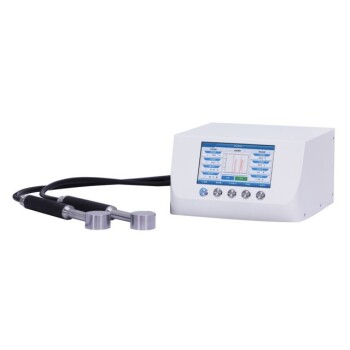
In the preparation of densified silica glass via liquid quenching, high-performance heating and rapid cooling equipment function as the critical gatekeepers of material structure. The heating apparatus drives the raw silica to extreme temperatures (e.g., 3600 K) to ensure a perfectly uniform melt, while the cooling system instantly drops the temperature to lock the material into a specific amorphous state before it can crystallize.
By pushing silica well beyond its melting point and then instantly freezing that state, this process bypasses the natural tendency of the material to crystallize. This creates a high-purity, disordered glass matrix that is structurally prepared for subsequent high-pressure densification.
The Role of Thermal Extremes
Achieving Absolute Homogeneity
The primary function of the high-performance heating equipment is to overcome the high melting point of silica. By raising the temperature to approximately 3600 K, the equipment does more than just melt the raw material.
It ensures the molten silica reaches a uniform molten state. At these temperatures, any residual crystalline structures are destroyed, and the chemical composition becomes homogenous throughout the volume. This uniformity is the foundation for a high-quality final product.
Suppressing Crystallization
Once the silica is molten, the rapid cooling (quenching) system takes over. Its role is to lower the system temperature to ambient levels at an extremely high rate.
Speed is the critical variable here. If the cooling is too slow, the silica atoms have time to rearrange themselves into an ordered, crystalline pattern. Rapid quenching denies the atoms this time, effectively suppressing crystallization.
Locking in the Amorphous Structure
The ultimate goal of the quenching phase is to "freeze" the disorder of the liquid state. By cooling rapidly, the system locks the silica into an amorphous structure.
This results in a glass matrix that retains the high purity established during heating. This specific amorphous structure is required to ensure the material is suitable for further high-pressure treatments.
Critical Process Challenges
The Window of Instability
There is a specific temperature range during cooling where the material is most likely to revert to a crystal. The equipment must be powerful enough to bypass this window almost instantaneously. Failure to cool fast enough results in a partially crystallized, unusable sample.
Energy and Material Demands
Reaching 3600 K places immense stress on the heating equipment. The system must be robust enough to sustain these temperatures without degrading or introducing contaminants into the silica. Any fluctuation in heating can lead to inhomogeneities that the quenching process locks in rather than eliminates.
Making the Right Choice for Your Goal
To maximize the quality of densified silica glass, you must balance thermal capacity with quenching speed.
- If your primary focus is material uniformity: Prioritize heating capabilities that can reliably sustain temperatures of 3600 K to ensure a fully homogenized melt.
- If your primary focus is preventing defects: Prioritize the speed of the quenching system to ensure the amorphous structure is locked in before crystallization kinetics can take over.
Success depends on the equipment's ability to seamlessly transition from extreme heat to ambient stability without hesitation.
Summary Table:
| Process Phase | Equipment Role | Critical Parameter | Outcome |
|---|---|---|---|
| Melting | High-Performance Heating | ~3600 K | Absolute homogeneity & destruction of crystal remnants |
| Quenching | Rapid Cooling System | Extreme Cooling Rate | Suppression of crystallization kinetics |
| Stabilization | Thermal Control | Ambient Transition | Locking the disordered liquid state into a glass matrix |
Elevate Your Material Research with KINTEK
Precise thermal management is the difference between a perfect amorphous structure and a failed sample. KINTEK specializes in comprehensive laboratory solutions designed to meet the rigorous demands of advanced material science.
Whether you are conducting battery research or developing densified silica glass, our range of manual, automatic, heated, and multifunctional models, alongside our cold and warm isostatic presses, provide the stability and control your lab requires.
Ready to optimize your densification process? Contact our technical experts today to find the perfect equipment for your high-pressure and high-temperature applications.
References
- Adam Puchalski, Pawel Keblinski. Structure and thermal conductivity of high-pressure-treated silica glass. A molecular dynamics study. DOI: 10.1063/5.0183508
This article is also based on technical information from Kintek Solution Knowledge Base .
Related Products
- Automatic High Temperature Heated Hydraulic Press Machine with Heated Plates for Lab
- 24T 30T 60T Heated Hydraulic Lab Press Machine with Hot Plates for Laboratory
- Lab Double Plate Heating Mold for Laboratory Use
- Automatic Heated Hydraulic Press Machine with Heated Plates for Laboratory
- Heated Hydraulic Press Machine With Heated Plates For Vacuum Box Laboratory Hot Press
People Also Ask
- Function of a Laboratory Hydraulic Press with Heated Platens in SSE? Enhance Battery Density & Conductivity
- How does a laboratory heated hydraulic press facilitate PBN sample prep for WAXS? Achieve Precise X-Ray Scattering
- What are the requirements for electrode pressing with high-viscosity ionic liquids like EMIM TFSI? Optimize Performance
- What are the industrial applications of heated hydraulic presses? Master Heat & Force for Precision Manufacturing
- Why is a laboratory hydraulic press with heating plates required for PLA/TEC films? Achieve Precise Sample Integrity