
The application of 640 MPa pressure during cold-pressing is a critical preparation step required to physically transform the Li-Lu-Zr-Cl electrolyte from a loose powder into a unified, dense pellet. This specific high-pressure value is necessary to eliminate internal porosity and maximize particle-to-particle contact. By doing so, you minimize the resistance occurring at the grain boundaries, ensuring that subsequent measurements reflect the true performance of the material rather than the artifacts of a poorly compacted sample.
The Core Insight In solid-state electrolyte research, the geometric arrangement of particles often dictates the measured resistance more than the chemistry of the particles themselves. Pressing at 640 MPa ensures the sample reaches a density where grain boundary resistance is negligible, allowing Electrochemical Impedance Spectroscopy (EIS) to reveal the intrinsic ionic conductivity of the bulk material.
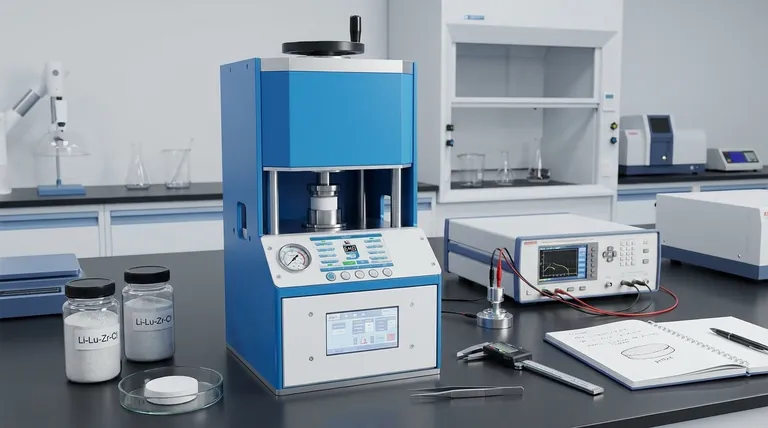
The Mechanics of Densification
Eliminating Microstructural Voids
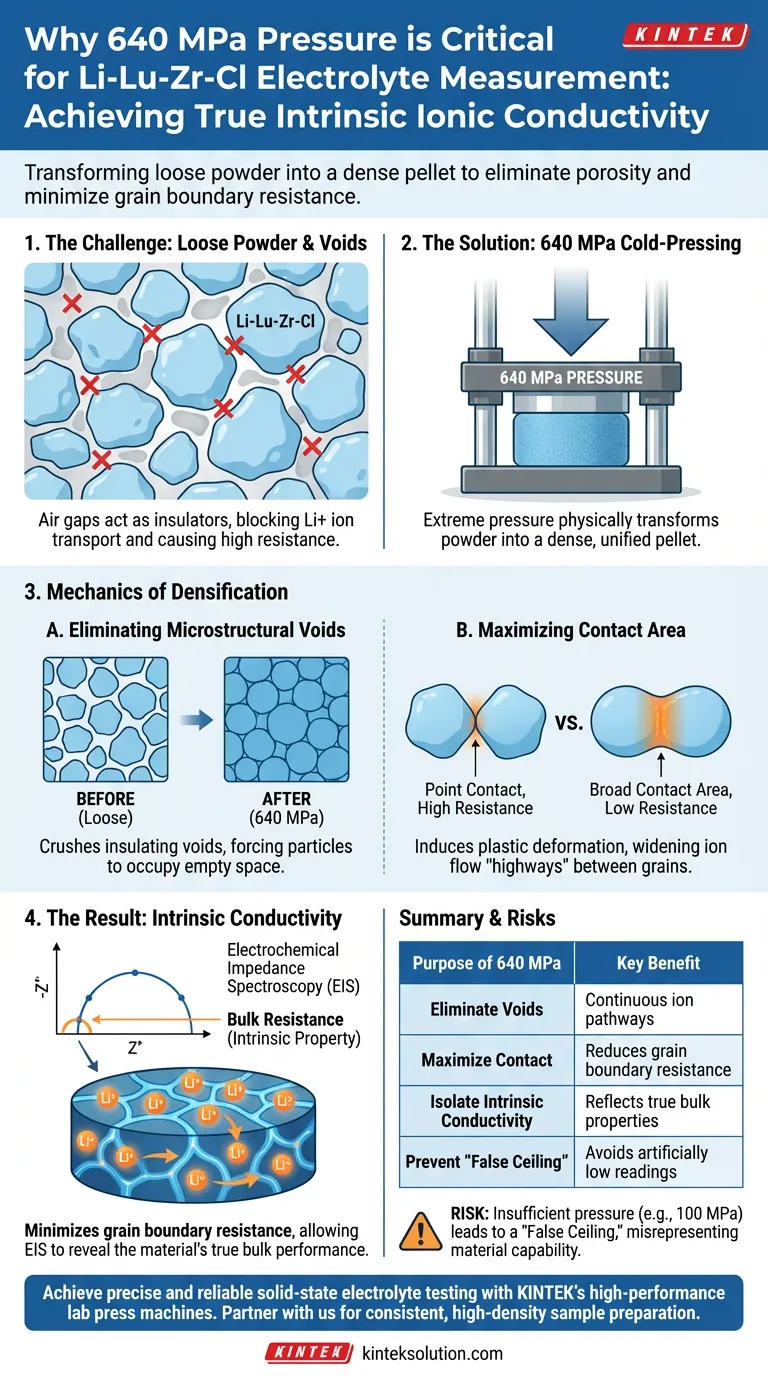
Synthesized electrolyte powders naturally contain significant amounts of empty space, or voids, between individual particles. Air is an electrical insulator; it does not conduct lithium ions.
If these voids remain during measurement, they act as physical roadblocks to ion transport. Applying 640 MPa effectively crushes these voids, forcing the solid particles to occupy the empty spaces and creating a continuous solid mass.
Maximizing Contact Area
Simply touching two particles together creates a "point contact," which offers a very narrow pathway for ions to travel. This creates a bottleneck known as high interfacial resistance.
The extreme pressure of cold-pressing induces plastic deformation in the powder. This flattens the contact points into broad contact areas, significantly widening the "highway" available for ion flow between grains.
Why "Intrinsic" Conductivity Matters
Isolating Bulk Properties
Your goal is to measure how well the Li-Lu-Zr-Cl crystal structure transports ions (intrinsic conductivity). However, impedance spectroscopy measures the total resistance of the sample, which includes both the bulk material and the boundaries between particles.
If the sample is not densified at high pressure (e.g., 640 MPa), the resistance at the grain boundaries will dominate the signal. This leads to artificially low conductivity readings that misrepresent the material's actual potential.
Creating Continuous Ion Pathways
For an electrolyte to function, lithium ions must move through the material via a connected network of transport sites.
High-pressure consolidation ensures these pathways are continuous across the entire pellet. This allows the measurement current to travel through the bulk of the material rather than struggling to jump across gaps between loose particles.
Understanding the Risks of Insufficient Pressure
While high pressure is beneficial, it is important to understand the implications of the fabrication process.
The "False Ceiling" of Conductivity
The most common pitfall in solid-state electrolyte research is reporting conductivity values that are lower than the material's theoretical limit. This is rarely due to chemical degradation and almost always due to insufficient densification.
If you press at a lower pressure (e.g., only 100 or 200 MPa), you may achieve a pellet that holds its shape but still contains microscopic pores. This results in data that characterizes the pellet's quality, not the material's capability.
Microstructural Integrity
The pressure must be uniaxial and uniform. If the pressure is applied unevenly, or if the pellet is ejected improperly, micro-cracks can form. While the material may look dense, these cracks re-introduce high-resistance barriers that negate the benefits of the high-pressure press.
Ensuring Accuracy in Your Analysis
To obtain data that the scientific community will trust, you must align your fabrication method with your measurement goals.
- If your primary focus is Material Discovery: Use the full 640 MPa to maximize density; your priority is establishing the theoretical upper limit of the material’s ionic conductivity.
- If your primary focus is Cell Integration: Ensure that the density achieved in the test pellet matches the density feasible in your actual battery assembly, as lower pressures in manufacturing may yield different performance.
Ultimately, the use of 640 MPa is not merely about shaping the sample; it is a prerequisite for removing physical variables so that the chemical reality of the electrolyte can be observed.
Summary Table:
| Purpose of 640 MPa Pressure | Key Benefit |
|---|---|
| Eliminate Microstructural Voids | Removes insulating air gaps for continuous ion pathways |
| Maximize Particle Contact Area | Reduces grain boundary resistance by creating broad contact areas |
| Isolate Intrinsic Conductivity | Ensures EIS measurements reflect bulk material properties, not pellet artifacts |
| Prevent Artificially Low Readings | Avoids the 'false ceiling' of conductivity caused by insufficient densification |
Achieve precise and reliable solid-state electrolyte testing with KINTEK's high-performance lab press machines.
Accurate ionic conductivity measurements start with proper sample preparation. Our automatic lab presses, isostatic presses, and heated lab presses are engineered to deliver the uniform, high-pressure compaction (like the critical 640 MPa) required to eliminate porosity and minimize grain boundary resistance in materials like Li-Lu-Zr-Cl. This ensures your EIS data reflects the true potential of your electrolyte material, supporting valid material discovery and credible research publications.
Let KINTEK be your partner in reliable lab fabrication. We specialize in serving the precise needs of laboratories and research institutions. Contact us today to discuss how our lab press solutions can enhance your solid-state battery research workflow and data integrity.
Visual Guide
Related Products
- Electric Lab Cold Isostatic Press CIP Machine
- Electric Split Lab Cold Isostatic Pressing CIP Machine
- Manual Cold Isostatic Pressing CIP Machine Pellet Press
- Automatic Lab Cold Isostatic Pressing CIP Machine
- Lab Isostatic Pressing Molds for Isostatic Molding
People Also Ask
- What role do electric lab cold isostatic presses play in industrial contexts? Bridge R&D and Manufacturing with Precision
- What are the applications of electric lab cold isostatic presses in research settings? Advance Material R&D with High-Pressure CIPs
- How does electrical Cold Isostatic Pressing (CIP) contribute to cost savings? Unlock Efficiency and Reduce Expenses
- What are some research applications of electric lab CIPs? Unlock Uniform Powder Densification for Advanced Materials
- What are the characteristics of standard off-the-shelf electric lab CIP solutions? Achieve Immediate, Cost-Effective Processing









