
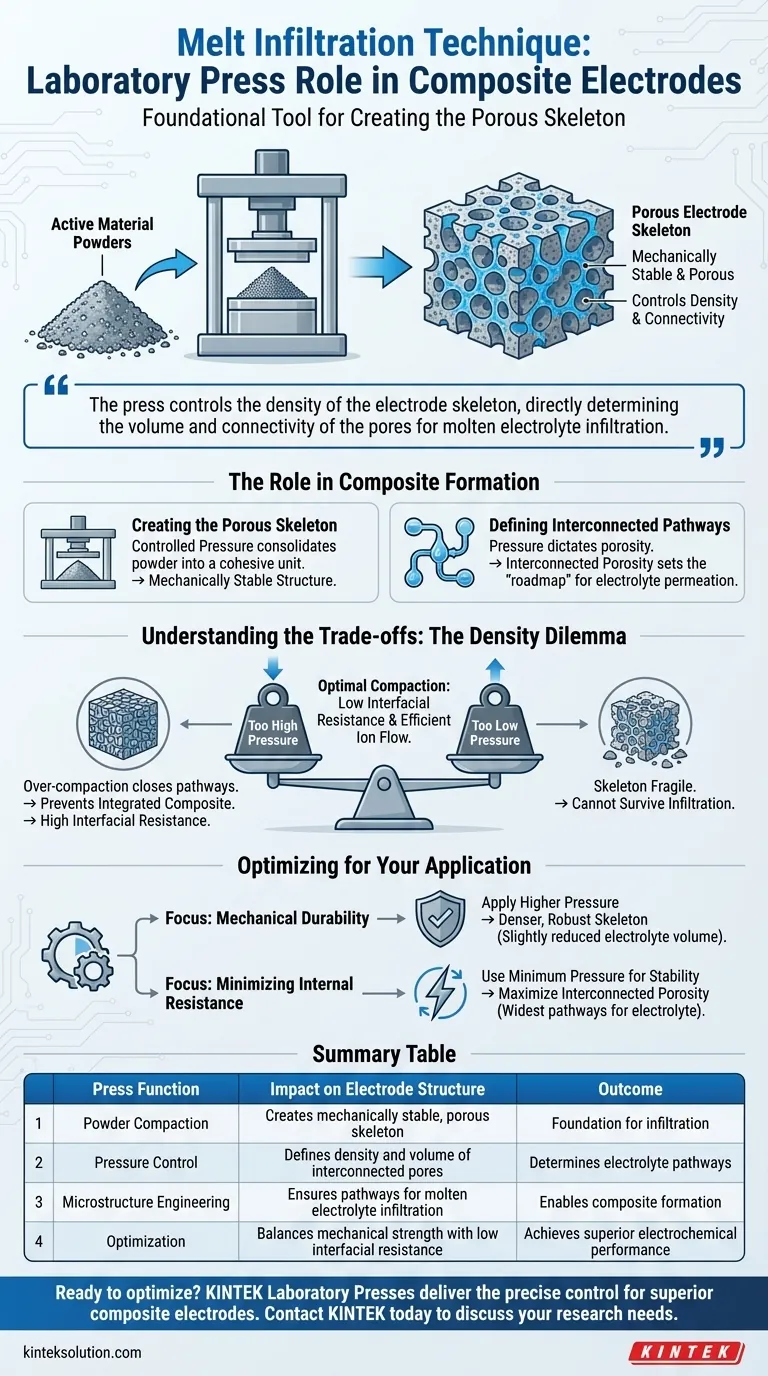
In the melt infiltration technique, a laboratory press serves as the foundational tool for establishing the electrode's internal architecture. It is specifically used to compress active material powders into a mechanically stable, porous skeleton, preparing the physical structure that will later absorb the molten electrolyte.
The press controls the density of the electrode skeleton, directly determining the volume and connectivity of the pores. This step is crucial for ensuring the molten electrolyte can fully infiltrate the structure to create a composite with low interfacial resistance.
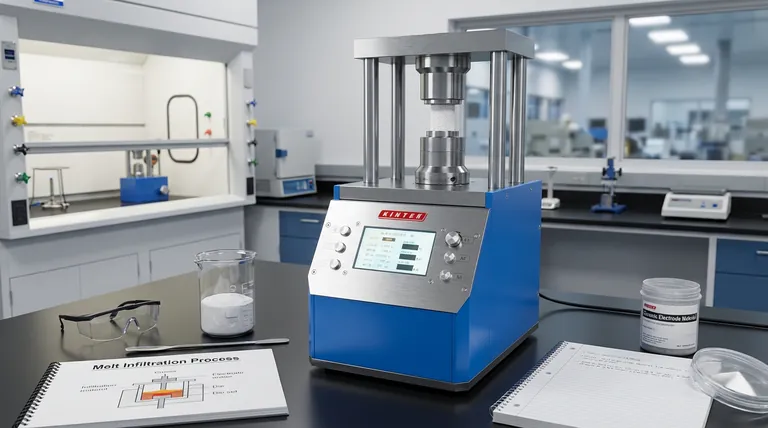
The Role of the Press in Composite Formation
The laboratory press is not merely a shaping tool; it is responsible for engineering the microstructure of the electrode before the electrolyte is introduced.
Creating the Porous Skeleton
The process begins with active material powders. The laboratory press applies controlled pressure to consolidate these loose powders into a cohesive unit.
This results in a mechanically stable structure capable of holding its shape during subsequent processing steps. Without this initial compaction, the electrode material would lack the structural integrity required for handling and infiltration.
Defining Interconnected Pathways
The pressure applied during this step dictates the porosity of the final skeleton. The goal is to create interconnected porosity rather than isolated voids.
These interconnected pathways are essential because they define the volume available for the molten electrolyte. The press effectively sets the "roadmap" that the liquid electrolyte will follow as it permeates the solid structure.
Understanding the Trade-offs
Achieving the correct degree of compaction is a balancing act. The pressure applied by the laboratory press involves a critical trade-off between mechanical strength and electrochemical performance.
The Density Dilemma
If the pressure is too low, the skeleton may be too fragile to survive the infiltration process. However, if the pressure is too high, the material becomes too dense.
Impact on Interfacial Resistance
Over-compaction closes off the pathways required for the melt to enter. This prevents the formation of a highly integrated electrode-electrolyte composite.
Proper compaction ensures the electrolyte contacts the active material fully, leading to low interfacial resistance. This low resistance is vital for the efficient flow of ions within the final battery or capacitor device.
Optimizing the Process for Your Application
The pressure settings on your laboratory press should be dictated by the specific requirements of your composite material.
- If your primary focus is mechanical durability: Apply higher pressure to create a denser, more robust skeleton, understanding that this may slightly reduce the volume available for electrolyte infiltration.
- If your primary focus is minimizing internal resistance: Use the minimum pressure required for structural stability to maximize interconnected porosity, ensuring the widest possible pathways for the molten electrolyte to penetrate.
By precisely controlling the compaction step, you determine the ultimate efficiency of the electrode-electrolyte interface.
Summary Table:
| Press Function | Impact on Electrode Structure |
|---|---|
| Powder Compaction | Creates a mechanically stable, porous skeleton |
| Pressure Control | Defines the density and volume of interconnected pores |
| Microstructure Engineering | Ensures pathways for molten electrolyte infiltration |
| Optimization | Balances mechanical strength with low interfacial resistance |
Ready to optimize your composite electrode fabrication?
The precise control offered by a KINTEK laboratory press is fundamental to successfully implementing the melt infiltration technique. Our automatic lab presses, isostatic presses, and heated lab presses are engineered to deliver the consistent, controlled pressure required to create the ideal porous skeleton for your specific application, ensuring complete electrolyte infiltration and superior electrochemical performance.
Let our expertise in serving laboratory needs help you achieve highly integrated electrode structures with low interfacial resistance. Contact KINTEK today to discuss how our lab press machines can enhance your research and development process.
Visual Guide
Related Products
- Laboratory Hydraulic Press 2T Lab Pellet Press for KBR FTIR
- Laboratory Hydraulic Press Lab Pellet Press Button Battery Press
- Laboratory Hydraulic Press Lab Pellet Press Machine for Glove Box
- Laboratory Split Manual Heated Hydraulic Press Machine with Hot Plates
- Laboratory Hydraulic Pellet Press for XRF KBR FTIR Lab Press
People Also Ask
- What is the role of a laboratory pressure machine and KBr in FTIR? Master Sample Preparation for Flame Retardants
- What is the role of a laboratory hydraulic press in high-loading NCM811 cathode prep for solid-state batteries?
- What role does a laboratory hydraulic press play in reaction pellets? Optimizing Lunar Soil and Metal Fuel Density
- Why is a laboratory hydraulic press necessary for sample preparation? Precise Pelleting for Spiro Heterocyclic Analysis
- What are the common uses of a laboratory hydraulic press? Precision Solutions for Materials Testing and R&D



















