
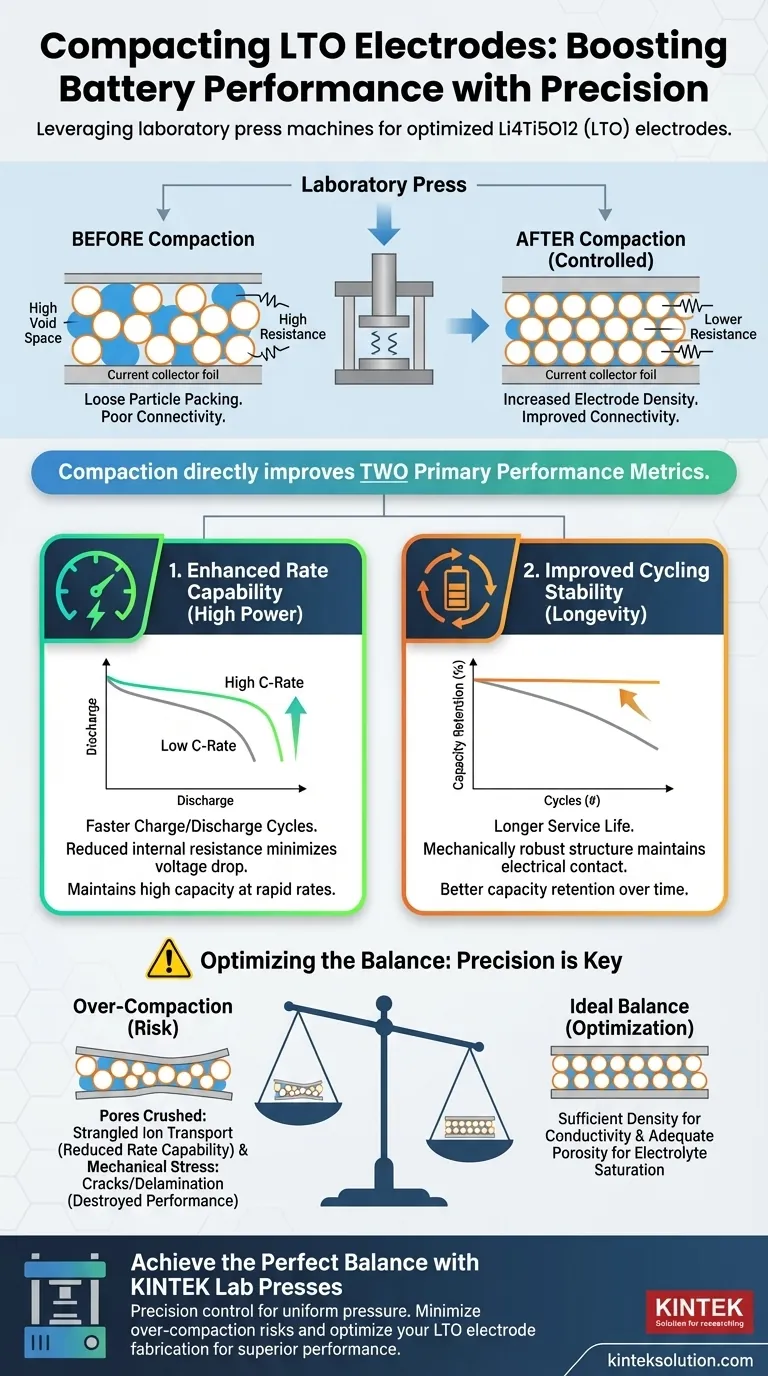
Compacting a Li4Ti5O12 (LTO) electrode directly improves two primary performance metrics: rate capability and cycling stability. By applying controlled mechanical pressure via a laboratory press, you fundamentally alter the electrode's microstructure, ensuring the battery can handle faster charge/discharge cycles and maintain its capacity over a longer service life.
The compaction process is not merely a shaping step; it is a critical optimization technique that increases electrode density and drastically reduces internal resistance, directly unlocking the material's full potential.
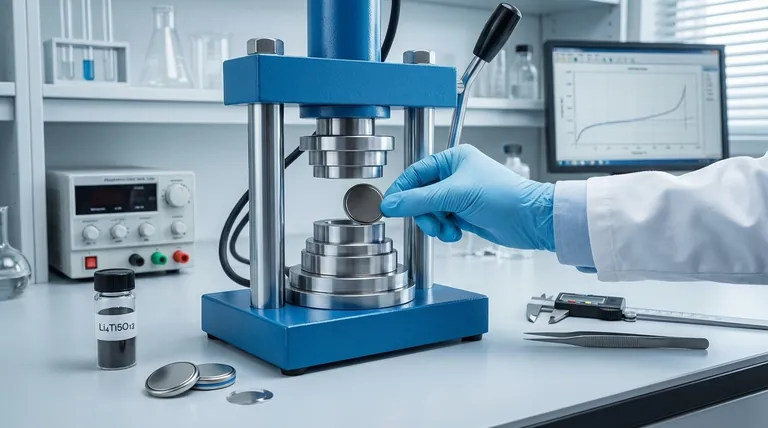
The Physical Impact of Compaction
To understand why performance improves, you must first understand the physical changes occurring within the electrode during the pressing stage.
Increasing Electrode Density
The primary physical change is the reduction of void space within the electrode coating.
By compacting the material, you increase the packing density of the active particles. This allows for a more efficient use of volume within the cell case.
Reducing Internal Resistance
The reference material highlights a reduction in internal resistance as a key driver of performance.
Pressing forces the LTO particles into closer contact with one another and with the current collector. This improved inter-particle connectivity facilitates easier electron flow, lowering the overall impedance of the cell.
Impact on Specific Performance Metrics
The physical changes described above translate directly into the two specific metrics cited in your reference material.
Enhanced Rate Capability
Rate capability refers to the battery's ability to deliver high capacity even when charged or discharged rapidly.
Because compaction lowers internal resistance, the voltage drop during high-current operation is minimized. This allows the LTO electrode to maintain high capacity at rapid rates, making it suitable for high-power applications.
Improved Cycling Stability
Cycling stability measures how well a battery retains its capacity after numerous charge and discharge cycles.
A compacted electrode is mechanically more robust. The improved structural integrity ensures that electrical contact is maintained over time, resulting in better capacity retention and a longer usable life for the battery.
Understanding the Trade-offs
While compaction is beneficial, it requires precision. It is important to recognize that "more" is not always "better."
The Danger of Over-Compaction
If an electrode is pressed too densely, you may eliminate too much porosity.
Lithium ions require a liquid electrolyte to move through the electrode structure. If the pores are crushed shut, the electrolyte cannot penetrate (wet) the material, which will strangle ion transport and paradoxically reduce rate capability.
Mechanical Stress
Excessive pressure can damage the current collector foil or cause the electrode coating to crack.
This leads to delamination, where the active material separates from the collector, ultimately destroying the battery's performance.
Optimizing Your Electrode Fabrication
To achieve the best results with Li4Ti5O12, you must balance mechanical density with ionic accessibility.
- If your primary focus is High Power (Rate Capability): Prioritize reducing resistance through compaction, but ensure enough porosity remains for rapid electrolyte saturation.
- If your primary focus is Longevity (Cycling Stability): Focus on achieving a uniform, cohesive structure that prevents particle isolation during repeated cycling.
Compaction is the defining step that transforms a loose powder coating into a high-performance, integrated electrochemical component.
Summary Table:
| Metric | How Compaction Improves It | Key Benefit |
|---|---|---|
| Rate Capability | Reduces internal resistance for efficient electron flow. | High capacity at fast charge/discharge rates. |
| Cycling Stability | Creates a robust, cohesive structure that maintains electrical contact. | Better capacity retention and longer battery life. |
Ready to optimize your LTO electrode fabrication and unlock superior battery performance? KINTEK specializes in precision lab press machines (including automatic, isostatic, and heated presses) designed for the exacting needs of battery research and development laboratories. Our equipment delivers the controlled, uniform pressure required to achieve the perfect balance of density and porosity for enhanced rate capability and cycling stability—without the risk of over-compaction. Contact us today via our [#ContactForm] to discuss how our lab presses can elevate your battery development process.
Visual Guide
Related Products
- Lab Round Bidirectional Press Mold
- Laboratory Hydraulic Press Lab Pellet Press Machine for Glove Box
- Automatic Heated Hydraulic Press Machine with Hot Plates for Laboratory
- Automatic Lab Cold Isostatic Pressing CIP Machine
- Electric Lab Cold Isostatic Press CIP Machine
People Also Ask
- What is the purpose of incorporating cartridge heaters into a lab press mold for MLCC block compression? Optimize Results
- Why is precise cooling management of the lab press mold necessary? Protect Core Integrity in Thermoforming
- What is the function of a pressing tool in thermoplastic panels? Master Precision Shaping & Fusion Bonding
- Why is a high-performance laboratory molding press critical for in-situ electrolyte formation? Unlock Battery Success
- How do the design and geometric precision of pressing molds and mandrels affect the quality of PTFE composite samples?



















