
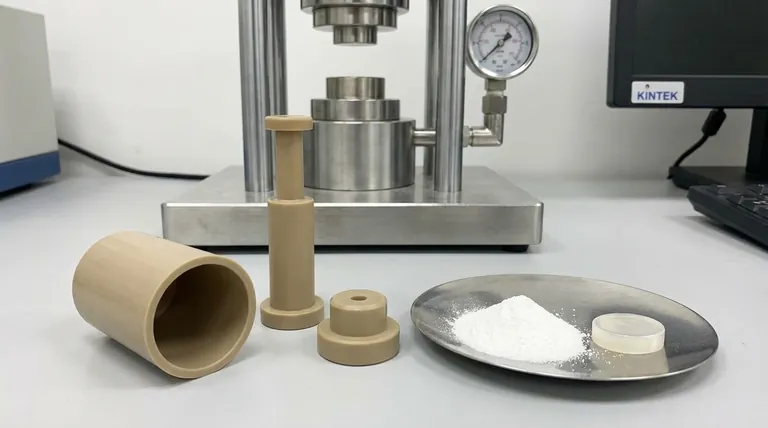
PEEK (polyetheretherketone) dies represent the critical intersection of structural durability and electrochemical neutrality in battery research. They are used for pressing solid-state electrolytes because they possess the unique mechanical strength to withstand pressures up to 360 MPa while remaining electrically insulating and chemically inert, ensuring the sample is neither short-circuited nor contaminated during formation and testing.
The primary value of PEEK lies in its ability to serve a dual purpose: it acts as a high-strength mold for densifying powders and simultaneously functions as an insulating housing for immediate electrochemical testing.
Achieving High Density Under Pressure
Withstanding Extreme Force
To create a viable solid-state battery, electrolyte powders must be compressed into a solid pellet. PEEK is chosen because it offers exceptionally high mechanical strength.
It can withstand forming pressures as high as 360 MPa without significant deformation or failure. This allows researchers to apply the intense force necessary to consolidate loose powders into a unified solid structure.
Eliminating Voids and Defects
The application of pressure (commonly around 120 MPa for materials like Li3PS4) is a pre-forming step essential for performance. Using a PEEK mold allows the press to effectively eliminate voids and air pockets within the powder.
This results in a dense, flat substrate. A dense pellet is crucial for creating a high-quality solid interface, which ensures proper contact during the subsequent coating of electrode materials.
Ensuring Electrochemical Integrity
Preventing Short Circuits
Unlike steel or carbide dies, PEEK is an excellent electrical insulator. This is perhaps its most vital advantage in battery cell assembly.
If a conductive metal die were used, the setup would require complex insulation layers to prevent the positive and negative terminals from shorting. PEEK naturally prevents these short circuits, streamlining the transition from pressing to electrochemical testing.
Chemical Inertness
Solid-state electrolytes can be highly reactive, but PEEK is chemically inert. It does not react with the electrolyte powders, ensuring the material remains pure.
This prevents contamination that could skew experimental data or degrade battery performance. It ensures that the electrochemical results reflect the properties of the battery chemistry, not a reaction with the die itself.
Understanding the Limits
Thermal and Viscosity Considerations
While PEEK is robust, the pressing process often involves heat to reduce the viscosity of polymer matrices. A laboratory heated press is used to enhance flowability and wet filler particles.
However, PEEK is a polymer, not a metal or ceramic. While it supports the heating required to distribute inorganic fillers uniformly, it has lower thermal limits than steel dies.
Pressure Ceilings
PEEK is exceptionally strong for a plastic, but it is not infinite. While it handles 360 MPa, requiring pressures beyond this for ceramic densification may necessitate harder materials.
Exceeding these limits can cause the die to deform permanently, compromising the geometry of the pellet.
Making the Right Choice for Your Goal
When selecting a die material for solid-state battery research, consider your specific experimental parameters:
- If your primary focus is electrochemical testing: Choose PEEK to ensure electrical insulation and prevent short circuits during in-situ measurements.
- If your primary focus is high-density compaction: Choose PEEK for pressures up to 360 MPa, but switch to steel or carbide if your protocol requires forces exceeding this threshold.
- If your primary focus is chemical purity: Choose PEEK to guarantee zero reaction between the mold and sensitive electrolyte powders like Li3PS4.
By utilizing PEEK dies, you ensure that the mechanical integrity of your electrolyte pellet is matched by the accuracy of your electrochemical data.
Summary Table:
| Key Property | Benefit for Solid-State Electrolyte Pressing |
|---|---|
| High Mechanical Strength | Withstands pressures up to 360 MPa for high-density pellet formation. |
| Electrical Insulation | Prevents short circuits, enabling direct in-situ electrochemical testing. |
| Chemical Inertness | Ensures sample purity by not reacting with sensitive electrolyte powders. |
| Pressure Limit | Ideal for most solid-state research, but may be unsuitable for pressures >360 MPa. |
Ready to enhance your solid-state battery research with precision pressing?
KINTEK specializes in laboratory press machines, including automatic and heated lab presses, designed to meet the exacting demands of battery development. Our expertise ensures you can achieve the high-density, electrochemically pure pellets required for accurate testing.
Contact our experts today to discuss how our lab press solutions can streamline your workflow and improve your results.
Visual Guide

Related Products
- Lab XRF Boric Acid Powder Pellet Pressing Mold for Laboratory Use
- Lab Ball Press Mold
- XRF KBR Plastic Ring Lab Powder Pellet Pressing Mold for FTIR
- Square Bidirectional Pressure Mold for Lab
- Warm Isostatic Press for Solid State Battery Research Warm Isostatic Press
People Also Ask
- Why are pellets used in XRF analysis, and what is their limitation? Boost Accuracy and Speed in Your Lab
- What are the primary factors to consider when deciding between a manual and an automatic XRF pellet press? Optimize Your Lab's Efficiency
- What are the differences between manual and automatic XRF pellet presses? Choose the Right Press for Your Lab's Needs
- What are the different pellet pressing options for XRF sample preparation? Choose the Best Method for Accurate Analysis
- What are specialized XRF pellet preparation presses designed for? Boost Lab Efficiency with High-Throughput Automation














