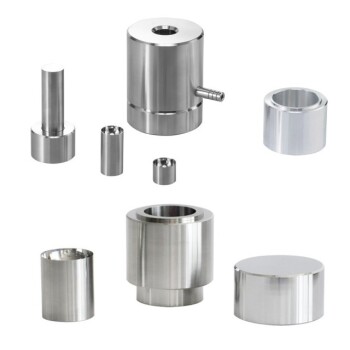
Floating hardened steel dies are preferred because they simultaneously solve the problems of uneven density and tool wear. The floating mechanism allows the die to move during compaction, effectively counteracting friction between the powder and the die walls to ensure pressure is distributed evenly. Meanwhile, the hardened steel material provides the necessary structural integrity to withstand high pressures without deforming, guaranteeing the dimensional accuracy of the aluminum alloy parts.
By combining a floating design with hardened steel, manufacturers achieve a critical balance: the mechanics ensure uniform density throughout the part, while the material ensures the longevity and precision of the tool itself.
The Mechanics of the Floating Design
Counteracting Wall Friction
In a static die, friction between the aluminum powder and the die walls creates a "drag" effect. This results in significant pressure loss as you move away from the punch.
A floating die mitigates this by allowing the die body to move relative to the punch. This movement effectively reduces the static friction that holds the powder back, simulating the effect of pressing from both ends even if only one punch is active.
Minimizing Density Gradients
The primary goal in uniaxial pressing is achieving a consistent density throughout the "green" (un-sintered) compact.
Because the floating design neutralizes friction losses, the pressure is applied more uniformly across the entire height of the specimen. This minimizes density gradients, preventing a scenario where the top of the part is dense but the bottom remains porous and weak.
The Role of Hardened Steel
Maintaining Structural Integrity
Uniaxial pressing involves exerting immense force to fuse loose powder into a solid shape.
Hardened steel is selected for its high yield strength. It resists the elastic and plastic deformation that softer metals would suffer under these loads. This rigidity ensures the die does not "bulge," which would distort the shape of the aluminum part.
Ensuring Surface Quality and Wear Resistance
Repeatedly pressing metal powders can be abrasive to tooling surfaces.
The high wear resistance of hardened steel prevents the die walls from becoming scored or pitted over time. This protection is vital for maintaining the dimensional accuracy and superior surface finish of the aluminum alloy specimens over thousands of cycles.
Understanding the Trade-offs
Complexity of Setup
While floating dies offer superior density distribution, they introduce mechanical complexity.
The tooling setup requires precise alignment and mechanisms to allow for the floating action. This can make the initial installation and calibration more time-consuming compared to simple stationary dies.
Cost Implications
The use of hardened steel and the complex geometry of a floating rig increases tooling costs.
Hardened steel is more difficult to machine than standard tool steels, and the floating mechanism adds distinct components to the assembly. This investment is justified by quality requirements but represents a higher upfront barrier.
Making the Right Choice for Your Project
When designing your compaction process, consider your specific quality requirements:
- If your primary focus is part homogeneity: Prioritize the floating die design to ensure the density is consistent from the top to the bottom of the component.
- If your primary focus is dimensional tolerance: Rely on hardened steel construction to prevent tool deflection and ensure every part matches the print specifications exactly.
The synergy of a floating mechanism and hardened material transforms uniaxial pressing from a blunt force process into a precision manufacturing method.
Summary Table:
| Feature | Floating Die Design | Hardened Steel Material |
|---|---|---|
| Primary Function | Counteracts wall friction & drag | Resists deformation & high pressure |
| Impact on Part | Ensures uniform density & homogeneity | Guarantees dimensional accuracy |
| Tool Longevity | Reduces localized stress points | Provides high wear & abrasion resistance |
| Key Advantage | Minimizes density gradients | Maintains superior surface finish |
Elevate Your Material Research with KINTEK
Precision in battery research and metallurgy starts with the right equipment. KINTEK specializes in comprehensive laboratory pressing solutions, offering a versatile range of manual, automatic, heated, and multifunctional models, as well as specialized cold and warm isostatic presses.
Whether you are working with aluminum alloys or advanced energy materials, our floating die systems and hardened steel tooling ensure your green compacts achieve the perfect density and structural integrity.
Ready to optimize your lab's efficiency and accuracy? Contact KINTEK today to find the ideal pressing solution for your specific application.
References
- Róbert Bidulský, Marco Actis Grande. Analysis of Densification Process and Structure of PM Al-Mg-Si-Cu-Fe and Al-Zn-Mg-Cu-Sn Alloys. DOI: 10.2478/amm-2014-0003
This article is also based on technical information from Kintek Solution Knowledge Base .
Related Products
- XRF KBR Steel Ring Lab Powder Pellet Pressing Mold for FTIR
- XRF KBR Plastic Ring Lab Powder Pellet Pressing Mold for FTIR
- Square Bidirectional Pressure Mold for Lab
- Lab Ball Press Mold
- Lab Ring Press Mold for Sample Preparation
People Also Ask
- What considerations are important regarding the die size of an XRF pellet press? Optimize for Your XRF Spectrometer and Sample
- Why are pellets used in XRF analysis, and what is their limitation? Boost Accuracy and Speed in Your Lab
- What is the general process for preparing a sample pellet for XRF? Master Consistency for Accurate Analysis
- What are the differences between manual and automatic XRF pellet presses? Choose the Right Press for Your Lab's Needs
- What are the different types of XRF pellet preparation methods available? Manual, Hydraulic, and Automated Presses Explained