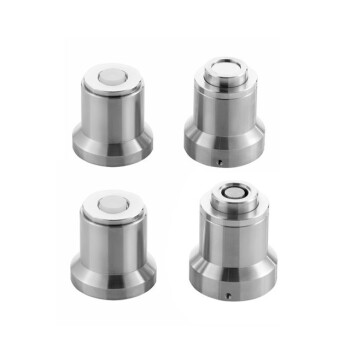
Graphite crucibles serve a critical dual function in high-pressure, dry phase equilibrium experiments. They act as robust, chemically inert vessels that maintain the physical integrity of solid powders at extreme temperatures, while simultaneously utilizing their electrical properties to create a protective environment that prevents sample oxidation.
Graphite's true value lies in how it combines physical containment with electrochemical protection. By acting as a conductor, it generates a reducing micro-environment that shields your sample from oxygen, ensuring the chemical composition remains unaltered throughout the heating process.
Physical Stability Under Extremes
Inert Containment
For accurate phase equilibrium results, the container must not react with the sample.
Graphite provides a chemically inert barrier for solid powders. This ensures that the experimental results reflect the properties of the sample itself, rather than a reaction between the sample and its vessel.
High-Temperature Integrity
High-pressure apparatuses subject materials to intense thermal stress.
Graphite crucibles are capable of maintaining their physical form at these elevated temperatures. This stability effectively holds the sample in place, preventing containment failure during the critical phases of the experiment.
Electrochemical Advantages
Preventing Oxidation
One of the most significant risks in high-temperature experiments is the unwanted oxidation of the sample.
Because graphite is electrically conductive, it facilitates the creation of a reducing micro-environment within the high-pressure assembly. This atmosphere actively scavenges oxygen, protecting the sample from oxidation and preserving its original chemical state.
Assisting Current Conduction
The utility of graphite extends to the operation of the apparatus itself.
Due to its conductivity, the crucible can assist in conducting electrical current through the assembly. This property is often integral to the heating mechanisms employed in high-pressure designs.
Important Considerations and Trade-offs
The Constraint of "Dry" Conditions
The specific application of graphite described here is strictly for dry phase experiments.
The interaction of graphite with moisture or other volatiles under high pressure can alter the thermodynamic environment unpredictably. It is crucial to ensure the experimental setup remains dry to maintain the integrity of the crucible and the sample.
The Reducing Environment Limit
While a reducing environment is beneficial for preventing oxidation, it is not universally desired.
If your experiment requires an oxidizing atmosphere, a graphite crucible is fundamentally unsuitable. The same property that protects against oxidation will actively fight against any attempt to maintain an oxidized state.
Making the Right Choice for Your Experiment
To determine if graphite is the correct material for your high-pressure assembly, evaluate your specific chemical requirements.
- If your primary focus is preventing oxidation: Graphite is the ideal choice, as it naturally creates a protective, reducing micro-environment.
- If your primary focus is structural containment: Graphite offers the necessary inertness and thermal stability to hold solid powders without reacting.
- If your primary focus is oxidizing conditions: You must avoid graphite, as its conductive nature will strip oxygen from the environment.
By aligning the crucible material with your specific atmospheric and physical needs, you ensure the validity of your phase equilibrium data.
Summary Table:
| Feature | Benefit for High-Pressure Experiments |
|---|---|
| Chemical Inertness | Prevents reactions between the sample and container, ensuring data purity. |
| High-Temperature Stability | Maintains physical integrity and containment under extreme thermal stress. |
| Electrical Conductivity | Creates a reducing micro-environment to actively prevent sample oxidation. |
| Material Compatibility | Ideal for dry solid powder containment but unsuitable for oxidizing conditions. |
Elevate Your Research with Precision Lab Solutions
Ensure the integrity of your phase equilibrium experiments with high-performance laboratory equipment. KINTEK specializes in comprehensive laboratory pressing solutions, offering manual, automatic, heated, multifunctional, and glovebox-compatible models, alongside cold and warm isostatic presses widely applied in battery and materials research.
Whether you need robust sample containment or advanced pressure systems, our experts are ready to provide the technical support and high-quality tools your lab demands.
Contact KINTEK today to find your perfect solution
References
- L. T. Elkins‐Tanton, T. L. Grove. Evidence for deep melting of hydrous metasomatized mantle: Pliocene high‐potassium magmas from the Sierra Nevadas. DOI: 10.1029/2002jb002168
This article is also based on technical information from Kintek Solution Knowledge Base .
Related Products
- Lab Cylindrical Press Mold for Laboratory Use
- Lab Double Plate Heating Mold for Laboratory Use
- Lab XRF Boric Acid Powder Pellet Pressing Mold for Laboratory Use
- Cylindrical Lab Electric Heating Press Mold for Laboratory Use
- Lab Anti-Cracking Press Mold
People Also Ask
- What is the purpose of incorporating cartridge heaters into a lab press mold for MLCC block compression? Optimize Results
- Why is precise cooling management of the lab press mold necessary? Protect Core Integrity in Thermoforming
- What is the function of a pressing tool in thermoplastic panels? Master Precision Shaping & Fusion Bonding
- Why is a high-performance laboratory molding press critical for in-situ electrolyte formation? Unlock Battery Success
- How does the geometry of laboratory molds influence mycelium-based composites? Optimize Density and Strength