Hermetically sealed aluminum pans provide a strictly controlled, closed environment that is mandatory for the accurate Differential Scanning Calorimetry (DSC) analysis of pyrrolidinium-based OIPC materials. By mechanically sealing the sample, you prevent volatile mass loss and atmospheric interaction, ensuring that the thermal data reflects the material's intrinsic properties rather than environmental interference.
Core Insight: The use of hermetically sealed pans is not merely a precaution; it is a requirement for data integrity. By isolating the sample from evaporation and moisture, you enable the precise detection of solid-solid phase transitions ($T_{s-s}$) and melting points ($T_m$), which are critical for defining the plastic crystal phase (Phase I).
The Necessity of Environmental Isolation
To characterize Organic Ionic Plastic Crystals (OIPCs) effectively, you must eliminate variables that alter the sample's composition during the heating cycle.
Preventing Sample Evaporation
Pyrrolidinium-based materials can be volatile when heated. Without a hermetic seal, portions of the sample may evaporate during the scan.
This loss of mass causes endothermic effects that mask true thermal events. A sealed pan traps the vapor, keeping the sample mass constant throughout the experiment.
Blocking Moisture Absorption
Many ionic materials are hygroscopic, meaning they readily absorb moisture from the laboratory atmosphere. Water acts as an impurity within the crystal lattice.
Even trace amounts of absorbed water can significantly depress melting points and shift transition temperatures. A hermetic seal locks out ambient humidity, ensuring you are testing the pure material.
Preventing Atmospheric Reactions
At elevated temperatures, OIPCs may react with oxygen or other atmospheric gases.
These chemical reactions can degrade the sample before the analysis is complete. The sealed aluminum pan creates an inert micro-environment, preventing oxidation and ensuring thermal stability.
Ensuring Accurate Phase Detection
The primary goal of DSC analysis for these materials is to map their thermal behavior, specifically the plastic crystal phase.
Detecting Solid-Solid Transitions ($T_{s-s}$)
OIPCs are defined by their ability to exist in a disordered solid phase before melting. This is marked by solid-solid phase transitions ($T_{s-s}$).
These transitions are often subtle energetic events. If the baseline is disturbed by evaporation or moisture release, these critical $T_{s-s}$ peaks can be obscured or completely missed.
Defining the Melting Point ($T_m$)
The melting point marks the upper limit of the solid phase. Accurate determination of $T_m$ is essential for establishing the temperature range of the plastic crystal phase (Phase I).
Hermetic sealing ensures that the melting endotherm is sharp and accurate, rather than broadened by impurities or mass loss.
Understanding the Trade-offs
While hermetically sealed pans are necessary for accuracy, they introduce specific experimental constraints that must be managed.
Risk of Pan Deformation
If the sample undergoes significant decomposition or releases a large volume of gas, the internal pressure can deform or burst the pan.
This "blowout" invalidates the run and can damage the DSC cell. Users must know the approximate decomposition temperature of the OIPC and stop the scan before that point.
The Importance of a Proper Cold Weld
Hermetic pans rely on a "cold weld" created by a specialized press. If the sealing surfaces are contaminated with sample material, the weld will fail.
A failed seal allows leaks, reintroducing the very errors (evaporation and moisture) the pan was meant to prevent. Visual inspection of the seal is critical before loading the sample.
Making the Right Experimental Choice
To generate publication-quality data for pyrrolidinium-based OIPCs, apply the following guidelines:
- If your primary focus is Phase Identification: Use hermetically sealed pans to ensure that solid-solid transitions and melting points are not shifted by moisture or mass loss.
- If your primary focus is Thermal Stability: Ensure the upper temperature limit of your protocol is safely below the point where high pressure could burst the sealed pan.
Use hermetically sealed pans to transform your DSC data from a rough estimate into a precise material characterization.
Summary Table:
| Feature | Benefit for OIPC Analysis | Impact on Data Accuracy |
|---|---|---|
| Mass Containment | Prevents volatile evaporation | Eliminates false endothermic peaks |
| Moisture Barrier | Blocks hygroscopic absorption | Prevents melting point depression |
| Inert Environment | Inhibits atmospheric oxidation | Ensures sample chemical stability |
| Pressure Seal | Maintains constant sample mass | Enables precise $T_{s-s}$ and $T_m$ detection |
Optimize Your Materials Research with KINTEK Precision Solutions
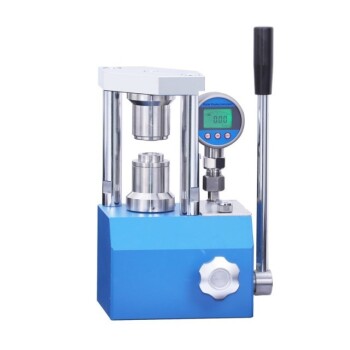
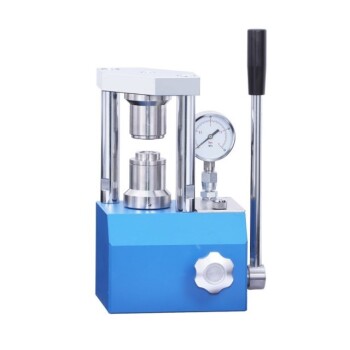
Precise DSC data starts with perfect sample preparation. KINTEK specializes in comprehensive laboratory pressing solutions designed for high-stakes research. Whether you are analyzing battery electrolytes or complex OIPCs, our range of manual, automatic, and heated presses provides the reliable "cold weld" needed for hermetic sealing.
Our value to you:
- Enhanced Data Reliability: Ensure sample integrity with consistent, leak-proof seals.
- Versatile Equipment: From multifunctional units to glovebox-compatible models, we support advanced battery and material science research.
- Specialized Technology: We offer cold and warm isostatic presses for demanding material characterization.
Contact KINTEK today to find the perfect pressing solution for your laboratory needs!
References
- Yoshifumi Hirotsu, Masahiro Yoshizawa‐Fujita. Enhanced ion-transport characteristics of pyrrolidinium-based electrolytes with Mg(FSA)<sub>2</sub>. DOI: 10.1039/d5cp01386k
This article is also based on technical information from Kintek Solution Knowledge Base .
Related Products
- Laboratory Hydraulic Press Lab Pellet Press Machine for Glove Box
- Lab Button Battery Disassembly and Sealing Mold
- Lab Double Plate Heating Mold for Laboratory Use
- Button Battery Sealing Machine for Button Batteries
- Lab Cylindrical Press Mold for Laboratory Use
People Also Ask
- How does a laboratory hydraulic press contribute to the preparation of Li3-3xScxSb samples? Optimize Ionic Conductivity
- What is the function of a laboratory hydraulic press in FT-IR of curcumin-coated MWCNTs? Achieve Optical Clarity.
- Why is a laboratory hydraulic press required for compression molding boron-siloxane? Solve High-Loading Density Challenges
- What role does a laboratory hydraulic press play in reaction pellets? Optimizing Lunar Soil and Metal Fuel Density
- What role does a laboratory hydraulic press play in the preparation of piezoelectric ceramic discs for DC-PG? | KINTEK