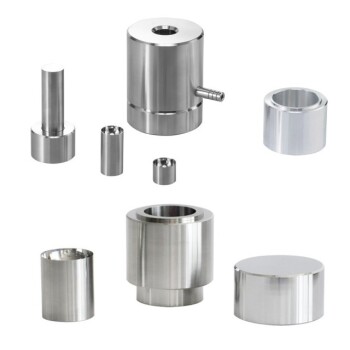
Precision steel molds act as the primary interface between the raw material and the finished structural component. They are critical because they dictate the exact geometric dimensions of the brick and possess the rigidity required to withstand high molding pressures without deforming, ensuring internal reinforcements like bidirectional jute fiber mesh remain correctly positioned.
The mold is not merely a shaping tool but a critical stabilizer that translates machine pressure into uniform density. Its rigidity ensures that reinforcement materials remain at exact depths, directly maximizing crack suppression and mechanical performance.
The Mechanics of Structural Integrity
Establishing Rigid Constraints
The primary function of the precision steel mold is to provide a non-negotiable physical boundary.
While the molding equipment generates force, the mold determines how that force is contained. It provides the rigid constraints necessary to transform loose soil mixtures into a solid, cohesive unit.
Withstanding High-Pressure Loads
Molding equipment exerts immense pressure to compact the soil mixture.
Precision steel is selected specifically for its ability to withstand these high loads without elastic or plastic deformation. If a mold yields even slightly under pressure, the transfer of force becomes inefficient, compromising the brick's final density.
Optimizing Reinforcement Performance
Precise Fiber Placement
In stabilized soil bricks, performance often relies on internal reinforcements, such as bidirectional jute fiber mesh.
Precision molds are designed to allow for the placement of these mesh layers at specific, calculated depths within the brick. This accuracy is impossible to achieve with flexible or lower-quality tooling.
Maximizing Crack Suppression
The effectiveness of fiber reinforcement is strictly positional.
Because the steel mold does not deform during the pressing process, the fiber reinforcement layer remains in its optimal position. This placement is essential for the fibers to effectively bridge micro-cracks and enhance the overall durability of the brick.
Ensuring Material Homogeneity
Uniform Pressure Transmission
High-quality steel molds ensure that the pressure applied by the equipment is transmitted uniformly to every part of the mixture.
Any deformation in the mold walls would create pressure sinks, leading to uneven compaction. Rigid tooling ensures the force is directed entirely into the material, not wasted on expanding the mold.
Eliminating Density Gradients
A stable mold prevents density gradients within the "green body" (the unfired brick).
Consistency during the molding phase is vital for predictable performance. It ensures that subsequent mechanical performance tests yield accurate, repeatable data rather than anomalies caused by structural flaws.
Understanding the Trade-offs
Initial Cost vs. Performance Assurance
Precision steel molds represent a higher initial investment compared to softer metals or composite molds.
However, using lower-grade molds introduces variables—such as flexing walls—that make quality control impossible. The cost of precision is the price of eliminating these variables.
Maintenance and Handling
Because these molds are precision instruments, they require careful maintenance.
Surface damage or warping from mishandling can permanently ruin the mold's ability to maintain geometric tolerances. They must be treated as calibration tools, not just containers.
Making the Right Choice for Your Goal
When selecting consumables for your molding process, consider your specific engineering objectives:
- If your primary focus is Crack Suppression: Prioritize molds with high rigidity to ensure the fiber mesh remains locked at the exact depth required to arrest fracture propagation.
- If your primary focus is Dimensional Consistency: Choose precision steel to prevent wall deformation under load, ensuring every brick meets identical geometric specifications.
The mold is the guarantor of your engineering design, translating theoretical specifications into physical reality.
Summary Table:
| Feature | Benefit for Soil Bricks | Impact on Performance |
|---|---|---|
| High Rigidity | Prevents deformation under load | Ensures uniform density and constant dimensions |
| Dimensional Precision | Exact geometric constraints | Guarantees consistent mechanical testing data |
| Reinforcement Control | Precise fiber mesh depth | Maximizes crack suppression and durability |
| Force Transmission | Eliminates pressure sinks | Directs energy into material for optimal compaction |
Elevate Your Material Research with KINTEK Precision Solutions
Maximize the mechanical performance of your stabilized soil bricks with laboratory pressing solutions designed for absolute precision. KINTEK specializes in comprehensive laboratory pressing equipment, including manual, automatic, heated, multifunctional, and glovebox-compatible models, alongside advanced cold and warm isostatic presses.
Whether you are refining battery research or optimizing fiber-reinforced construction materials, our high-rigidity tooling eliminates variables and ensures your engineering designs translate perfectly into physical reality. Contact KINTEK today to discuss your laboratory pressing needs and discover how our expertise can enhance your research outcomes.
References
- Y. Nidhish, S. Supreeth. Manufacturing of Stabilised Mud BlocksReinforced with Jute fiber for SustainableConstruction. DOI: 10.13052/rp-9788743807001.06
This article is also based on technical information from Kintek Solution Knowledge Base .
Related Products
- XRF KBR Steel Ring Lab Powder Pellet Pressing Mold for FTIR
- Lab Polygon Press Mold
- Lab Anti-Cracking Press Mold
- Lab Isostatic Pressing Molds for Isostatic Molding
- Lab Infrared Press Mold for No Demolding
People Also Ask
- What considerations are important regarding the die size of an XRF pellet press? Optimize for Your XRF Spectrometer and Sample
- Why are pellets used in XRF analysis, and what is their limitation? Boost Accuracy and Speed in Your Lab
- What is the general process for preparing a sample pellet for XRF? Master Consistency for Accurate Analysis
- What are the differences between manual and automatic XRF pellet presses? Choose the Right Press for Your Lab's Needs
- What are the different types of XRF pellet preparation methods available? Manual, Hydraulic, and Automated Presses Explained