
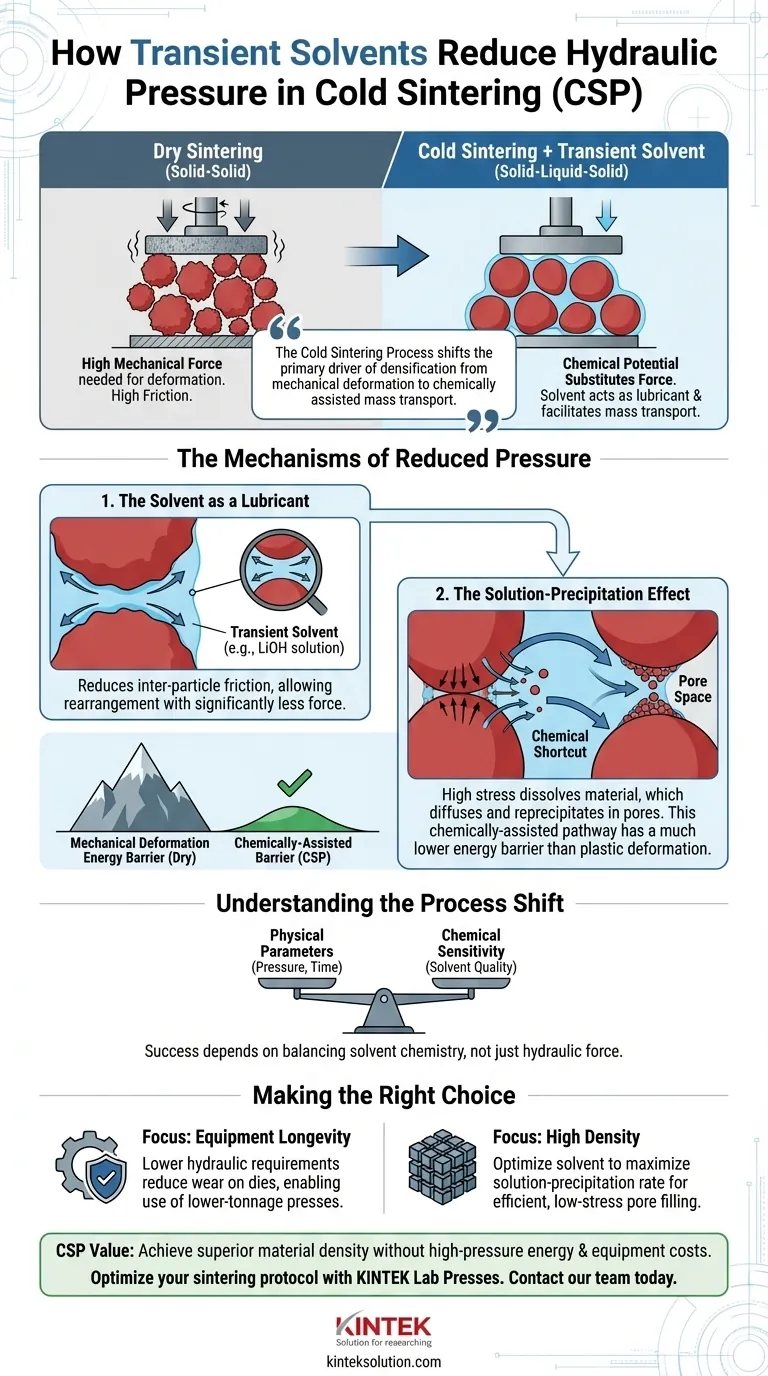
The introduction of a transient solvent effectively substitutes chemical potential for mechanical force. By acting as a lubricant and facilitating a specific mass transport mechanism, the solvent allows particles to rearrange and bond without the extreme physical stress required to crush or plastically deform them in a dry state.
By changing the environment from solid-solid to solid-liquid-solid, the Cold Sintering Process shifts the primary driver of densification from mechanical deformation to chemically assisted mass transport.
The Mechanisms of Reduced Pressure
The reduction in hydraulic pressure requirements is not magic; it is the result of two distinct physical and chemical phenomena working in tandem.
The Solvent as a Lubricant
In traditional dry pressing, friction between particles is a significant barrier to densification. Significant force is required just to overcome this friction to pack particles closer together.
The transient solvent introduces a liquid phase between these particles. This fluid layer acts as a lubricant, significantly reducing inter-particle friction. Consequently, particles can slide past one another and rearrange into a denser packing configuration with much less applied force.
The Solution-Precipitation Effect
The most critical factor in pressure reduction is the solution-precipitation mechanism.
When pressure is applied, stress concentrates at the contact points between particles. In a dry environment, overcoming this stress requires massive force to plastically deform the solid material.
In CSP, the solvent creates a chemical shortcut. The high stress at particle contact points causes the material to locally dissolve into the solvent. This dissolved material then diffuses away and re-precipitates in the lower-pressure pore spaces.
Lowering the Energy Barrier
This process fundamentally changes the energy landscape of densification.
Instead of forcing a solid material to change shape through brute force (plastic deformation), the process chemically moves mass from high-stress areas to low-stress areas.
This chemically-assisted pathway has a much lower energy barrier than mechanical deformation. Therefore, the hydraulic press only needs to supply enough pressure to initiate the solution process and maintain particle contact, rather than the immense pressure needed to mechanically crush the void spaces.
Understanding the Process Shift
It is important to recognize that while pressure requirements decrease, the complexity of the process control shifts.
From Physical to Chemical Parameters
In traditional dry pressing, the primary variables are physical: pressure magnitude and dwell time.
In the Cold Sintering Process, you are trading mechanical intensity for chemical sensitivity. The success of the low-pressure densification depends entirely on the solvent's ability to facilitate the solution-precipitation cycle. If the chemistry is unbalanced, the pressure reduction benefits will be lost, regardless of the hydraulic force applied.
Making the Right Choice for Your Goal
When designing your sintering protocol, understand how the solvent dictates your equipment needs.
- If your primary focus is Equipment Longevity: Utilize CSP to lower hydraulic requirements, reducing wear on dies and allowing for the use of less expensive, lower-tonnage presses.
- If your primary focus is High Density: Prioritize the selection of a solvent (like LiOH) that maximizes the solution-precipitation rate, ensuring pore filling occurs efficiently at low stress.
Leveraging the chemical interactions of a transient solvent allows you to achieve superior material density without the energy and equipment costs of high-pressure processing.
Summary Table:
| Mechanism | Key Function | Effect on Pressure |
|---|---|---|
| Solvent as Lubricant | Reduces inter-particle friction | Enables particle rearrangement with less force |
| Solution-Precipitation | Dissolves material at high-stress points, reprecipitates in pores | Shifts densification from mechanical to chemical, lowering energy barrier |
Achieve superior material density while reducing equipment wear and energy costs. The Cold Sintering Process (CSP) demonstrates how strategic chemistry can replace brute mechanical force. At KINTEK, we specialize in providing the precise lab press equipment—including automatic, isostatic, and heated lab presses—that enables advanced processes like CSP. Let our experts help you optimize your sintering protocol for efficiency and performance. Contact our team today to discuss your laboratory's specific needs.
Visual Guide
Related Products
- Automatic High Temperature Heated Hydraulic Press Machine with Heated Plates for Lab
- Laboratory Hydraulic Press 2T Lab Pellet Press for KBR FTIR
- Automatic Laboratory Hydraulic Press for XRF and KBR Pellet Pressing
- Manual Laboratory Hydraulic Pellet Press Lab Hydraulic Press
- Manual Cold Isostatic Pressing CIP Machine Pellet Press
People Also Ask
- Function of a Laboratory Hydraulic Press with Heated Platens in SSE? Enhance Battery Density & Conductivity
- What are the requirements for electrode pressing with high-viscosity ionic liquids like EMIM TFSI? Optimize Performance
- How does a laboratory heated hydraulic press facilitate PBN sample prep for WAXS? Achieve Precise X-Ray Scattering
- What are the industrial applications of heated hydraulic presses? Master Heat & Force for Precision Manufacturing
- Why is a laboratory hydraulic press with heating plates required for PLA/TEC films? Achieve Precise Sample Integrity



















