
Cold Isostatic Pressing (CIP) achieves uniform density and strength because it utilizes a high-pressure fluid medium to apply force equally from every direction. Unlike traditional pressing methods that exert force from only one or two axes, CIP eliminates the internal friction and pressure gradients that typically cause uneven compaction, ensuring the material is consolidated homogeneously throughout its entire volume.
Core Takeaway: By subjecting a material to identical hydraulic pressure on all surface areas simultaneously, CIP ensures that every particle experiences the same compaction force. This results in a "green" part with no density variations, which leads to uniform shrinkage during sintering and superior structural integrity in the final product.
The Mechanics of Isostatic Compaction
The Principle of Omnidirectional Pressure
The primary driver of uniformity in CIP is the use of a fluid medium to transmit force.
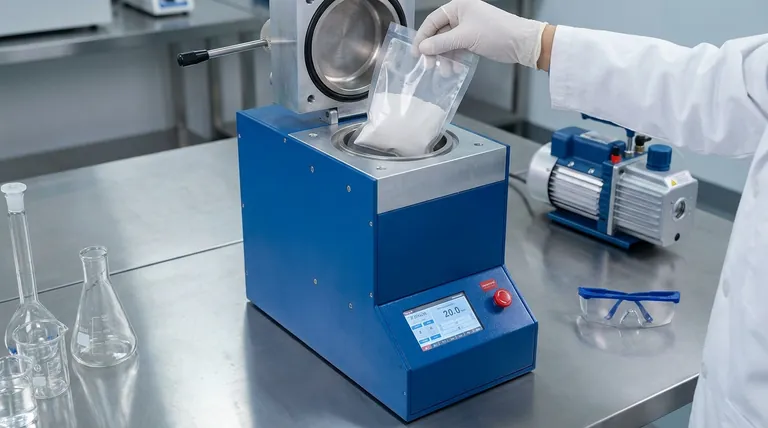
In this process, powdered materials (metal, ceramic, plastic, or composite) are sealed in a flexible mold and immersed in liquid. Hydraulic pressure is then applied to the fluid.
Because fluids transmit pressure equally in all directions, the material is compressed inwardly from every side with the exact same magnitude of force.
Contrast with Uniaxial Pressing
To understand why CIP is superior for uniformity, one must compare it to uniaxial pressing.
In uniaxial pressing, rigid dies compress powder from the top and bottom. This creates friction between the powder and the die walls, leading to significant pressure drops.
The result is a part that is dense at the edges but porous in the center. CIP eliminates this die-wall friction entirely, allowing for consistent density regardless of the part's geometry.
Elimination of Internal Defects
Because the pressure is uniform, the internal structure of the material is compacted evenly.
This minimizes common defects found in other pressing methods, such as voids, air pockets, or internal cracks.
For materials like isotropic graphite and high-performance ceramics, this lack of defects is critical for ensuring reliable performance under stress.
From Green State to Final Performance
High "Green" Density and Strength
CIP is highly effective at consolidating powders, typically achieving 60% to 80% of the theoretical density.
This results in exceptional "green strength"—the strength of the molded material before it is fully hardened or sintered.
High green strength allows operators to handle the parts easily without breakage and even perform machining operations on the part before the final hardening process.
Predictable Sintering Behavior
The most critical advantage of uniform density appears during the subsequent sintering (heating) phase.
When a material with uneven density is sintered, it shrinks unevenly, leading to warping or unpredictable dimensions.
Because CIP parts have uniform density, they undergo uniform shrinkage. This ensures the final component retains its intended shape and structural integrity, making the manufacturing process highly reliable.
Understanding the Trade-offs
While CIP offers superior uniformity, it is important to understand the operational context compared to other methods.
Process Complexity vs. Speed
CIP is often a more complex process than simple uniaxial pressing. It generally involves filling flexible molds, sealing them, and immersing them in fluid, which can be more time-consuming than the rapid cycle times of mechanical die pressing.
The Necessity of Secondary Processing
It is vital to remember that CIP is primarily a consolidation process.
While it produces high green density, the part is not yet fully dense or hardened. It almost always requires a subsequent sintering step to fuse the particles and achieve final material properties.
Making the Right Choice for Your Goal
Deciding whether to utilize Cold Isostatic Pressing depends on the specific requirements of your final component.
- If your primary focus is Geometric Complexity: CIP is the ideal choice because the fluid pressure naturally conforms to intricate shapes that rigid dies cannot mold.
- If your primary focus is High-Performance Reliability: CIP is essential for critical applications (like aerospace or medical implants) where internal voids or density gradients could lead to catastrophic failure.
- If your primary focus is Machinability: CIP provides the high green strength necessary to machine parts into near-net shapes before the final sintering phase.
Summary: CIP is the definitive solution when the structural integrity and internal consistency of a material are more critical than the speed of low-cost production.
Summary Table:
| Key Factor | Impact on Uniformity |
|---|---|
| Omnidirectional Pressure | Applies equal force from all directions, eliminating pressure gradients. |
| Fluid Medium | Transmits pressure uniformly, unlike rigid dies, preventing internal friction. |
| Uniform Green Density | Ensures predictable, even shrinkage during sintering for final part integrity. |
| Defect Elimination | Minimizes voids and cracks, critical for high-reliability applications. |
Need to produce high-integrity lab materials with uniform properties? KINTEK specializes in lab press machines, including isostatic presses, designed to deliver the precise, uniform compaction your R&D or quality control requires. Contact our experts today to find the perfect press for your laboratory's needs and achieve reliable, consistent results.
Visual Guide

Related Products
- Electric Lab Cold Isostatic Press CIP Machine
- Electric Split Lab Cold Isostatic Pressing CIP Machine
- Automatic Lab Cold Isostatic Pressing CIP Machine
- Manual Cold Isostatic Pressing CIP Machine Pellet Press
- Lab Isostatic Pressing Molds for Isostatic Molding
People Also Ask
- What are the applications of electric lab cold isostatic presses in research settings? Advance Material R&D with High-Pressure CIPs
- What role do electric lab cold isostatic presses play in industrial contexts? Bridge R&D and Manufacturing with Precision
- How does electrical Cold Isostatic Pressing (CIP) contribute to cost savings? Unlock Efficiency and Reduce Expenses
- What are some research applications of electric lab CIPs? Unlock Uniform Powder Densification for Advanced Materials
- What are the characteristics of standard off-the-shelf electric lab CIP solutions? Achieve Immediate, Cost-Effective Processing
















