
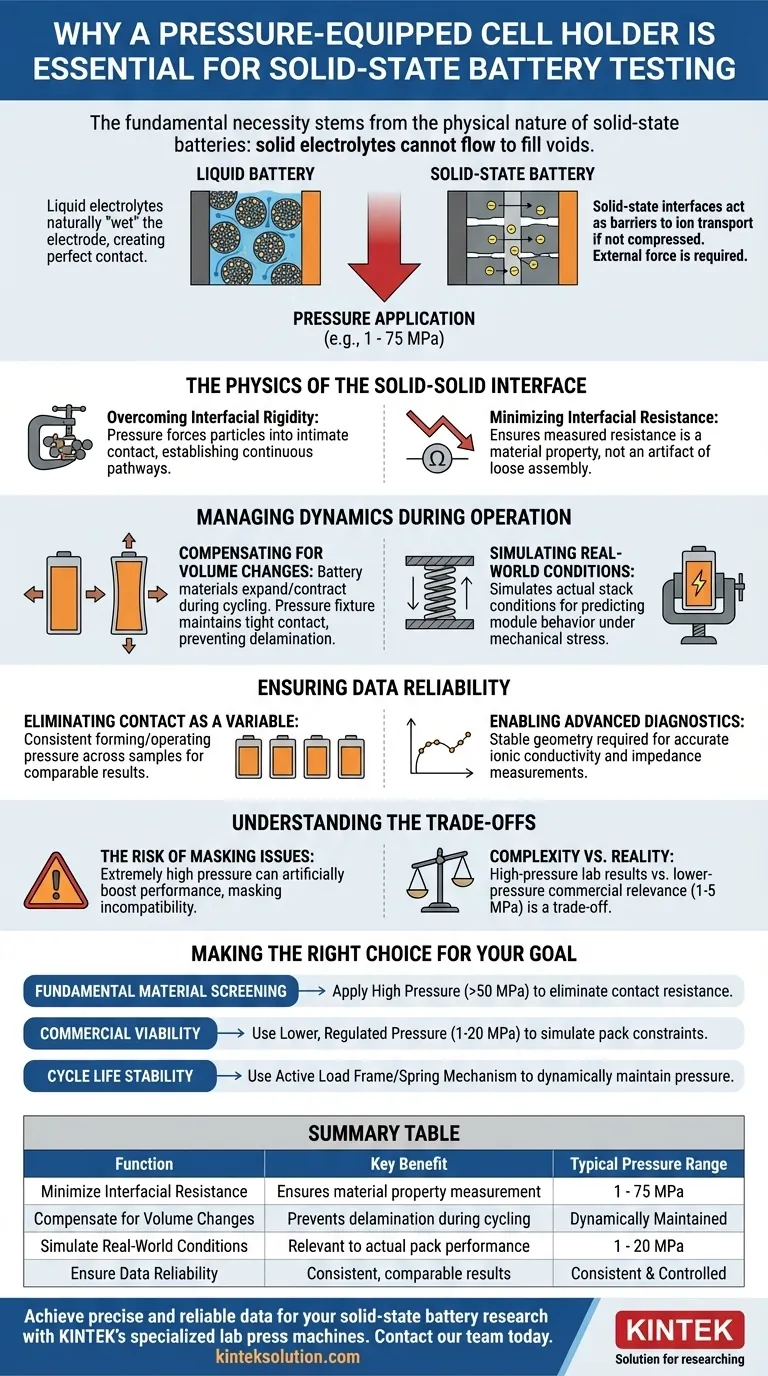
The fundamental necessity of a pressure-equipped cell holder stems from the inherent physical nature of solid-state batteries: unlike liquid electrolytes, solid electrolytes cannot flow to fill voids. You must apply external mechanical force to create and maintain the physical contact required for lithium ions to bridge the gap between the electrode and the electrolyte.
The rigid interfaces within a solid-state battery act as barriers to ion transport if not mechanically compressed. A pressure application device is not merely an accessory; it is a critical component that minimizes interfacial resistance and counteracts material expansion, ensuring that your test results reflect true electrochemical performance rather than poor physical contact.

The Physics of the Solid-Solid Interface
Overcoming Interfacial Rigidity
In traditional batteries, liquid electrolytes naturally "wet" the electrode, creating perfect contact. In solid-state systems, the cathode, anode, and electrolyte are all rigid components.
Without external pressure, these layers meet only at microscopic high points, leaving vast gaps where ions cannot travel. A pressure device forces these particles into intimate contact, establishing the continuous pathways necessary for ion transport.
Minimizing Interfacial Resistance
The primary metric affected by contact quality is interfacial resistance. High resistance leads to poor voltage response and low capacity utilization.
By applying constant uniaxial pressure (often ranging from 1 to 75 MPa depending on the test stage), you mechanically minimize voids at the interface. This ensures that the resistance measured is a property of the materials themselves, not an artifact of loose assembly.
Managing Dynamics During Operation
Compensating for Volume Changes
Battery materials, particularly anodes, expand and contract significantly during charge and discharge cycles.
Without a device to maintain constant pressure, this "breathing" causes the layers to separate (delaminate). The pressure fixture acts as a stabilizer, maintaining tight contact even as the internal volume of the cell fluctuates, preventing the permanent loss of capacity due to disconnection.
Simulating Real-World Conditions
Commercial solid-state battery packs will invariably operate under mechanical constraint.
Using a specialized testing fixture allows you to simulate these actual stack conditions in a controlled laboratory environment. This data is vital for predicting how a cell will behave when integrated into a module where mechanical stress is a constant variable.
Ensuring Data Reliability
eliminating Contact as a Variable
If physical contact varies from cell to cell, your electrochemical data becomes noisy and unreliable.
A pressure-controlled holder ensures that the "forming pressure" and operating pressure remain consistent across all samples. This standardization allows you to attribute performance differences to material chemistry rather than inconsistent assembly techniques.
Enabling Advanced Diagnostics
Accurate measurements of ionic conductivity and impedance spectra require stable geometry.
If the pressure drifts, the contact area changes, skewing these sensitive measurements. A load frame or hydraulic fixture creates the stability required to obtain repeatable, authentic data points regarding the electrolyte's performance.
Understanding the Trade-offs
While pressure is essential, it introduces complexity that must be managed carefully.
The Risk of Masking Issues
Applying extremely high pressure (e.g., >75 MPa) can sometimes artificially boost performance by forcing contact in materials that are otherwise chemically incompatible. This can create "false positives" regarding a material's practical viability.
Complexity vs. Reality
High-pressure fixtures are bulky and expensive, but testing at low pressures (closer to practical pack levels of 1-5 MPa) is significantly more difficult.
There is often a trade-off between the ease of obtaining good lab results (using high pressure) and the relevance of those results to commercial applications (which require performance at lower pressures).
Making the Right Choice for Your Goal
To select the correct pressure parameters for your testing fixture, consider your immediate objective:
- If your primary focus is fundamental material screening: Apply high pressure (above 50 MPa) to eliminate contact resistance entirely and isolate the intrinsic electrochemical properties of the material.
- If your primary focus is commercial viability: Use lower, regulated pressures (1-20 MPa) to simulate the mechanical constraints of a real battery pack and test the material's resilience.
- If your primary focus is cycle life stability: Ensure your fixture uses an active load frame or spring-loaded mechanism that can dynamically maintain pressure as the cell expands and contracts.
Ultimately, the cell holder provides the mechanical bridge that makes electrochemical observation possible in a solid-state system.
Summary Table:
| Function | Key Benefit | Typical Pressure Range |
|---|---|---|
| Minimize Interfacial Resistance | Ensures measured resistance is material property, not an artifact of poor contact. | 1 - 75 MPa |
| Compensate for Volume Changes | Maintains tight contact during charge/discharge cycles to prevent delamination. | Dynamically Maintained |
| Simulate Real-World Conditions | Provides data relevant to performance in actual battery pack constraints. | 1 - 20 MPa (for viability) |
| Ensure Data Reliability | Standardizes assembly for consistent, comparable results across samples. | Consistent & Controlled |
Achieve precise and reliable data for your solid-state battery research with KINTEK's specialized lab press machines.
Our automatic lab presses, isostatic presses, and heated lab presses are engineered to provide the consistent, controlled pressure application essential for accurate electrochemical testing. Whether you are focused on fundamental material screening or assessing commercial viability, our equipment helps you eliminate contact resistance as a variable and obtain authentic performance metrics.
Let KINTEK's expertise support your laboratory's needs. Contact our team today to discuss how our lab press solutions can enhance your R&D process and deliver the reliable data you need.
Visual Guide
Related Products
People Also Ask
- Why use standardized CR2032 components & high-precision presses? Ensure reliability in lithium metal battery research.
- Why is a laboratory battery sealing press essential for desolvation energy testing? Ensure Reliable Kinetic Data
- Why is a laboratory hydraulic press or battery sealing machine essential? Ensure Coin Cell Data Integrity
- How do laboratory battery sealing machines ensure performance consistency? Master Your Lithium and LFP Battery Assembly
- What role does a laboratory sealing press play in thermal analysis of solid dispersion films? Ensure Data Integrity

